
Stance and reach · 3 min read
Adapt a Pool Stance to Long Reach and Restricted Space
Long reach and tight room clearance are different problems. A long reach threatens bridge stability and legal footing; a wall, chair or player-area boundary threatens the backswing. The useful adaptation is the smallest one that restores a stable base and clear cue path. It is never climbing onto the table or forcing a stroke with no clearance.
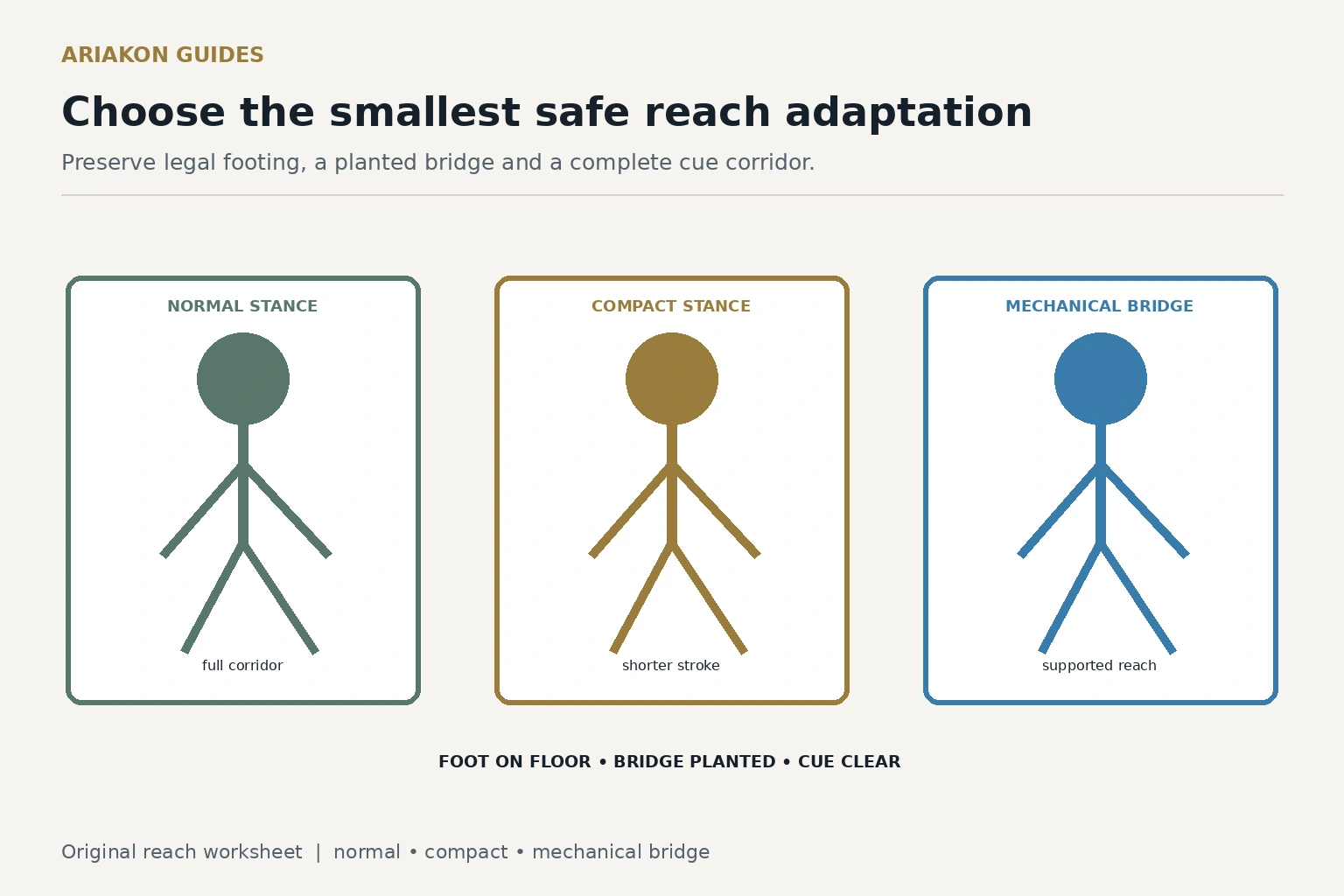
Run the four-question reach screen
| Question | If no |
|---|---|
| Can at least one foot remain on the floor under the active rules? | Use a legal alternate reach or mechanical bridge |
| Can the bridge base stay planted through contact? | Shorten reach or use mechanical support |
| Does the cue have a complete backswing and finish corridor? | Use a compact stroke or different bridge orientation |
| Can the head and eyes see the selected line without strain? | Raise, reset or choose mechanical support |
Choose a repeatable stance height before adding a special reach adaptation.
Learn the mechanical bridge deliberately instead of treating it as a last-second rescue.
Create three safe practice conditions
Use a straight-in object ball one diamond from a corner and mark three cue-ball starts: ordinary reach, long reach near table center, and a restricted-backspace start where a chair is placed outside the rail at least eighteen inches behind the normal grip path. Keep the chair out of every player and ball path. Adjust that distance only to create a safe, visible clearance problem; it is not an official room specification.
At each start, choose before bending: normal stance, compact stance with shorter backswing, or mechanical bridge. Do not switch after getting down unless you stand up and reset. Shoot four attempts per condition for twelve total.
Score stability and clearance
| Point | Observable requirement |
|---|---|
| 1 | Adaptation chosen while standing |
| 1 | Legal foot contact is maintained |
| 1 | Bridge base stays planted |
| 1 | Cue completes its corridor without striking an obstacle |
| 1 | Object ball reaches the called pocket |
| Maximum 60 | Twelve attempts across three conditions |
Use the least disruptive adaptation
| Evidence | Preferred next choice |
|---|---|
| Normal reach passes | Keep the ordinary stance |
| Backspace only is restricted | Compact backswing; preserve line and finish |
| Bridge hand cannot plant | Mechanical bridge |
| Balance changes during delivery | Stand up and choose more support |
| No safe corridor exists | Do not force the shot; select another option |
Worked example and rack transfer
A hypothetical player scores 20/20 at ordinary reach, 13/20 at long reach and 18/20 with the mechanical bridge. The long-reach failures are bridge movement and lost foot contact, not pocket aim. The worksheet therefore chooses the mechanical bridge for that distance and preserves the normal stance elsewhere.
During two practice racks, call the reach category before every shot. Record whether the choice preserved legal footing, a planted bridge and full cue clearance. Under the standard WPA rule, loss of all foot contact with the floor at tip contact is a foul; the rule includes its stated footwear condition and a separate parasports section. Use the governing event rule for any adapted format. Build a comfortable stance and repeatable visual alignment rather than copying one body pose.
Sources and further reading
References support the specific factual information above. The practical checklists are Ariakon editorial guidance.