
Beginner fundamentals · 3 min read
A Pool Fundamentals Checklist for Your First Month
Your first month needs a small repeatable curriculum, not a tour of every technique. Practice three 30-minute sessions each week. Keep one comfortable stance and delivery, add cue-ball tasks gradually and end every session with a choice that resembles play.
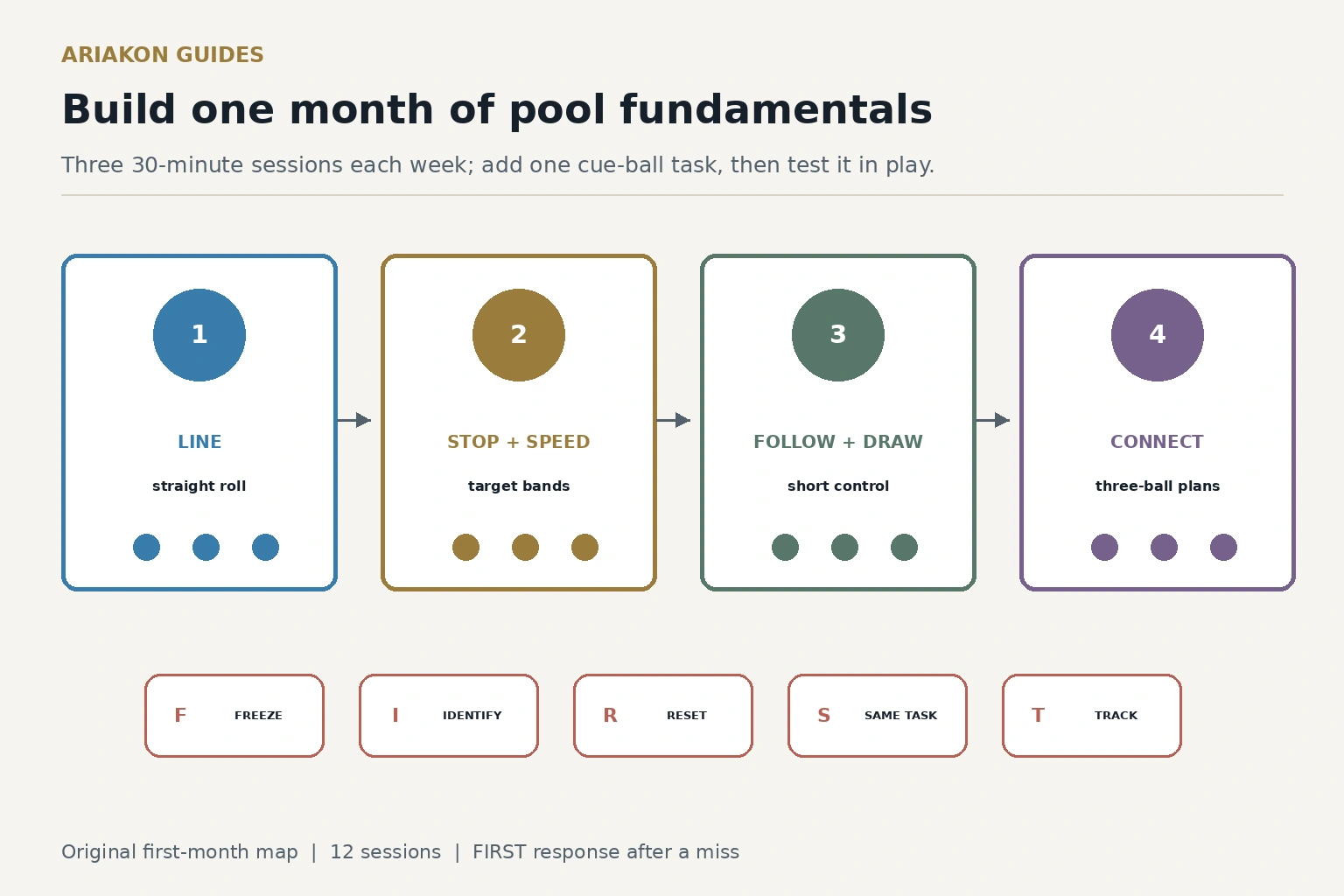
Use the four-week checklist
Use a 30-minute clock: minutes 0 to 5 for six unscored center-ball rolls and setup, 5 to 20 for the twelve listed attempts, 20 to 28 for the transfer task, and 28 to 30 for notes. Stop each block when its time ends and record incomplete attempts rather than extending the session. Use generous zones. The ball-width stop target and one-diamond follow/draw band are local starting references, not official skill standards.
This first-month card separates line, speed and cue-ball tasks so the next practice decision comes from an observable component. Its schedule and local scores do not certify playing ability or convert into an external examination result.
| Week | 12-shot station | Transfer task | Checklist |
|---|---|---|---|
| 1 — Line | Straight-in shot: object ball one diamond from corner, cue ball one diamond away | Three open balls; choose the easiest first shot | Still head, stable bridge, cue finishes on line |
| 2 — Stop + speed | Six stop shots plus six cue-ball-only rolls into a one-diamond end band | Three balls with one stop route | Name speed before standing down |
| 3 — Follow + draw | Six short follow and six short draw shots; target within one diamond | Choose center, follow or draw for three balls | No sidespin; finish balanced |
| 4 — Connect | Four three-ball patterns; one attempt each, at most three strokes per pattern and twelve total | One ordinary rack or six-ball rotation | Plan three balls, reset after each shot |
Continue to advanced pool fundamentals after the month feels stable.
Use a broader ten-skill baseline for a broader periodic assessment.
Answer every miss with FIRST
Match scenario: with ball in hand and three open balls, you miss the easiest first ball and the cue ball travels too far. Say, ‘Result: overran. Class: speed. Same route, softer intention.’ Replace the layout for the next practice attempt. In a real rack, accept the current table and use FIRST only to identify the next controllable action.
| Step | Question or action |
|---|---|
| F — Freeze the result | Where did the object ball and cue ball actually finish? |
| I — Identify one class | Line, speed, cue-ball contact or decision—choose one |
| R — Reset | Stand up, replace the balls and begin the full routine |
| S — Same task | Repeat the same intention once before changing anything |
| T — Track | Mark the component and continue; no mid-set rebuild |
Keep a twelve-session practice log
A hypothetical beginner ends week two with setup 2, routine 2, line 2, cue-ball task 1 and transfer 1. The next action is another stop-and-speed session with the same marks, not adding sidespin. Keep the schedule when the process is improving; narrow the target only after at least two comparable sessions.
This log measures your own practice behavior, not talent or rank. If equipment, discomfort or access prevents a fair session, write that context instead of manufacturing a score.
| Line | 0 | 1 | 2 |
|---|---|---|---|
| Setup | Marks changed | One accidental change | All attempts comparable |
| Routine | Often skipped | Mixed | Used on every scored shot |
| Line | Miss pattern unknown | Pattern named | Pattern named and reduced |
| Cue-ball task | Not measured | Some target finishes | At least 8/12 in target |
| Transfer | Not attempted | Attempted without a plan | Plan named before play |