
Match play · 4 min read
Win More Pool Lags With Speed and Line Control
The lag looks simple because there is no pocket and no object-ball contact. It is difficult for exactly that reason: line and speed are exposed. A useful lag practice does not chase a single heroic stop. It teaches you to send a ball cleanly to the foot cushion and return it close to the head cushion often enough that match pressure feels familiar.
Know what the lag decides
Under the current World Pool-Billiards Association rules, the lag opens the match and the winner chooses who takes the first break. Each player shoots a ball from behind the head string toward the foot cushion, trying to finish closer to the head cushion than the opponent.
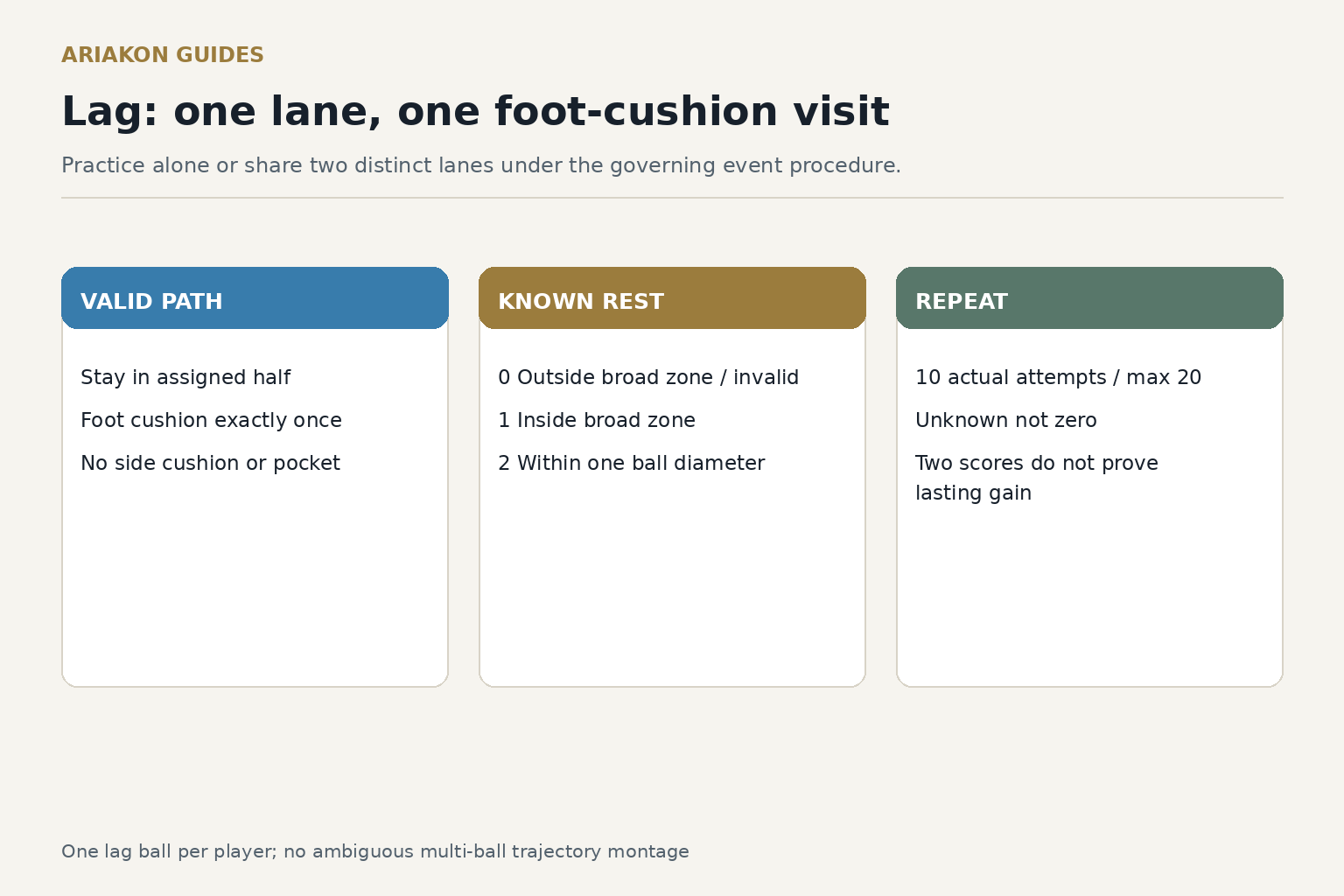
The same rules list ways to lose the lag, including crossing into the opponent's half, contacting the side cushion, failing to contact the foot cushion, pocketing or jumping the ball, or letting it rest in the jaws of a head pocket. Tournament instructions can add procedures, so listen to the referee before assuming a local custom.
Choose a simple center-ball delivery
Start near the middle of your half of the table and aim at a clear point on the foot cushion. Use a level cue and a center-ball hit. Added sidespin makes cushion response and speed harder to read, which is the opposite of what a lag needs.
Let the cue travel through the ball with the same smooth finish you use on a normal control shot. A jab creates unpredictable pace; a long forced follow-through can disturb alignment. Your goal is a straight roll with just enough energy to return.
Calibrate distance instead of guessing
Place one ball behind the head string and lag it by itself. Mark the result mentally as short, useful or long. Repeat five times without changing your aiming line. If every ball stops long, shorten the stroke or reduce tempo slightly. If results scatter, stabilize the delivery before adjusting power.
Table cloth, cushion response, cleanliness and humidity can change the required pace. Use legal warm-up time to collect evidence from the table you will actually play. One measured lag tells you more than a hard practice break about slow-speed cushion response.
Practice a landing zone
Treat the first diamond from the head cushion as a broad beginner zone, then gradually shrink the target. Use exclusive scores:0 for a known invalid lag or finish outside the broad zone;1 for a valid finish in the broad zone but farther than one ball width from the cushion;2 for a valid finish within one ball width. A ball width means the actual diameter. A known legal ball frozen to the head cushion may score 2; inspect corner-mouth limits. Maximum 20 for 10 known attempts. Unknown results stay unscored. A ball frozen to the cushion is not automatically a problem under every rule set, but aiming for a small gap gives you useful speed margin.
Record ten attempts. A seven-point day followed by a twelve-point day is a higher score under that setup; two sessions alone do not establish lasting improvement. The score rewards repeatability rather than your memory of the best attempt.
Prepare for the shared shot
In a match, both players shoot at about the same time. Set your stance without crowding the other player's space, confirm your lane and be ready to deliver on the official's cue. Do not rush merely because the other player moves first.
If balls touch or a procedural issue occurs, stop and let the official apply the event rules. The lag is a rules-governed shot, not a contest to settle ambiguous contact by negotiation while the match clock runs.
Use a five-minute match warm-up
- Roll one ball by hand to sense cloth speed without treating that as a scored lag.
- Shoot three center-ball lags and classify each finish as short, useful or long.
- Make one small speed adjustment and shoot three more.
- Finish with two lags using your full match routine.
- Keep the speed cue that produced the tightest group, not merely the closest single ball.
Sources and further reading
References support the specific factual information above. The practical checklists are Ariakon editorial guidance.