
Aiming and throw · 3 min read
Use Throw on Nearly Straight Pool Shots: A Calibration Exercise
A pocket miss can combine a changed cue path, a changed cut and object-ball friction. This original 18-strike worksheet starts with collinear centers, records signs explicitly and withholds a throw diagnosis when the actual contact is unknown.
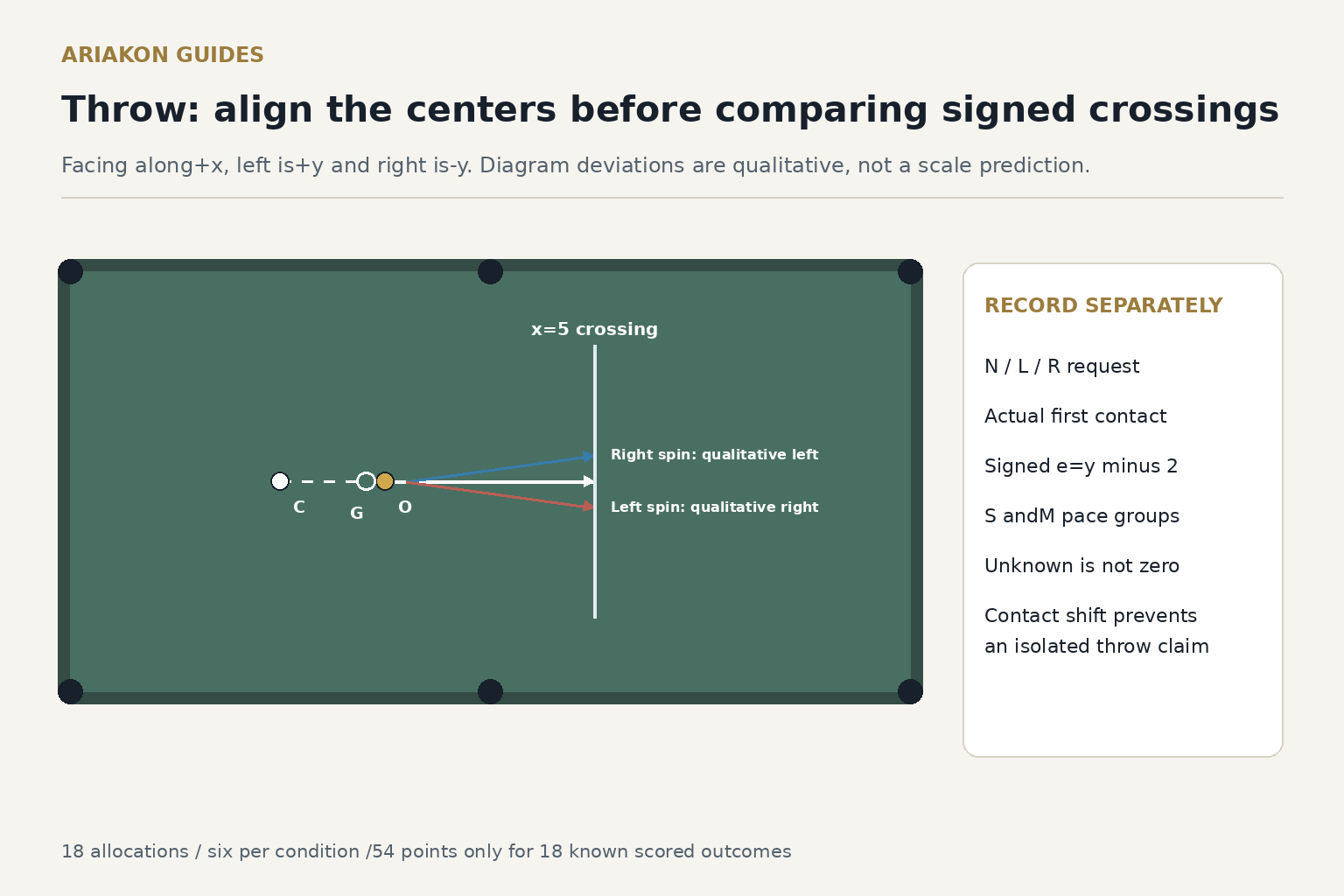
Use a collinear no-spin reference
Coordinates are ball centers on an illustrative 100 by 50 inch bed: x=0..8 along length, y=0..4 across width, origin at the lower left cushion nose. One unit is 12.5 inches. For 2.25 inch equal balls, radius is 0.09 and diameter 0.18 units. Intact cushion center boundaries are x=0.09,7.91 and y=0.09,3.91; pockets interrupt the physical boundary at the four corners and (4,0),(4,4). Measure actual bed, balls and jaws before scaling. Remove every measuring aid before shooting; never mark a competition table.
Set cue C(2,2) and object O(3,2), with nominal full-hit contact center G(2.82,2). Observe object-center crossing at x=5. Both starting centers and baseline crossing(5,2) lie on y=2. No quarter-ball start offset remains. The guide concerns small departures from this near-full-hit condition.
Use minimum practical elevation, no obstacle and a modest safe pace. Observe first contact; a sidespin request can shift cue travel before impact, making a changed cut rather than isolated spin-induced throw. Reject an isolated-throw conclusion when contact or the cue axis is unresolved.
Define signs from the shooter’s view
Facing along+x, left is+y and right is-y. Record e=y_cross minus 2 in actual coordinate units. In an ideal full-hit friction picture, left cue-ball sidespin can throw the object toward the shooter’s right and the mirrored spin can throw it left. This is a qualitative direction, not a promised magnitude or a claim that the requested tip position arrived unchanged.
Use two individually repeatable controlled pace labels S and M. For each pace take condition order N,L,R,R,L,N,N,L,R: three requests each and nine strikes. Two paces give 18 allocations, six per condition overall. L/R are a modest comfortable repeatable request, not a universal half-tip prescription. Hold actual cue, balls, cloth and bridge fixed.
Keep a signed observation ledger
At x=5 use a broad window |e|≤0.36 and inner window |e|≤0.09, both centered on the same zero reference for all conditions. These windows measure near-baseline grouping, not a contest for maximum throw. Use a permitted registered overhead view or rail references; no physical strip crosses the lane. Stop on miscue, hop, cloth strike or uncontrolled motion.
| Points | Established result |
|---|---|
| 0 | Known safety/legality failure or wrong intended object contact |
| 1 | Safe known crossing outside broad ±0.36 window |
| 2 | Safe crossing 0.09<|e|≤0.36 |
| 3 | Safe crossing|e|≤0.09 |
| Unscored | Required contact or crossing not observable; keep visible fields separately |
Compare medians before attributing an effect
Retain N,L,R medians and full spread separately for each pace. Compare spin medians with that pace’s N median, not with the best single N attempt. A directional difference smaller than observation uncertainty is unresolved. A same-side shift in both spin groups first asks for a setup/contact check. No 54-point total can establish spin-induced throw if first-contact geometry changed.
To investigate a candidate, take six new mirror requests at the same pace, three per spin, and record all six. Keep them separate from the 18 baseline. Then test a speed change in a new record. Do not turn one small sample into a universal compensation chart.
Transfer only a supported small adjustment
For five separately recorded ordinary shots choose a comfortably near-straight real-corner setup and a specific pot/finish goal before shooting. Use the smallest tested request, inspect the actual first contact and score only known legal pot plus chosen finish. A cue-path correction and object throw are different questions. If their effects cannot be distinguished, keep ordinary no-intentional-sidespin play and return to observation.
Sources and further reading
References support the specific factual information above. The practical checklists are Ariakon editorial guidance.