
Practice planning · 3 min read
Turn Pool Self Doubt Into a Specific Practice Question
‘I cannot play under pressure’ is emotionally real but mechanically untestable. It combines many possible events—decision time, routine completion, pocketing, speed control and response after a miss—into one verdict. This worksheet does not diagnose or treat a mental-health condition. It converts one pool concern into an observable question that can guide the next practice block.
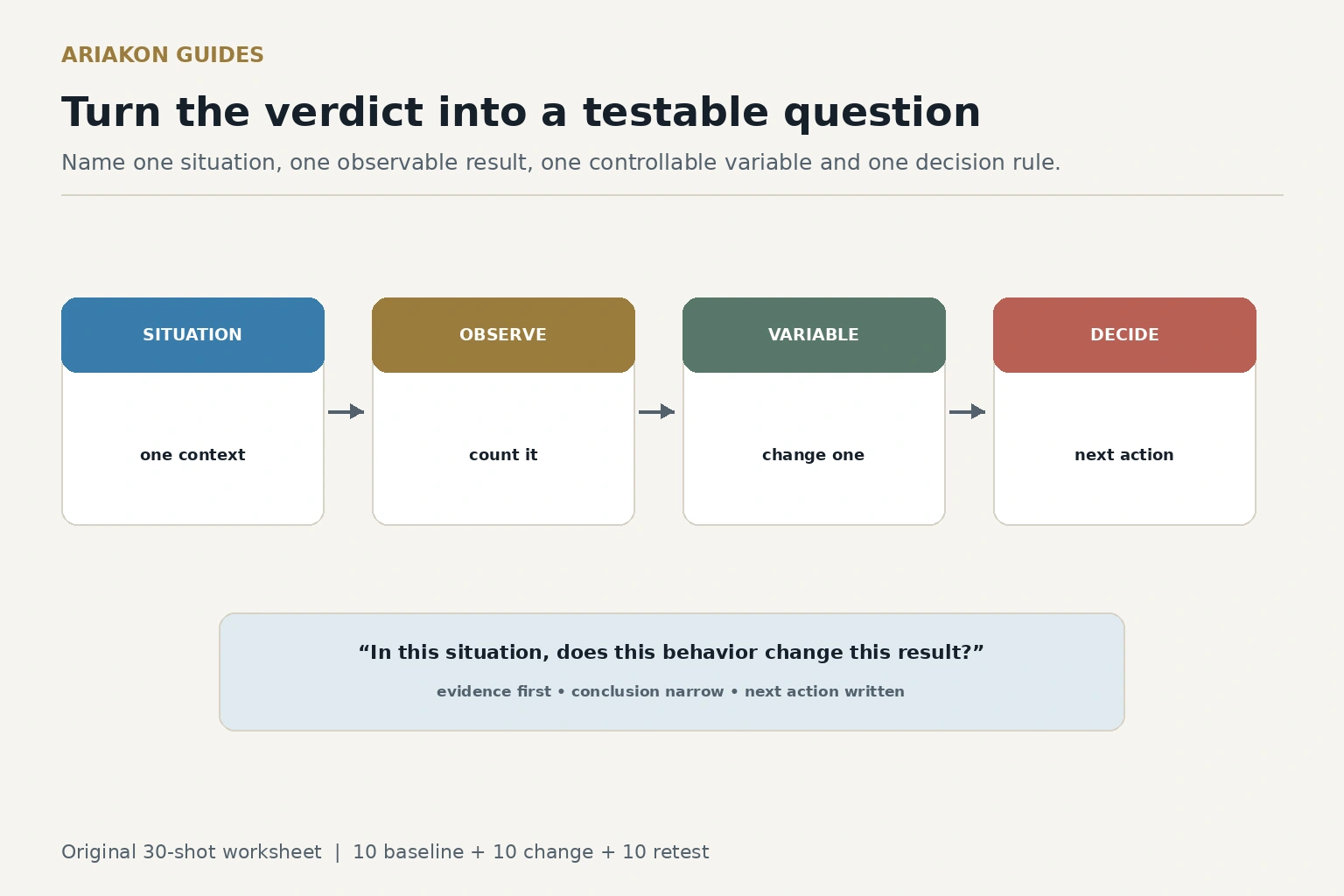
Separate the story from the observation
| Field | Write | Useful example | Not yet useful |
|---|---|---|---|
| Situation | One repeatable context | Game-ball shot after a wait | Pressure |
| Observed result | Something countable | Routine restarted 1 of 10 | I fell apart |
| Variable | One controllable behavior | Stand up if the picture changes | Be confident |
| Decision | Rule for next action | Keep if completion rises by 3 | Try harder |
Use the competition composure routine when the concern occurs between turns or immediately after a miss.
Write measurable practice goals when the question needs a longer training cycle.
Write one question a score can answer
Use this sentence: ‘In [situation], does [one behavior] change [one observable result] over [number of attempts]?’ A workable example is: ‘After a thirty-second seated wait, does completing my stand-see-step-set routine raise clean routine completions on the same game-ball shot over ten attempts?’
The question asks whether one behavior changes one observation in one controlled task. Defined tasks and a recorded denominator keep the result testable. This original worksheet does not diagnose doubt, promise a cure or reproduce a formal examination.
Run a thirty-shot comparison
| Block | Condition | Record | Purpose |
|---|---|---|---|
| 1 Baseline | Current routine | Routine complete? Shot result? | Locate the actual pattern |
| 2 One change | Chosen behavior only | Same two observations | Test the question |
| 3 Retest | Return after a short break | Same two observations | Check immediate repeatability |
Score process and result separately
| Measure | 0 | 1 | Why separate it |
|---|---|---|---|
| Process | Chosen behavior omitted | Chosen behavior completed | A pocket cannot hide a broken process |
| Shot | Miss or foul | Called ball pocketed | A good process can still miss |
| Recovery | Judgment only | Next observation written | The record creates the next question |
Work an evidence-based example
A player begins with ‘I always choke on the last ball.’ Video or an observer shows that the player completed the full routine on 4 of 10 baseline attempts and pocketed 6. The one-change block uses a spoken standing decision—ball, pocket, cue-ball stop—before bending: routine 8 of 10, pocketed 6. The retest is routine 7 of 10, pocketed 7.
The honest conclusion is narrow: the spoken decision improved immediate routine completion in this setup; pocketing evidence is too small to promise a match result. The next action is two more sessions with the same protocol. If routine completion holds but misses stay signed to one side, the next question becomes alignment, not confidence.
Choose a next action instead of a verdict
| Evidence | Next action | Do not conclude |
|---|---|---|
| Process rises in both changed blocks | Repeat on a second day | The change works for everyone |
| Process rises; result does not | Keep process, test a technical variable | Pressure is solved |
| Neither measure changes | Rewrite the question or simplify setup | You lack ability |
| Results scatter | Increase attempts before deciding | One miss proves the story |