
Practice planning · 3 min read
Turn Pool Goals Into Monthly Habits and Review Dates
A goal becomes useful when it names an observable action, a trigger and a review date. Build one 30-day cycle around a narrow pool task. The calendar should tell you what to do even on an ordinary day; the review should tell you whether to keep, shrink or advance the task without turning one result into a judgment about talent.
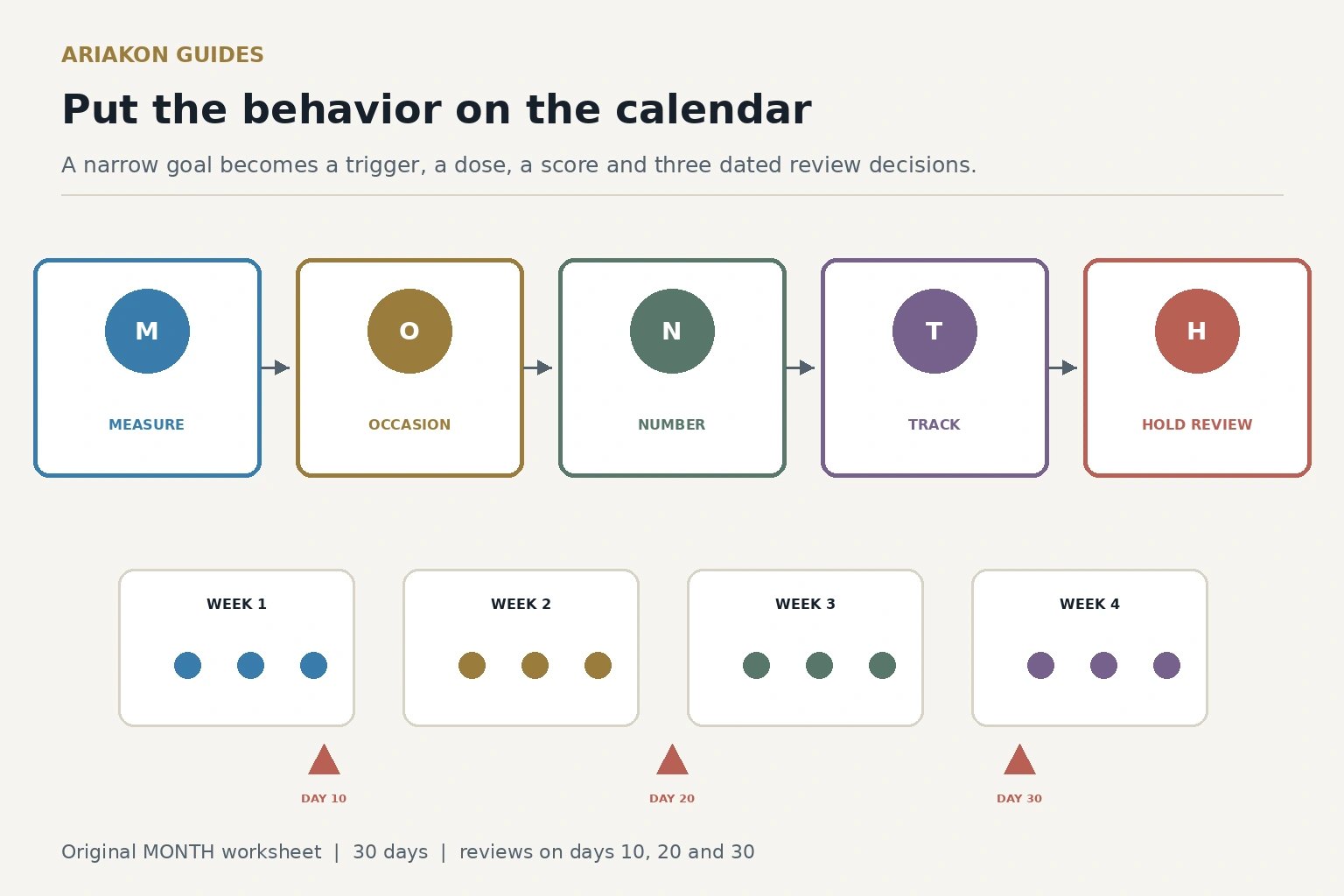
Fill the MONTH worksheet
The Association for Applied Sport Psychology recommends specific, observable and measurable goals, practice as well as competition goals, and dates or numbers that make progress visible. Apply that principle to a behavior under your control. ‘Become a better player’ is an outcome wish; ‘complete twelve marked stop shots after warm-up three times each week’ is a schedulable action.
Use a minimum version for difficult days: set all marks and complete four attempts. That preserves the occasion without falsely recording a full session. A missed session is data, not debt; do not double the next dose automatically.
| Letter | Write this | Pool example |
|---|---|---|
| M — Measurable behavior | One action and one scoring rule | Twelve marked stop shots; pocket plus six-inch stop zone |
| O — Occasion | A stable cue for starting | After Tuesday, Thursday and Saturday warm-up |
| N — Number | Dose and monthly opportunities | 12 attempts × 3 sessions × 4 weeks |
| T — Track | One sheet with process and result fields | Setup, routine, pocket, zone and note |
| H — Hold reviews | Dates for two brief checks and one final decision | Days 10, 20 and 30 |
Build the wider improvement plan before choosing the single monthly focus.
Use a first-month fundamentals schedule for an introductory curriculum.
Score behavior separately from outcome
A session can earn strong behavior marks while results fluctuate. That distinction protects the schedule from being rewritten after one good or bad night. Add the session totals only to compare your own consistency; they are not a skill rating and should not be compared across players.
At day 10 ask whether the trigger and dose are workable. At day 20 inspect the recurring miss class. At day 30 choose exactly one action: keep the same cycle, shrink the dose, advance the target or replace the task because the original goal changed.
| Line | 0 | 1 | 2 |
|---|---|---|---|
| Start | Skipped | Minimum version | Full session on the planned occasion |
| Setup | Changed or unknown | One accidental change | All marks consistent |
| Routine | Mostly skipped | Mixed | Used on all scored attempts |
| Result | Not recorded | Pocket or zone only | Pocket and zone recorded separately |
| Review | No note | General feeling | One evidence-based next action |
Worked 30-day example
A hypothetical player schedules twelve full stop-shot sessions. By day 10, three full sessions supply 36 scored attempts and one minimum session supplies four separately logged attempts. Eight of the 36 full-dose attempts reach both pocket and zone. Keep those denominators separate. The trigger stays, but the venue marks are corrected so setup is repeatable.
By day 20, six full sessions supply 72 scored attempts and the minimum remains separate: 24 of the 72 full-dose attempts reach pocket and zone. At day 30 the record is ten full sessions, one minimum and one missed session. The final two full sessions produce 15/24. Repeat the same marks before advancing distance; this hypothetical pattern does not establish match improvement.
Sources and further reading
References support the specific factual information above. The practical checklists are Ariakon editorial guidance.