
Aiming · 3 min read
Separate Visual Aiming From Cue Delivery on a Pool Shot
A miss can begin with the wrong line or with a cue that fails to travel on the chosen line. Treat those as separate questions. First preserve the standing decision and final visual target; then use physical cue gates and a frozen finish to observe delivery. Changing aim after every poor stroke teaches neither skill.
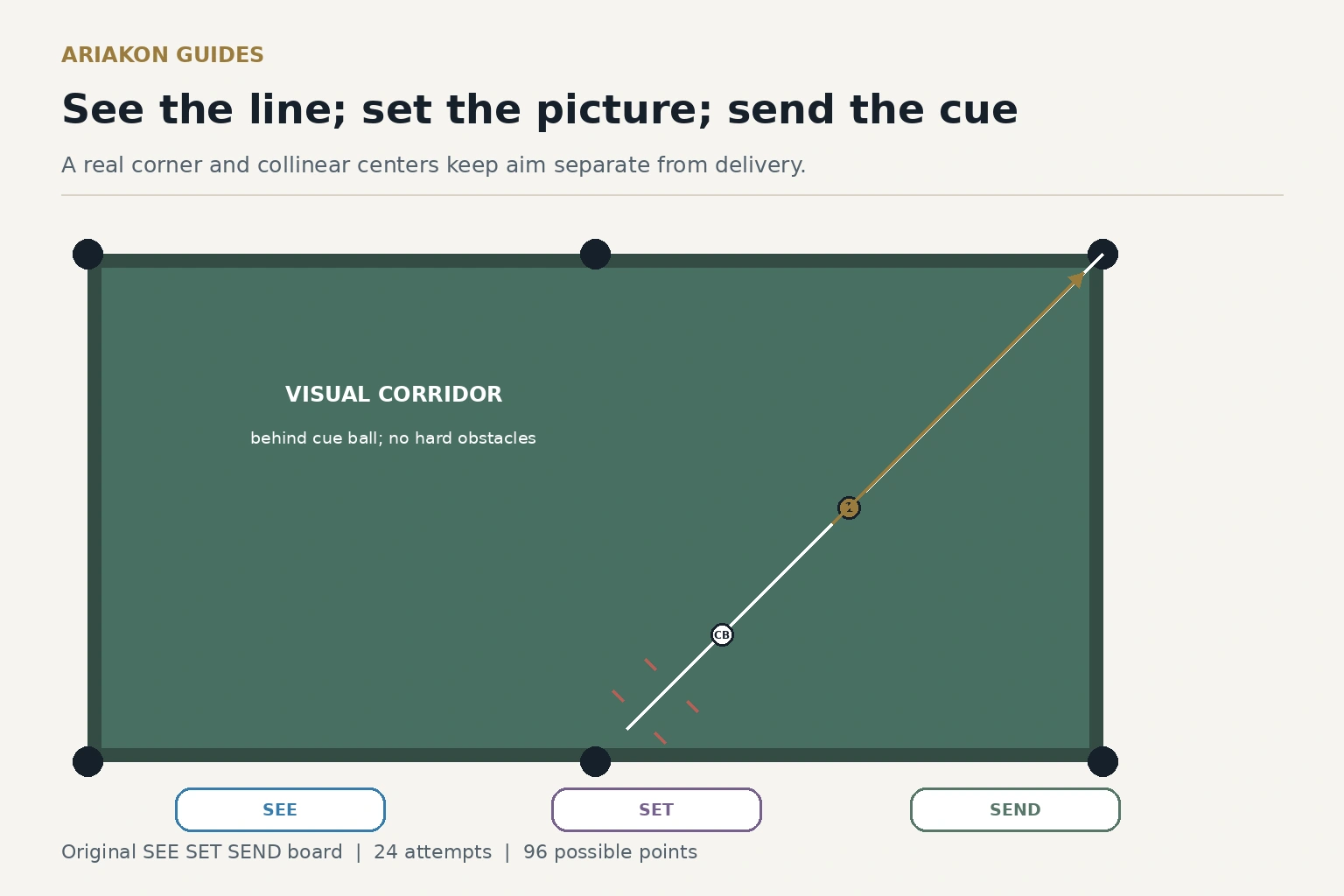
Mark the SEE–SET–SEND layout
Use a 100 by 50 inch example surface and 2.25 inch balls. In 12.5 inch units let x run 0 to 8 along length and y run 0 to 4 across width. Use real corner P=(8,4), object O=(6,2) and cue C=(5,1). These are collinear. The full-contact cue center is G=(6-0.18/√2,2-0.18/√2). For the longer block move C half a unit backward along the same diagonal. Use two visual cue-path references behind the cue ball, outside all cue, hand and ball paths. They are viewing aids, never hard obstacles.
SEE: choose the object-ball path and cue-ball contact while standing. SET: enter the stance, check near contact and the far target, then settle the final look before cue motion. SEND: deliver once without steering and hold the comfortable finish. A settled look is a repeatability checkpoint here; no universal gaze duration or medical claim is prescribed.
Build a consistent eye pattern before using this diagnostic separation.
Check body and cue alignment when the cue cannot pass both gates.
Score four blocks of six
Block 1 uses the comfortable straight shot. Block 2 lengthens it by half a diamond. Block 3 returns to the first distance but narrows the cue gates slightly without touching the shaft. Block 4 alternates the two distances in an unknown order supplied by a partner or shuffled card.
Do not move the aim line after a gate contact; repeat the same visual decision and repair delivery. Do not alter grip, stance, bridge and eye pattern together after a clean delivery that repeatedly misses one side; preserve the delivery and inspect the standing line or vision-center setup.
| Point | Observable condition |
|---|---|
| 1 — SEE | Standing line and cue-ball contact are declared before descent |
| 1 — SET | Final near/far check finishes before the backswing |
| 1 — SEND | Cue clears both gates and finish is held |
| 1 — Result | Object ball enters the declared pocket |
| Maximum | 96 points; record miss side and gate contact separately |
Diagnose the score pattern and transfer it
Worked example: a player scores 23 SEE, 21 SET, 15 SEND and 16 pocket results over 24 attempts. Eight shots miss; seven of those misses include a cue-path failure. Keep the visual routine and widen the viewing corridor for six slow center-ball deliveries. Another player clears the corridor but repeatedly misses left at both distances; inspect the standing alignment rather than tightening the stroke.
Transfer with six ordinary rack shots. Before each, name the line while standing; after the shot, record visual-decision confidence, cue-path evidence and outcome in separate columns. This does not prove a medical vision issue. Persistent visual difficulty belongs with an eye-care professional, while technique questions can be taken to a qualified instructor.
| Pattern | Likely next question | Next six attempts |
|---|---|---|
| Low SEE, clean gates | Was the line chosen before descent? | Name pocket, contact and line while standing |
| High SEE/SET, gate contact | Did cue direction change during delivery? | Widen gates and film safely from behind |
| Clean gates, repeated one-side miss | Does setup place the cue on the chosen line? | Rebuild stance entry without changing stroke |
| Fixed good, alternating poor | Does the visual routine survive context change? | Alternate only distance and retain all checkpoints |