
Shot Making · 3 min read
Practice the Kiss-Back Shot Without Guessing
A kiss-back should be studied as an observable contact sequence, not a lucky return. This guide corrects the loose-object-ball picture, uses one ball at an intact cushion and keeps the legal shot result separate from whether a second collision was actually seen.
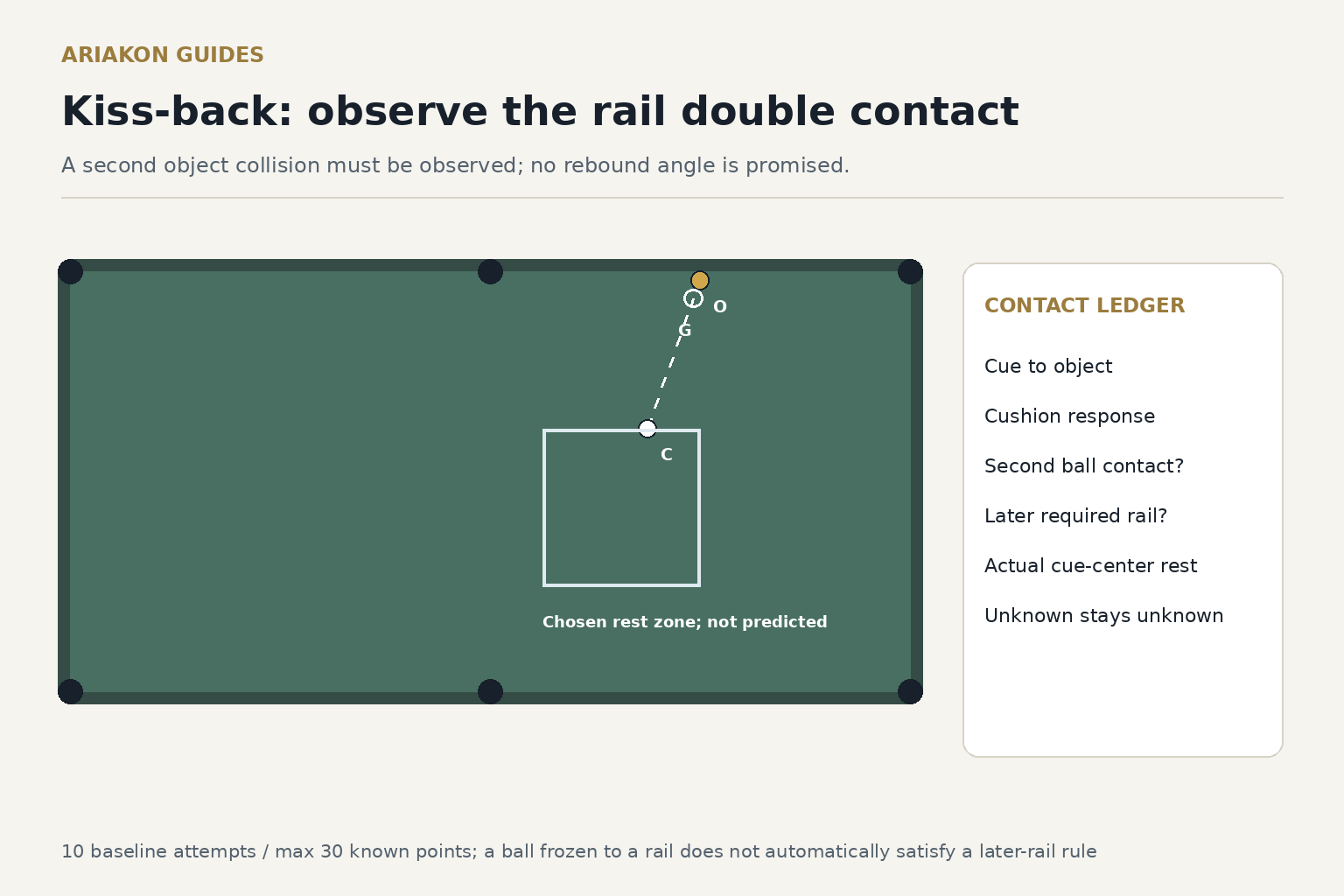
Name the rail double-kiss task correctly
In this guide, a kiss-back is a cue ball that contacts an object frozen or close to a cushion, then can contact it again after its cushion response. It is not simply two loose object balls bouncing toward a corner. A second ball-to-ball collision is different from an illegal second cue-tip hit. Do not confuse those two events.
Use permitted ordinary-stroke practice with a knowledgeable observer or instructor for close-contact legality. No scoop, steep cueing, hard facing hit or ball driven off the table belongs in this task. If the cue tip remains on the cue ball as object contact occurs, ordinary double-hit rules apply.
Start from a documented intact-cushion layout
Coordinates are ball centers on an illustrative 100 by 50 inch bed: x=0..8 along length, y=0..4 across width, origin at the lower left cushion nose. One unit is 12.5 inches. For 2.25 inch equal balls, radius is 0.09 and diameter 0.18 units. Intact cushion center boundaries are x=0.09,7.91 and y=0.09,3.91; pockets interrupt the physical boundary at the four corners and (4,0),(4,4). Measure actual bed, balls and jaws before scaling. Remove every measuring aid before shooting; never mark a competition table.
Place only object O(6,3.91), touching the intact upper cushion at nose(6,4), away from side pocket(4,4). Start cue C(5.5,2.5). For the nominal full hit, e=(O−C)/|O−C| and first-contact cue center G=O−0.18e, approximately(5.939841,3.740351). Use a modest familiar near-stun request with no intentional sidespin; this is an input to calibrate, not a prescribed exact tip height.
Choose a cue-center rest rectangle x=4.5..6,y=1..2.5 before shooting. It is a chosen control target, not a promised rebound. Keep the same ball centers, cue, cloth and comfortable pace. Photograph only for your own reset with permission, and remove aids before every attempt.
Observe contacts and the legal finish separately
Track cue→object first contact, object/cushion response, any second cue→object collision, any later cushion after object contact, and final cue location. If the second collision is not visible, record unknown rather than inferring it from a return. No universal three-times-angle rule or measured trajectory is claimed here.
With no ball pocketed, an ordinary legal shot needs a ball driven to a rail after object contact. An object frozen to its starting rail is not newly driven there merely by remaining against it. If that object does not leave and return, a later cue-ball cushion may be needed. A visually impressive return that never satisfies that requirement is a foul.
Score ten reset attempts with an explicit gate
| Points | Established outcome |
|---|---|
| 0 | Known foul, wrong first target or unsafe action |
| 1 | Complete legal shot; intended second ball contact known absent |
| 2 | Complete legal shot with observed intended second contact; finish outside called rectangle |
| 3 | Score 2 plus cue center resting in called rectangle |
| Unscored | Required legality/contact/finish hidden; retain known events separately |
Change one supported variable
A candidate practice setting needs at least eight known legal shots and six observed second contacts among ten actual attempts, no safety stop and every scored finish visible. The points cannot waive a legal-contact failure. This is a local original gate, not proof of match reliability.
If the second contact fails, inspect reset and actual first contact before making one small pace or aim change. Retest five new attempts at the unchanged coordinates, maximum 15 known points, and keep the baseline. Do not widen the rectangle after a miss. If the return is legal but leaves an easy attack, a conventional containing safety may be the better game choice.
Sources and further reading
References support the specific factual information above. The practical checklists are Ariakon editorial guidance.