
Safety play · 3 min read
Practice Distance Safeties When a Full Snooker Is Unavailable
A safety can reduce the opponent's options without hiding the entire object ball. When no blocker is available, distance, rail proximity and an awkward reply can still be practiced. This guide deliberately scores a distance safety, not a full snooker. Check the current rules for the discipline and event before using any legal-contact or cushion requirement.
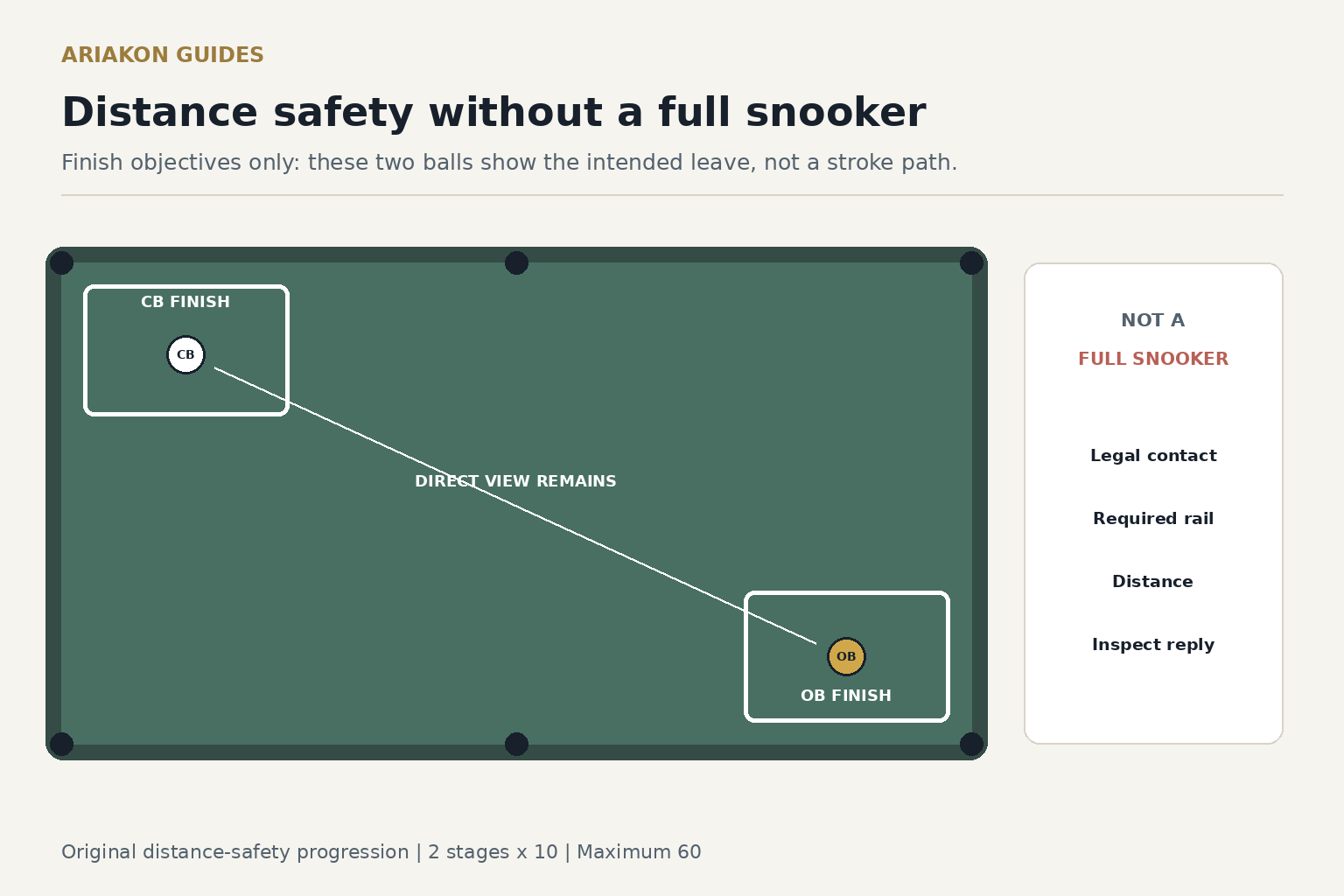
Mark opposing landing zones
During unscored calibration, put the object ball near table center and choose a cue-ball start with comfortable legal access. Mark an object-ball finish zone about one diamond square by the foot rail and a cue-ball zone of similar size by the opposite head rail. First find a controlled legal contact and vertical-axis delivery that sends the object ball to its rail zone. Then test the cue-ball return; controlled draw or an additional cushion may be needed. Do not assume a thin hit alone reverses the cue ball toward the head rail. If a route needs unsafe elevation or extreme spin, enlarge or move the finish zones before scoring and record the adjusted layout.
The intended thin contact sends the object ball toward its foot-rail zone while the cue ball travels to the opposite head-rail zone. Use a legal stroke and the cushion requirements of the current discipline. If the room or event uses different rules, the official rule or director controls.
The illustration shows final objectives only, not starting positions or physical trajectories. After calibration, record the exact two starts and zone boundaries, reset them for every scored attempt, and apply the chosen discipline’s legal first-contact and post-contact rail requirements.
Learn the three-part safety decision for legal contact, cover and distance as a general game framework.
Start with object-ball control
| Stage | Attempts | Cue-ball task | Object-ball task |
|---|---|---|---|
| A | 10 | Finish on the head half | Enter the foot-rail zone |
| B | 10 | Enter the cue-ball rail zone | Enter the object-ball rail zone |
Score legal outcome and distance
| Points | Legal outcome | Landing zones | Separation |
|---|---|---|---|
| 0 | Foul under the chosen rules | Any | Any |
| 1 | Legal; no higher score applies | Neither joint zone requirement satisfied | Same half or insufficient separation |
| 2 | Legal | Exactly one called zone; or neither zone but opposite halves | Record actual separation |
| 3 | Legal | Both called zones on opposite halves | Inspect intended long reply |
Record the best available reply
After every Stage B attempt, stand at the cue ball's finish and name the opponent's simplest legal reply: direct pocket, return safety, bank, kick or another event-legal choice. Do not award yourself an extra point because a shot merely looks difficult. The landing-zone score is objective; reply quality is a written game-transfer note.
A full snooker means a different problem: the required object ball is obstructed under the applicable rules. This drill leaves a direct line on purpose, so its score cannot be used as evidence that you can hide the ball consistently.
Diagnose which ball lost control first
| Pattern | Likely practice question | Next five shots |
|---|---|---|
| Object ball misses zone; cue ball is stable | Contact fullness | Score object-ball zone only |
| Object ball stable; cue ball runs short | Cue-ball speed | Keep contact; change speed only |
| Both balls run long | Delivery speed | Reduce speed; keep line |
| Contact varies left/right | Aim and tip alignment | Shorten distance and restore legal hit |
Use the sixty-point result conservatively
Twenty attempts have a maximum of 60. A worked session scores 22 in Stage A and 18 in Stage B. The object ball reaches its zone 14 times, but the cue ball reaches its zone only 7. The next action is ten attempts with the same contact and a clearly called cue-ball speed—not a thinner hit that changes both balls.
For game transfer, place one legal blocker away from the direct line and play six safety choices. On each, decide whether distance alone or cover plus distance offers the wider margin. The score stays separate from the original test because the reader task has changed.
Sources and further reading
References support the specific factual information above. The practical checklists are Ariakon editorial guidance.