
Equipment care · 4 min read
Pool Table Maintenance Troubleshooting: Cloth, Rails, Level and Pockets
A ball that drifts, slows or rebounds differently does not identify a damaged component by itself. Record the location, control the easy confounders and change only one permitted care variable before retesting. This guide produces a service-ready symptom record for an in-use table; it is not an installation procedure or a remote repair diagnosis.
Separate six domains before taking action
Record table identity, actual cloth and ball identity, location and when the symptom began. Keep installation records separate from later use. Stop immediately for structural movement, exposed fasteners, broken pocket parts, wet cloth or a dangerous damaged ball. Do not test around a known hazard.
| Domain | Observe | Do not infer |
|---|---|---|
| Cloth | Visible debris, wrinkles, tears and local path behavior | Every white mark is a burn or every drift is cloth |
| Cushions | Repeatable response at a named solid cushion location | A weak rebound proves loose rubber |
| Bed and support | Repeatable departure; visible seam or movement | Hand rolling certifies slate level |
| Pockets | Visible sharp edges, loose parts, approach behavior | One rattle establishes incorrect pocket geometry |
| Balls | Damage, contamination and behavior with a known clean ball | A ball’s appearance certifies roundness |
| Room conditions | Recent spill, temperature/humidity change, lighting | A room change proves the hidden cause |
Check the installation handoff record if the symptom began immediately after work.
Use the separate ball-consistency ledger when the comparison suggests a ball-specific issue.
Fix the observation conditions, not the table hardware
With the operator’s permission, use one clean undamaged ball, the same room light and the same fixed-camera view. Record conditions rather than claiming perfectly controlled release speed. No cue stroke is used; release by hand with no deliberate sidespin. Hand variability is an explicit limitation.
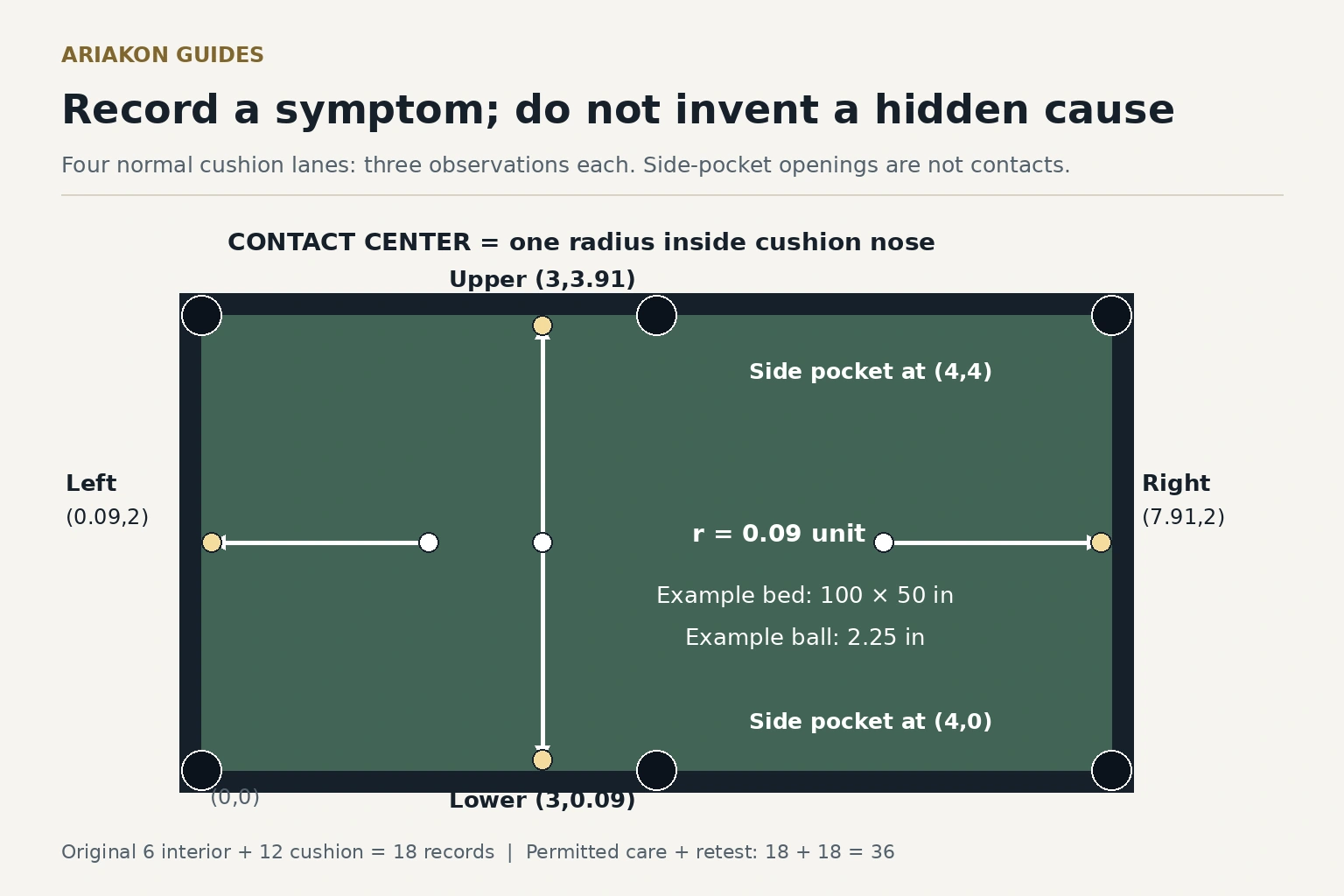
The example bed is 100×50 inches, represented by an 8×4 cushion-nose rectangle with origin at the lower-left. The example 2.25-inch ball has radius 0.09 coordinate unit. Six pockets sit at four corners and at (4,0) and (4,4). The cushion-contact coordinates below use the ball center one radius inside the nose boundary, never a pocket center. Scale to the actual bed; these are not universal equipment dimensions.
Collect eighteen baseline records
Each intended cushion run-in is 1.91 coordinate units or 23.875 inches. The long-rail lanes use x=3, away from side pockets at x=4. Release only fast enough for a gentle intended contact. A ball stopping before the cushion is recorded as short, not silently omitted; a release with visible unintended sideways rotation is recorded as uncontrolled.
Six interior observations plus twelve cushion observations make eighteen. For each write lane, repeat, completed/short/uncontrolled, lateral departure, contact location if reached and approximate rebound direction and stop area. No cushion angle or stopping distance is guaranteed. At ideal zero-spin normal incidence the geometric reverse direction is the reference, not a claim that a real cushion returns along an exact line.
| Lane | Start center | Direction/checkpoint or first contact center |
|---|---|---|
| Interior forward | (2,2) | Toward (6,2), no required reach |
| Interior reverse | (6,2) | Toward (2,2), no required reach |
| Lower long cushion | (3,2) | First center contact (3,0.09) |
| Upper long cushion | (3,2) | First center contact (3,3.91) |
| Left short cushion | (2,2) | First center contact (0.09,2) |
| Right short cushion | (6,2) | First center contact (7.91,2) |
Change one permitted care variable and compare
Read the exact installed cloth and ball care instructions before cleaning. If you cannot identify the material and permitted method, stop and request them. Do not transfer a cleaner, brush, vacuum setting, wax, sealant or solvent recipe from a different material. Protect other surfaces from the permitted supply and record precisely what was done.
Repeat the same eighteen records after one permitted action under comparable conditions: 18 before +18 after =36 planned observations. A hypothetical session has sixteen completed and two short baseline trials, then seventeen completed and one uncontrolled retest: 16+2=18 and 17+1=18. That is not a 33/36 table-quality score. Keep the categories and videos, and do not claim a causal improvement from one uncalibrated session.
If care was not authorized or safe, the retest is omitted and the report remains an eighteen-record baseline with an open care question. Never level slate, tighten rails, stretch cloth or apply body weight as part of this screen.
Hand off the repeated symptom with limits
A complete report can end with an unresolved service question. A hand-roll comparison does not measure rebound coefficients, cushion height, pocket acceptance geometry or certified level. Keep the actual warranty and work-order terms; do not invent coverage or a service interval.
- Name the exact lane and cushion or bed location; attach dated video.
- Report short and uncontrolled trials separately from completed observations.
- Include the actual materials, care instructions and one permitted change—or why none occurred.
- Describe what repeats and what remains unknown; do not name a hidden defective component.
- Ask a qualified table technician what inspection is needed before further use.
Return to the routine care checklist only once the unresolved hazard or service condition is addressed.
Sources and further reading
References support the specific factual information above. The practical checklists are Ariakon editorial guidance.