
Table care · 4 min read
Inspect a Pool Table Cloth Installation Before Accepting the Work
The useful end of a cloth installation is a documented handoff: what was fitted, which visible conditions were checked and who will resolve an outstanding concern. Walk through the finished table with the installer before routine play. Do not pull the cloth, add adhesive or tighten hardware to improve the appearance of an acceptance inspection.
Agree what acceptance covers
Save the work order, exact cloth identity, installed surfaces, agreed repairs, completion date and the installer’s current care instructions. Ask whether any adhesive cure time or restriction applies to this exact job before putting balls on the table. This guide does not prescribe a universal wait, tension or fastening method.
Use diffuse room light, then low-angle light without resting a lamp or sharp object on the bed. Photograph an overall view and any concern from two directions. An installation walkthrough is distinct from choosing replacement cloth, performing the installation and troubleshooting a table that has already been used.
Plan cloth replacement before work begins for the separate scope and service decision.
Troubleshoot an in-use table when symptoms develop after the handoff.
Fill the six-zone acceptance record
For each zone write four fields: location, observation, photograph identifier and installer response. Six zones make 24 entries. Blank means not checked, not passed. Record inaccessible areas as inaccessible; do not remove rails or pockets for this walkthrough.
Never lean body weight onto the cloth as a tension test. A visually smooth surface does not prove the hidden installation method or the slate level. Exposed sharp hardware, loose structural parts, liquid contamination or moving cloth is a reason to stop and involve the installer before rolling balls.
| Zone | Observe without loading or dismantling | Question to resolve |
|---|---|---|
| Bed surface | Visible ripples, debris, cuts and seams showing through | Is this an unresolved surface condition? |
| Bed perimeter | Visible loose areas or uneven transitions | Does the installed edge require attention? |
| Cushion faces | Smooth cloth and consistent visible contours | Is a local fold or irregularity intentional? |
| Pocket approaches | Visible folds, exposed fasteners or sharp edges | Can normal ball and cue contact damage the cloth? |
| Rail and pocket transitions | Accessible finished joins and hardware condition | What service is required before use? |
| Room and finish | Lighting, dust, surrounding finish and handoff cleanup | What protection and care apply here? |
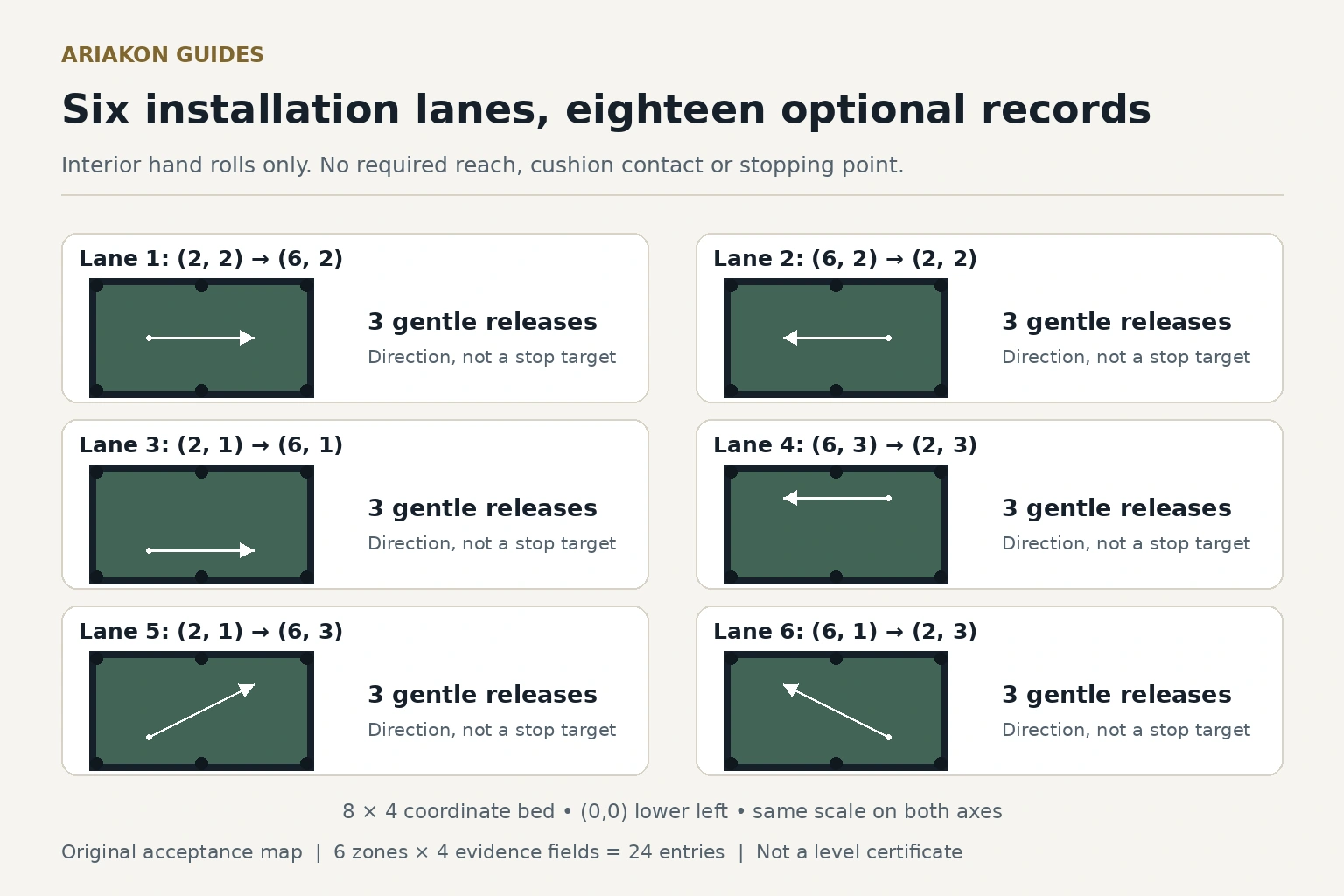
Optionally observe six interior hand-roll lanes
Only after the installer permits ball use, take one clean undamaged ball and release it gently by hand without deliberate sideways rotation. The exercise does not use a cue, pocket a ball or require cushion contact. Leave the ball alone until it stops; if it approaches a hazard, stop the trial and record why. Use a fixed camera and an off-table diagram, not tape or marks on fresh cloth.
Example coordinate bed: cushion-nose rectangle 0≤x≤8, 0≤y≤4, corresponding here to 100×50 inches. The origin is the lower-left corner in the diagram. A 2.25-inch example ball has radius 0.09 coordinate unit. These are an illustrative setup, not the dimensions of every table. Scale positions to your actual bed and ball.
| Lane | Ball-center start | Direction toward interior checkpoint |
|---|---|---|
| 1 | (2,2) | (6,2) |
| 2 | (6,2) | (2,2) |
| 3 | (2,1) | (6,1) |
| 4 | (6,3) | (2,3) |
| 5 | (2,1) | (6,3) |
| 6 | (6,1) | (2,3) |
Record eighteen observations without a pass score
Repeat each lane three times: 6×3=18 records. Write lane, repeat, visible lateral departure, approximate stopping area and any interrupted trial. The checkpoint gives a reproducible intended direction; it is not a required reach or stop target. Gentle releases will differ in speed and spin.
A worked record might contain fifteen completed observations and three interrupted releases: 15+3=18. It does not score 15/18 as an acceptable table. If a departure appears repeatedly in the same area, show the videos to the installer. Ball irregularity, hand release, surface contamination, cloth and level can contribute; this screen cannot assign a hidden cause.
Close every outstanding handoff item
The FTC’s warranty guidance supports reading actual terms and retaining records. It does not determine whether a particular cloth installation is covered. A complete handoff can legitimately retain an open item; do not mark it resolved until the agreed work and recheck exist.
- List each unresolved location separately, with its photo and observed symptom.
- Record the installer’s explanation or agreed service action without inventing a deadline.
- Save which areas were not inspected and whether optional rolling was omitted.
- Retain the exact care instructions and seller/service terms with the work order.
- Leave structural, tension, slate and fastening corrections to qualified service.
Create the ongoing table-care routine using the actual installed-material instructions after acceptance.
Sources and further reading
References support the specific factual information above. The practical checklists are Ariakon editorial guidance.