
Practice planning · 3 min read
Play a Full Pool Practice Set Without Sidespin
Removing sidespin for a full set is a constraint, not a claim that English is bad. The constraint reveals whether route planning, speed and vertical-axis contact can solve more shots than expected. This guide defines the allowed contact line, calibrates it in fifteen shots, then uses a best-of-nine race against the table. Apparent exceptions go into a later test instead of becoming a mid-set excuse.
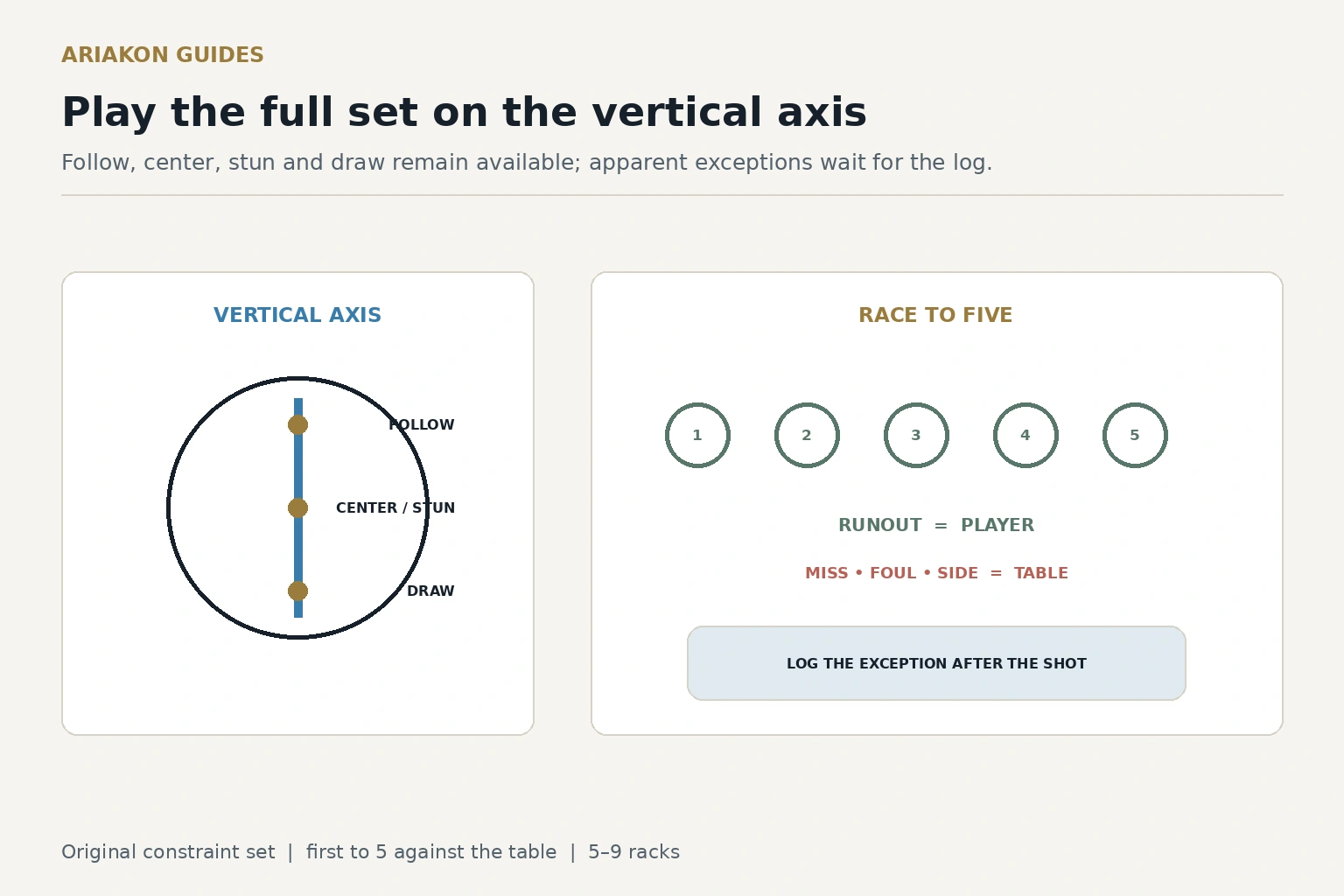
Define the constraint precisely
Intentional cue-tip contact is limited to the cue ball's vertical centerline: follow above center, center ball, stun near center at impact and draw below center are allowed. Intentional left or right contact, masse and swerve shots are not. Use a striped cue ball with the stripe vertical when available so the called contact is visible.
Sidespin changes cue-ball and object-ball behavior through effects including squirt, swerve and throw. Avoiding it reduces those compensation decisions, but it does not remove cut-induced throw, speed judgment or table variation.
Learn when sidespin earns its complexity after the baseline set identifies a route that may genuinely benefit from it.
Calibrate fifteen vertical-axis shots
| Station | Setup | Attempts | Pass signal |
|---|---|---|---|
| Follow | Straight shot; cue ball rolls one diamond forward | 5 | 3 called-zone finishes |
| Center/stun | Same shot; cue ball stays within half a diamond | 5 | 3 called-zone finishes |
| Draw | Same shot; cue ball returns half to one diamond | 5 | 3 called-zone finishes |
Play a best-of-nine set against the table
Choose the discipline you normally practice and use its current governing rules. Rack and break normally. After a legal break, take cue ball in hand once and attempt the run using only the vertical axis. A completed rack scores one game for you. A miss, foul or intentional sidespin contact scores one game for the table. First to five wins; the set lasts five to nine racks.
If your normal discipline or room rules do not permit this solo format, label it clearly as a practice modification. It is not an official match result or rating. Safeties may be played only when they are part of the chosen practice task; otherwise a safety ends the offensive rack and gives the table the game.
Record every route decision before bending
| Field | Write before shot | Write after shot |
|---|---|---|
| Cue-ball action | Follow, center, stun or draw | Actual signed finish |
| Route | Zero, one or two cushions | Cushions actually contacted |
| Target | Area or line | Inside, short, long, left or right |
| Exception | None during the shot | Why sidespin seemed useful |
Use an exception log, not a loophole
Do not add sidespin because the first choice looks awkward. Finish the no-sidespin decision, play it, and then log the exact reason an alternative seemed valuable: avoiding traffic, widening a target, changing cushion approach or preventing a scratch. A simple dislike of the vertical-axis route is not yet an exception.
Worked example: a player loses 5–3. Across the calibration and set log, seven cue-ball finishes miss their called speed zones, while two layouts are logged because the natural route crosses a blocker. The next session is not nine racks with English. It is ten attempts on each blocked layout: five vertical-axis and five with one called side contact—scored by the same target.
Decide what to train next
| Evidence | Next action | Do not conclude |
|---|---|---|
| Most misses are short/long | Run a speed-control block | Sidespin is required |
| Routes fail before contact | Plan while standing | Stroke is the only problem |
| One layout repeats as an exception | Run a paired route test | English is always better |
| Set completes cleanly | Repeat on another day | The constraint suits every rack |
Sources and further reading
References support the specific factual information above. The practical checklists are Ariakon editorial guidance.