
Break practice · 4 min read
Develop a Break Practice Scorecard That Tracks More Than Made Balls
A made ball is visible, but it is a noisy measure of the breaker. A legal square hit can pocket nothing, while an off-center hit can be rewarded by a fortunate drop. A better practice scorecard records the controllable events that precede the outcome: rule compliance, intended rack contact, cue-ball control and access to a realistic next shot. Pocketed balls stay in the notebook as context, not the whole grade.
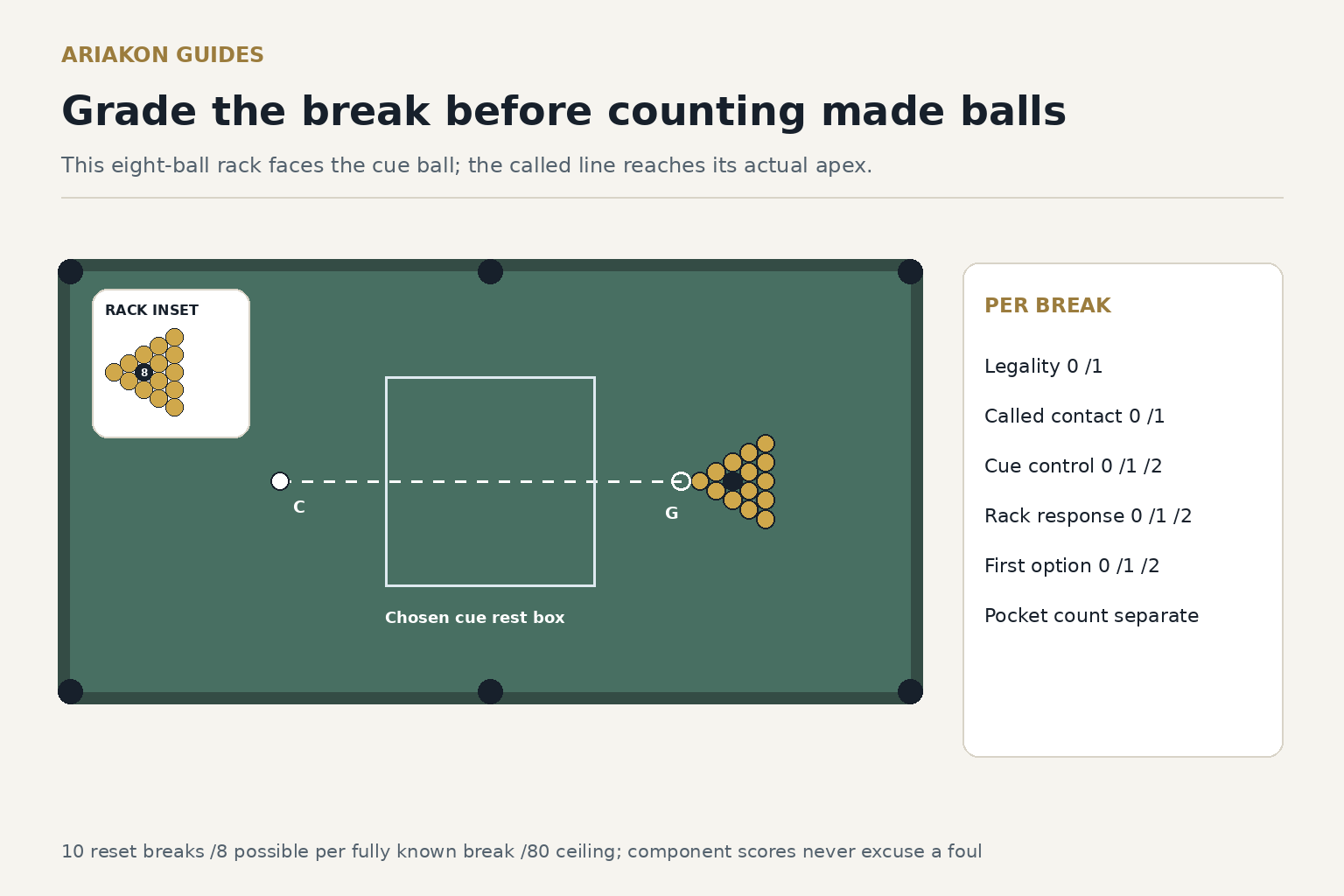
Name the ruleset before the first rack
Write the discipline, rules source and effective date at the top of the sheet. The WPA Rules of Play effective September 15, 2025 define discipline-specific legal-break requirements, and the WPA regulations include a three-ball break rule for specified nine-ball competition. A league or event can use different requirements. The scorecard therefore asks whether this break was legal under the named current rules; it does not invent one universal rail or pocket count.
Use the same rack template or rack procedure, cue-ball start, head-ball target and personal effort band for all ten attempts. Inspect that the rack is tight enough for the practice claim. A changing rack is a changing test.
Develop speed without losing control after this scorecard identifies the limiting event.
Mark the controllable setup
| Field | Fixed choice | Evidence after each break |
|---|---|---|
| Cue-ball start | Named coordinate or break-box position | Actual start confirmed |
| Rack target | Head-ball center or called fraction | Observed hit fraction |
| Effort | One repeatable personal band | Smooth, rushed or changed |
| Cue-ball zone | Two-diamond center box | Inside, outside or pocketed |
| Next shot | Any legal object ball with direct pocket or planned safety | Yes, no or rules-dependent |
Score eight controllable points per break
| Measure | 0 points | 1 point | 2 points |
|---|---|---|---|
| Legality | Foul or illegal under named rules | Legal break | Not used |
| Called rack contact | Wrong fraction | Called fraction observed | Not used |
| Cue-ball control | Scratch or off table | On table outside zone | Inside called center zone |
| Rack response | Obvious loose-rack or dead-cluster invalidates comparison | Usable spread with major cluster | No obstructive cluster at the intended end |
| First-shot window | No legal controlled option | Safety or difficult legal option | Direct shot or clearly planned safety |
Keep made balls as a separate observation
Log pocketed-ball count, break-ball identity where relevant and whether the made ball was legal, but do not add those counts directly to the eighty-point control score. Ten breaks have a maximum of 80 points: legality and called contact contribute one point each; cue-ball control, rack response and first-shot window contribute two each.
Track the requested effort, observable delivery and intended first contact independently. The scorecard uses called contact and cue-ball location because those observations tell you more about the next correction than a lucky pocket.
Read the component totals
| Low component | Likely practice need | Next five-break block | Do not change yet |
|---|---|---|---|
| Legality | Rules, start or foul control | Legal medium-speed breaks | Power |
| Called contact | Alignment and head-ball accuracy | Reduce speed; mark hit fraction | Cue model |
| Cue-ball zone | Vertical contact or square hit | Center-zone squat/stop intention | Rack location |
| Rack response | Rack quality or energy transfer | Verify rack, then square contact | Multiple variables |
| First-shot window | Cue-ball route or break location | Same effort from one alternate legal start | Pocketed-ball target |
Work one sample sheet
Suppose ten breaks score 9 legality points, 7 called-contact points, 12 cue-ball points, 15 rack-response points and 11 first-shot points: 54 of 80. Six balls were made across the set, but called contact and cue-ball control are the two priorities for the next check. The next assignment is five medium-speed square-contact breaks with the center zone unchanged—not a harder break intended to raise the made-ball count.
Repeat the same ten-break sheet on another day. A component that improves twice under the same setup is stronger evidence than one high total. If the rack procedure or rules change, start a new comparison rather than blending the rows.
Transfer the scorecard to match planning
Before a match, select the effort band whose last two sheets produced the best combined legality, called contact and cue-ball result. The goal is not to reproduce a practice pocket count; it is to begin the rack legally with a controlled decision available.
After competition, add only observed facts: foul, cue-ball finish, rack contact and next-shot window. Do not retrofit uncertain contact grades from memory. Let the next practice block address the first recurring low component.
Sources and further reading
References support the specific factual information above. The practical checklists are Ariakon editorial guidance.