
Competition · 3 min read
Create Pool Team Traditions That Welcome New Players
A team tradition should reduce uncertainty and create belonging, not test whether a newcomer can guess unwritten rules. Use a short arrival ritual, a rotating useful role, an explicit opt-out and an end-of-night check-in. The productive-practice guide organizes shared drills; this guide designs inclusive customs around league or team play.
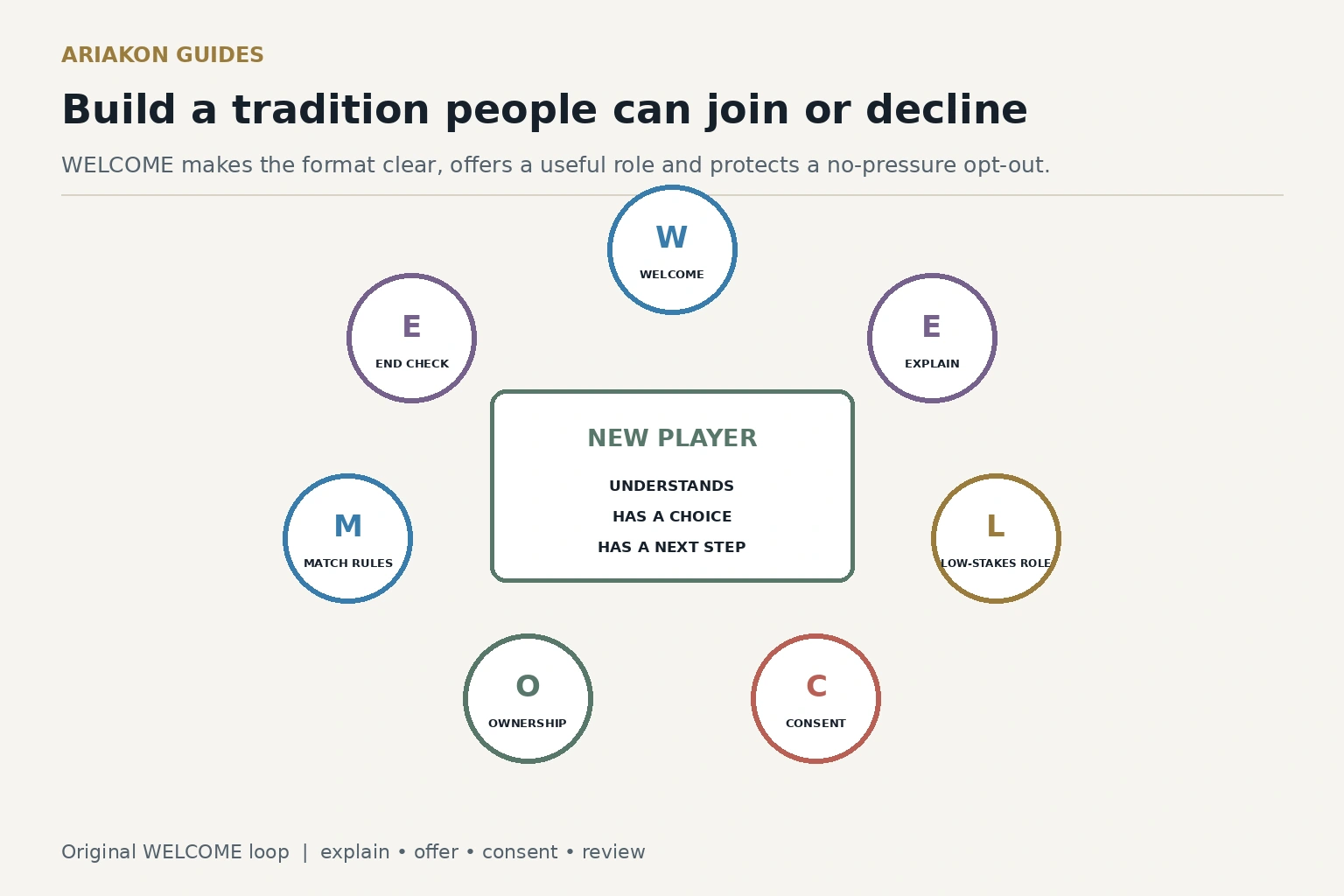
Use the WELCOME design check
Check the current team manual, local bylaws and venue rules before assigning scorekeeping, coaching or table-area roles. A friendly custom cannot authorize conduct the event prohibits.
| Step | Team action | Evidence |
|---|---|---|
| W — Welcome | Use the person's stated name and pronunciation | One teammate owns the introduction |
| E — Explain | Describe format, schedule and venue norms | New player can ask without being rushed |
| L — Low-stakes role | Offer a useful, bounded first-night task | Role has an easy handoff |
| C — Consent | Ask before photos, nicknames or public rituals | No penalty for declining |
| O — Ownership | Rotate who leads the tradition | It does not belong to one clique |
| M — Match conduct | Tie customs to current league and venue rules | No coaching or conduct conflict |
| E — End check | Ask what was clear and what was missing | One next-night adjustment is recorded |
Run productive team practice when the group needs shared drills and role rotation.
Give constructive feedback with the shooter’s permission when feedback language also needs a reset.
Design three moments, not one initiation
Avoid traditions built around alcohol, gambling, humiliation, hazing, physical exertion or sharing private information. Never require a social-media post, photo, nickname or purchase as the price of belonging.
| Moment | Repeatable tradition | Boundary |
|---|---|---|
| Arrival | Two-minute welcome and format card | No surprise performance test |
| Between matches | Rotating role: rack check, score confirmation or water reminder | Role must be legal and easy to decline |
| Departure | One appreciation and one practical question | No public ranking or forced speech |
Prepare the host before the newcomer arrives
| Before | During | After |
|---|---|---|
| Confirm time, place, format and accessibility needs | Introduce rules without jargon | Send the next date only with permission |
| Choose one host and one backup | Offer the role and opt-out | Record one clarification for the team card |
| Check venue and league conduct rules | Intervene if a joke excludes | Thank the rotating host |
Worked example: a first league night
A new player arrives twenty minutes before play. The host introduces three teammates, shows the score sheet and explains when coaching is allowed under the current local rules. The offered role is confirming table numbers between matches; the player declines and instead chooses to observe scorekeeping. The team treats that choice as complete participation.
At the end, the host asks, ‘What was clear, and what should we explain before next week?’ The player says the match order was confusing. The team adds a one-line order example to its welcome card. No personal response is posted or shared without permission.
Review whether the tradition welcomed
| Question | Yes/no evidence |
|---|---|
| Could the newcomer describe the format? | They knew when and where to be ready |
| Was a useful role offered without pressure? | Accepting and declining were both normal |
| Were names, photos and jokes handled by consent? | No opt-out carried a penalty |
| Did the tradition comply with rules and venue policy? | No coaching, conduct or access conflict |
| What changes next time? | One named update and owner |