
Shot planning · 3 min read
Complete Pool Shot Decisions Before Starting Warmup Strokes
Warmup strokes are for rehearsing a decided delivery, not for continuing a debate about pocket, speed or route. Build a standing contract, lower only after all five fields are chosen and stand up if any field changes. The three-question guide helps select a shot; this progression trains the moment at which that decision becomes complete.
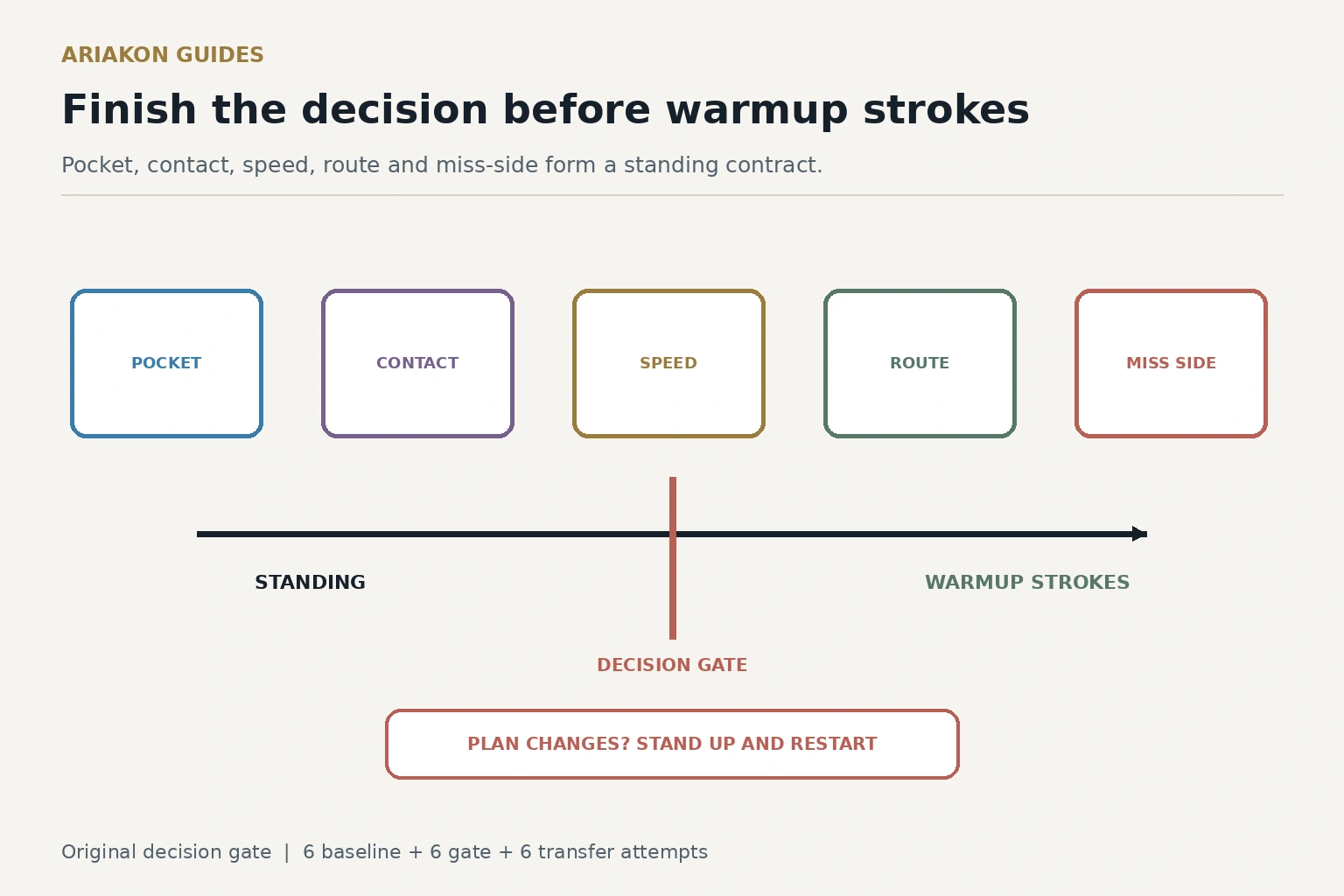
Write the standing contract
The contract does not require a spoken essay in competition. Practice it in full until a compact visual plan is familiar. Confirm the current game's call-shot, foul and shot-clock requirements before play; this routine never overrides them.
| Field | Decision |
|---|---|
| Called pocket or safety target | |
| Contact | Object-ball contact and cue-ball height |
| Speed | Named speed band and finish zone |
| Route | Expected cue-ball rails or containing path |
| Miss side | Acceptable miss and opponent consequence |
Use the three-question shot decision to choose pocket, cue-ball destination and miss cost.
Build a consistent pre-shot routine when the full approach needs structure.
Register one two-ball position shot
Place the object ball one diamond from the lower-left corner pocket on a moderate cut. Put the cue ball near center table and place the next object ball one diamond from the opposite side pocket. Mark a one-diamond cue-ball position box. Use center-ball or a familiar small vertical-axis contact and one named speed.
The decision is complete when all five fields can be pointed to on the table. Warmup strokes then rehearse only the chosen speed and delivery. If the contact, speed or route changes, stand up, update the contract and approach again.
Run baseline, gate and transfer sets
Maximum score is fifty-four. Also count late changes and completed stand-up restarts. A restart is not a failure; noticing an unfinished decision and refusing to steer the cue is the skill being trained.
| Set | Attempts | Rule | Three points each |
|---|---|---|---|
| Baseline | 6 | Use familiar routine | Legal pocket + zone + no late change |
| Decision gate | 6 | State five fields; stand up on change | Same three components |
| Transfer | 6 | Vary angle or blocker from prewritten cards | Correct choice + execution + restart discipline |
Diagnose the timing failure
| Observed event | Likely task | Next action |
|---|---|---|
| Pocket changes during warmups | Shot selection unfinished | Return to standing comparison |
| Speed changes in final stroke | Finish zone not visualized | Name zone and speed band earlier |
| Tip contact changes after lowering | Route and contact disagree | Rebuild the standing contract |
| Plan stable; execution misses | Decision timing may be sound | Use a technical diagnostic separately |
Worked game-transfer example
A hypothetical baseline produces four legal pockets, three zone finishes and three no-change attempts: 10/18. The decision-gate set produces five pockets, four zones and six no-change attempts: 15/18, including two correct stand-up restarts. Transfer scores 12/18 when one blocked route forces a safety.
In a game, the player lowers for a thin cut and realizes the planned high contact sends the cue ball toward a scratch. The correct response is to stand up, recalculate route and miss cost, then begin again. Steering during warmups would preserve pace but abandon the decision boundary.
Sources and further reading
References support the specific factual information above. The practical checklists are Ariakon editorial guidance.