
Equipment acceptance · 4 min read
Check a Replacement Chalk Lot Before Changing Your Match Kit
A repeat purchase can arrive with a different package, lot marking or handling feel. This receiving workflow asks whether the actual replacement is documented and usable in your existing match kit. It is not the broader decision of which chalk product to buy, nor a method for proving composition or authenticity from appearance.
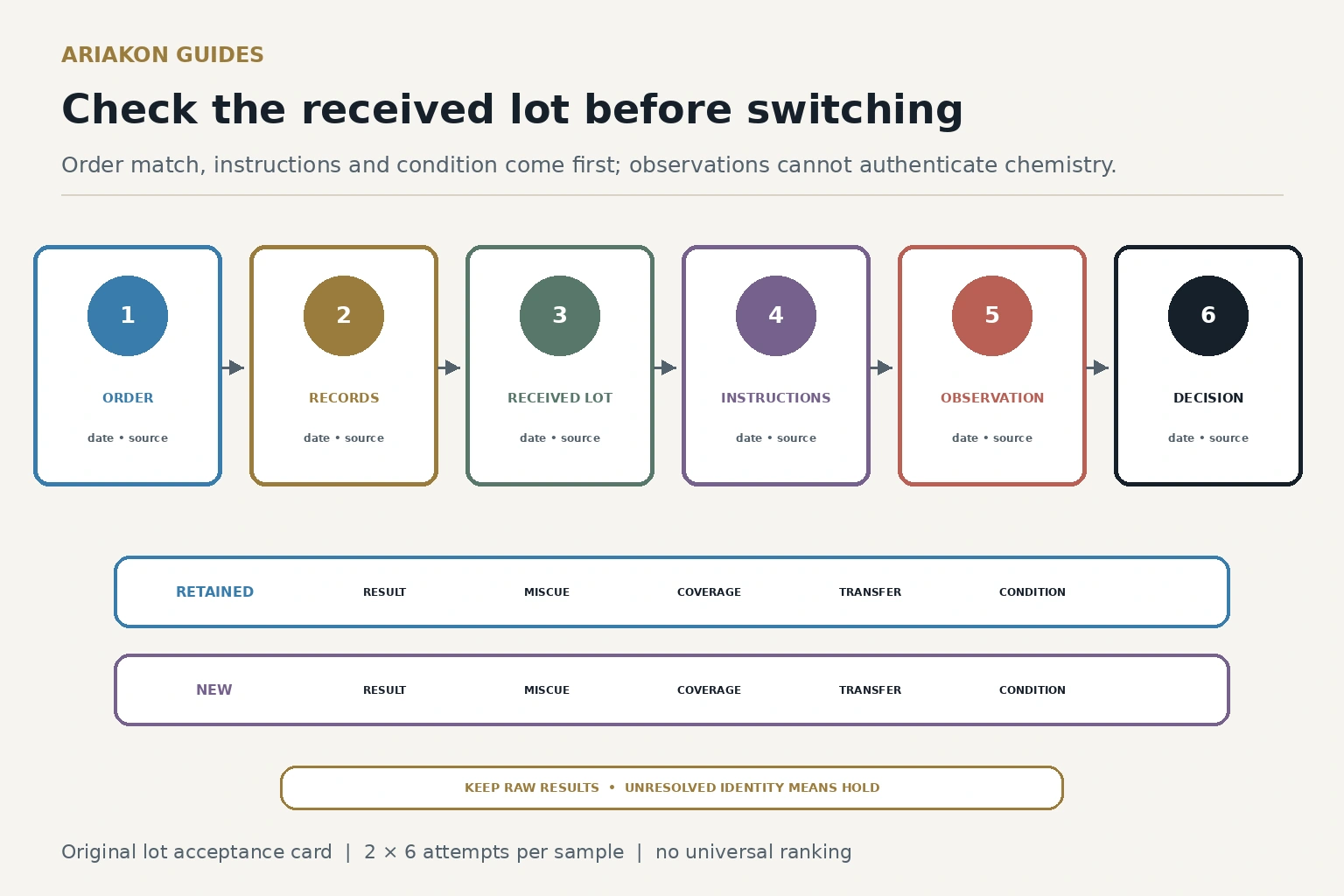
Keep the receipt, retained sample and new item separate
Use RETAINED and NEW on your private record, not invented laboratory codes that imply testing occurred. Preserve the sealed package when a mismatch might require return evidence. A missing lot number is not proof of counterfeit manufacture; a familiar wrapper is not proof of genuine identity. Ask the documented seller or maker to resolve uncertainty before putting an unidentified material on your tip.
| Field | Retained match sample | New received sample |
|---|---|---|
| Identity | Actual label and purchase record if available | Order description, received label and package photographs |
| Lot and date | Marking or explicit unknown | Marking or explicit unknown; receipt date |
| Condition | Storage history, wear and visible contamination | Seal, damage and received condition |
| Instructions | Current documented use for that product | Supplied instructions and any changed directions |
| Mismatch | What is already uncertain | Difference requiring seller or maker clarification |
Use the general chalk comparison guide for choosing between different products rather than accepting a received replacement.
Resolve four gates before shooting
Do not clean aggressively just to complete a comparison. If a safe reset between samples is unavailable, stop this single-tip trial. Different tips can be observed separately, but their results are confounded and cannot establish a chalk-lot effect. Keep receipts and correspondence; do not assume a return, refund or stock policy.
| Gate | Proceed when | Hold when |
|---|---|---|
| Order match | Received identity and contents match the documented order | Wrong item or unresolved label difference |
| Use permission | Actual instructions and venue rules permit the intended use | Unknown tip compatibility or venue restriction |
| Condition | Sample and sound installed tip are usable | Contamination, broken bond or structural concern |
| Reset plan | Safe maker-permitted removal of old chalk is documented | Changing samples would require unapproved abrasion, solvent or reshaping |
Observe two six-attempt blocks per safe sample
Use a 100 × 50 inch playing area and 2.25 inch balls in this example. Coordinates describe ball centers in units of 12.5 inches, with x=0–8 along the length and y=0–4 across the width. Set C=(5,1), O=(6,2), real corner pocket P=(8,4). The contact cue-ball center G=(6−0.18/√2,2−0.18/√2) is one ball diameter behind O on the same straight line.
Use a familiar straight stop shot without side spin. A stop success requires a target-pocket pot, no scratch and a resting cue-ball center within radius 0.125 units of G. No cushion contact is prescribed. Reset ball centers for each attempt, keep the same sound cue/tip and speed intention, and apply a normal even coating before every shot using the actual documented method.
Run six retained-sample attempts then six new-sample attempts in the first session. In a later comparable session reverse the order: six new then six retained. That gives 12 attempts and 12 applications per sample,24 attempts total. Inspect cue-ball transfer after each six-attempt block under the same light; record both inspections. Clean only with the ball maker’s permitted method at the same declared reset points. A miscue is an event to record and inspect, not an invitation to push contact farther from center.
Keep five outcome lines instead of a winner score
Hypothetical example: RETAINED has 11 pots,9 qualifying stops,0 miscues,12 even applications and visible marks in 1 of 2 inspections. NEW has 10 pots,9 stops,0 miscues,11 even applications and marks in 2 of 2 inspections. The stop tallies are equal, but application and transfer observations differ. This tiny personal record cannot identify formulation, quantify miscue risk or prove one lot inferior.
| Line | Count or record | Limit |
|---|---|---|
| Shot result | Pots 0–12; qualifying stops 0–12 separately | Stops cannot exceed pots |
| Miscues | Count and attempt number | Delivery and tip condition may be responsible |
| Coverage | Even pre-shot applications 0–12 | Appearance does not quantify friction |
| Transfer | Cue-ball marks at two block inspections | Residue is not an accuracy measure |
| Physical condition | Crumbling, damage or interrupted application | Two sessions do not establish service life |
Make the receiving decision and preserve the evidence
If the gates pass and ordinary use is predictable, you can adopt the received sample provisionally and keep the record. If identity or instructions remain unresolved, retain the familiar safe sample and request clarification with package photos and the receipt. If only handling differs, repeat the relevant observation rather than declaring a chemistry change.
Save the raw attempts, two inspection notes, dates, cue/tip condition and the exact decision. This lot acceptance sheet adds a receiving boundary to the general chalk comparison method; it does not replace detailed application training or create an Ariakon inventory claim.
Review the chalking habit when coverage is inconsistent before interpreting the lot.
Inspect tip condition when a miscue or edge concern interrupts the trial.
Sources and further reading
References support the specific factual information above. The practical checklists are Ariakon editorial guidance.