
Player lessons · 3 min read
Build Pool Versatility Across Four Disciplines
Different pool games expose different decisions. A repeatable delivery can transfer between them, while position routes, legal targets and scoring demands change. This original four-session cycle keeps one common fundamentals test and gives each session its own planning question. It makes no claim about a named player’s career or a universal rate of improvement.
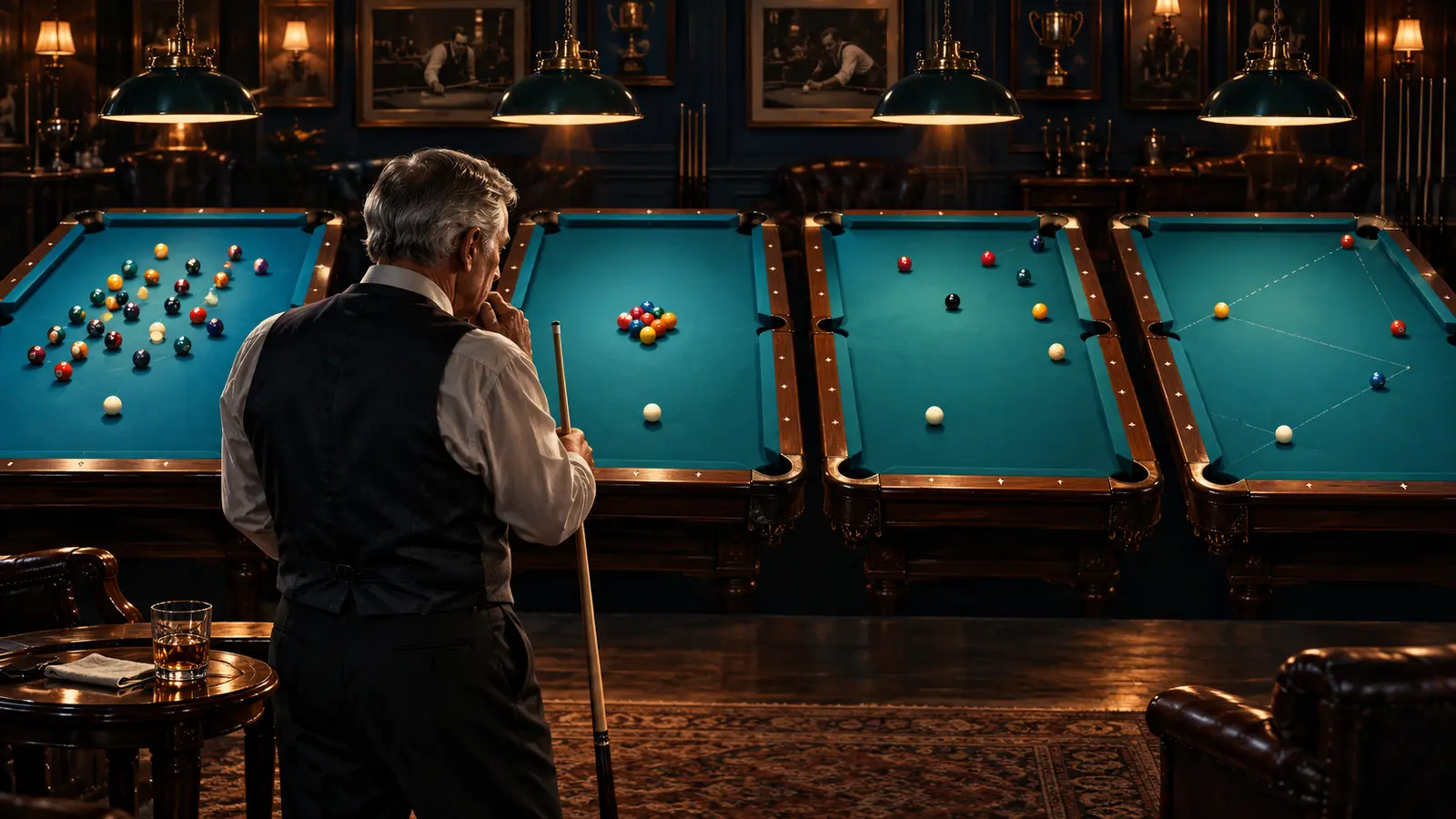
Keep one common test across the cycle
Choose a short straight shot that can be reset accurately. Before each session, take ten attempts with the same cue, pocket, ball centers and comfortable speed. Score one point for a legal pocket and one for the cue-ball center stopping inside a two-ball-wide target centered at its object-ball contact position. Maximum twenty per session. Record the miss direction and table conditions.
This baseline is an original comparison card, not a rating, a published exam or proof that a discipline caused a change. If the table or equipment changes, label the new condition rather than mixing scores.
Build fundamentals that travel
Straight pool rewards small patterns and cluster control. Nine-ball demands rotation routes and recovery. Eight-ball adds group selection, while one-pocket and bank pool make speed, rails and defense central.
The common layer is a repeatable delivery, accurate cue-ball contact and honest speed control. Test those fundamentals in more than one game so a familiar table pattern is not doing all the work.
Rotate strategic demands
Use one session for open-table offense, one for safeties and escapes, and one for banks, clusters or pocket-specific routes. Keep one scored baseline across the cycle.
A change of discipline should reveal a weakness, not erase measurement. Record why turns end and bring the repeated error back to a fixed drill.
Practice the transition between speeds
Multi-discipline play requires more than powerful break speed or soft touch alone. Move deliberately between lag speed, pocket speed, firm position routes, banks and break shots while keeping cue delivery organized.
Use a speed ladder on one familiar layout. The target is predictable cue-ball travel at each band, not making every shot with the same stroke.
Treat conduct as part of every format
Read the active game rules, acknowledge fouls, follow the event’s calls and give the opponent space to shoot. A practice format does not excuse moving a live ball, delaying a turn or inventing a rule after a disputed result.
Use the same reset after an error: record the actual event, choose the next legal decision and continue the routine. Do not use a biography, reputation or equipment endorsement as performance evidence.
Run a four-session versatility cycle
Use the current published rules for the chosen game, and define any solo modification before scoring. Keep each discipline’s results separate. The twenty-point shared baseline may be compared across the cycle only when its setup and conditions match.
At the end, choose the repeated error that appeared in at least two contexts and design one fixed table test for it. A common miss may reflect shared delivery; a miss confined to one game may require a game-specific decision test. The cycle supplies a next question, not a guaranteed improvement.
| Session | Distinct reader task | Record |
|---|---|---|
| 1 Straight pool | Preserve a break ball and a workable key-ball angle | First failed pattern link |
| 2 Rotation | Reach the next legal numbered ball | Legal first contact and position miss |
| 3 Eight-ball | Choose a group pattern with traffic resolved | Problem ball and escape option |
| 4 Bank practice | Calibrate one rail and compare a safety | Called cushion, pocket result and safe leave |
Sources and further reading
References support the specific factual information above. The practical checklists are Ariakon editorial guidance.