
Practice games · 4 min read
Build a Two Player Pool Practice Game With Clear Scoring
A two-player practice game needs more than a catchy name. It needs identical tasks, a stable reset, equal attempts, transparent points and a rule for ties or mismatched skill. This four-station circuit keeps both players active while producing a score that identifies what to practice next. It is an original training format, not a reproduction of a competitor's named game.
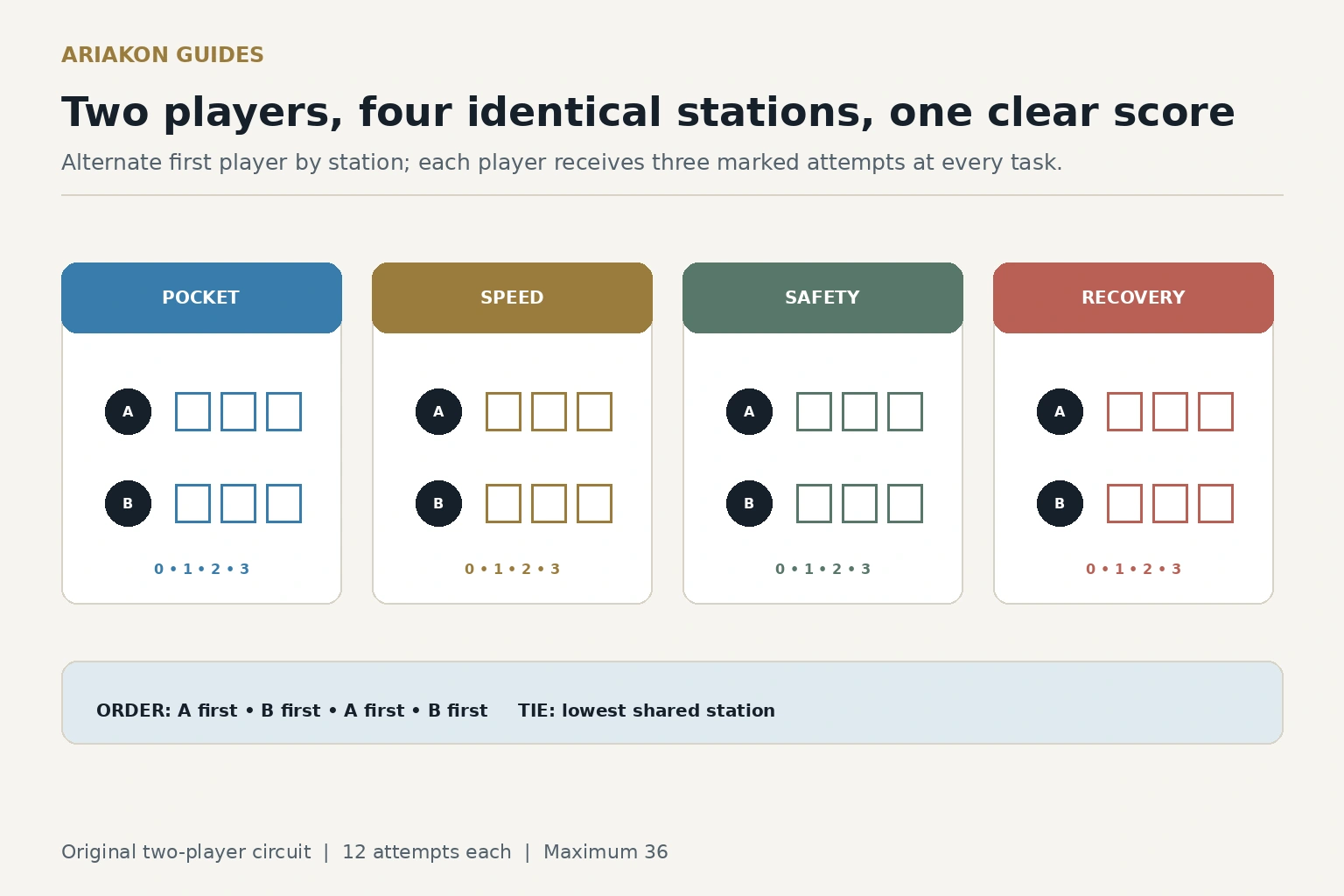
Build four marked skill stations
| Station | Exact task | Attempts each | Primary evidence |
|---|---|---|---|
| Moderate cut to called corner; cue ball stays in table-center box | 3 | Pocket and control | |
| Speed | Cue ball rolls one rail into a two-diamond target zone | 3 | Short, zone or long |
| Safety | Legal thin contact; cue ball finishes behind blocker | 3 | Contact, cover and distance |
| Recovery | One-rail kick to called half of object ball | 3 | Rail, contact half and leave |
Choose other measurable practice games when the group wants a different skill emphasis.
Freeze the reset and turn order
Record every ball center and target boundary, then remove all physical aids before each strike. Player A takes one attempt, the table is reset, then Player B takes the same attempt. Alternate who shoots first at each station: A first at Pocket and Safety; B first at Speed and Recovery. No player receives a second attempt before the other completes the same numbered attempt.
Use one current ruleset for fouls and legal contacts. A moved marker, bad reset or outside interruption produces a no-score replay before either player sees the next layout. Coaching waits until both players finish the station.
Write the exact station card before either player scores
For each of the four task labels, record all centers, game/first legal target, pocket or required cushion order, finite primary-success boundary and finite cue-center finish/control boundary. Inspect that both players can attempt it safely with ordinary delivery. A caption such as moderate cut is a task family, not a reset coordinate. Use one agreed version for all six turns at that station.
At Speed, the primary result is a safe one-rail return into its called target zone; the control bonus is the separately called smaller inner zone. At Safety, primary requires a complete legal shot and called cover, and the bonus adds the predeclared separation. At Recovery, primary requires a complete legal hit on the called half and the bonus requires its declared cue-center zone. Unknown required evidence leaves nested points unscored. A kick rail before contact does not satisfy a later rail requirement.
Use one scoring language
| Points | Result | Examples |
|---|---|---|
| 0 | Known foul, wrong first contact or wrong required route | Scratch, wrong ball or missed required cushion |
| 1 | Legal task begins but primary result misses | Known cue-only route outside its finish zone; legal safety without called cover |
| 2 | Called primary result succeeds | Pocket made, target contacted or called kick half reached |
| 3 | Primary result plus control condition | Pocket plus center box; legal safety plus cover and distance |
Play to thirty-six, then read the station totals
Twelve attempts create a maximum of 36 points per player. The higher total wins the circuit, but the useful practice result is the four station subtotals out of 9. A player who scores 30 overall but 4 on Recovery has a clearer next assignment than a player who hears only that the match was close.
Tie-break with one attempt at each player's lowest shared station. If the lowest stations differ, use the station with the smaller combined subtotal. Alternate first player again. Continue sudden-death rounds only if both players want competition; the training evidence is already complete.
Balance unequal players without changing geometry
| Observed gap after two circuits | Adjustment | Why it stays comparable |
|---|---|---|
| 0–5 points | No handicap | Normal session variation |
| 6–10 points | Lower scorer may replay one zero per circuit | Same layout and capped help |
| 11–15 points | Lower scorer receives one bonus point at each passed station | Rewards demonstrated primary results |
| More than 15 | Play cooperative team target of 50 | Shifts goal from mismatch to joint improvement |
Work a sample score
Player A scores Pocket 8, Speed 5, Safety 6 and Recovery 4 for 23. Player B scores 6, 7, 4 and 5 for 22. Player A wins the circuit, but both return to different five-shot blocks: A practices one-rail recovery contact; B practices safety cover. The rematch starts only after each player completes that assignment.
Keep the same station card for three sessions before redesigning it. Changing the task every turn removes the fixed comparison; preserve the version and reset before interpreting a station subtotal.
Transfer the circuit into ordinary play
Finish with one short alternate-shot rack. Before each shot, the non-shooter identifies which station family applies: Pocket, Speed, Safety or Recovery. The shooter calls the primary result and cue-ball condition. Score the team 1 point for a correct family and 1 for the completed call; stop at ten decisions.
The transfer round does not decide the circuit winner. It checks whether the station language helps both players recognize the same skills in changing layouts.
Sources and further reading
References support the specific factual information above. The practical checklists are Ariakon editorial guidance.