
Practice planning · 3 min read
Build a Pool Practice Plan for Limited Table Access
Limited table access makes setup time expensive. The answer is not to cram every weakness into one visit; it is to decide the question, diagram the setup and prepare the scorecard before the clock starts. This four-week worksheet assumes two forty-five-minute table sessions and three ten-minute off-table blocks per week. Substitute your real minutes, but keep one priority and one measurement long enough to learn from them.
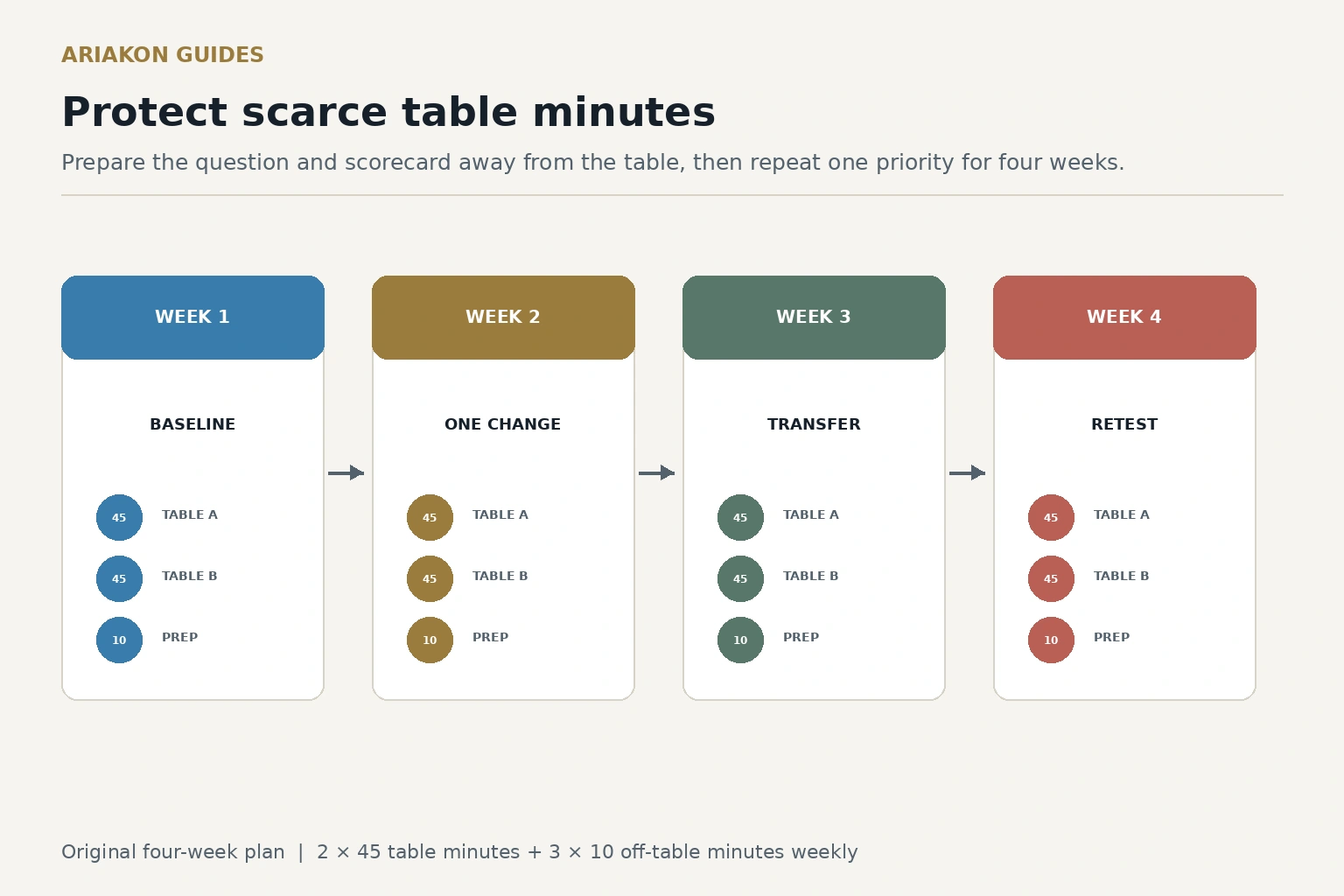
Inventory minutes before choosing drills
| Window | Minutes | What belongs there | What does not |
|---|---|---|---|
| Table A | 45 | Baseline and isolated skill | Searching for a drill |
| Table B | 45 | Retest and game transfer | Several new techniques |
| Off-table 1 | 10 | Choose question and diagram setup | Pretend stroke repetitions |
| Off-table 2 | 10 | Review signed misses and source | Invented test results |
| Off-table 3 | 10 | Prepare next scorecard | Changing the goal without evidence |
Write a measurable pool practice goal before spending a scarce table window on an unscored activity.
Use a slump reset when performance has changed rather than treating ordinary scheduling limits as a performance diagnosis.
Give every table visit the same four blocks
| Block | Minutes | Task | Evidence |
|---|---|---|---|
| Calibrate | 5 | Five familiar center-ball shots | Signed finish |
| Priority | 25 | One setup; 20 scored attempts | Score plus miss direction |
| Transfer | 10 | Five game-like attempts | Decision and result |
| Close | 5 | Total, photograph marks, write next action | Complete log |
Run one question through four weeks
| Week | Session A | Session B | Decision |
|---|---|---|---|
| 1 | Baseline the fixed setup | Repeat without a technique change | Name the stable miss |
| 2 | Change one variable | Repeat the same change | Keep or remove it |
| 3 | Narrow the target | Add the next shot | Check transfer |
| 4 | Return to baseline | Final transfer set | Set the next four-week priority |
Prepare the table before you arrive
The off-table card contains the exact ball coordinates, target size, attempt count, point rules, one current technical source and the previous session's signed misses. Pack removable markers, a pencil and the same score sheet. Do not rely on memory for the setup.
Watching instruction is preparation only when it answers the current question. Stop after one primary or clearly attributed technical source, write the one variable you will test, and protect the next table visit from browsing.
Work a realistic two-session example
A player has ninety table minutes per week and wants better draw-distance control. Week 1 scores the same twenty-shot draw ladder twice. Both logs show pocket success but long finishes in the shortest band. Week 2 reduces only delivery speed for two sessions. Week 3 adds a second object ball to the passed band. Week 4 repeats the original twenty shots, then plays five two-ball transfers.
The plan produces 160 comparable priority attempts in four weeks, plus forty transfer attempts, without claiming the score will improve. If a session is missed, the player resumes the numbered session; the calendar date changes, but the evidence sequence does not.
Use a simple continuation rule
| Result across two sessions | Meaning | Next four weeks |
|---|---|---|
| Score and miss pattern improve | Change may be repeatable | Narrow target or add transfer |
| Score stable; pattern narrows | Control is becoming more consistent | Keep setup one more cycle |
| Score and pattern scatter | Setup or variable is not controlled | Simplify and rebaseline |
| Priority no longer matters | Reader task changed | Write a new goal before booking drills |