
Practice planning · 3 min read
Build a Pool Improvement Loop From Learning, Observation and Verification
Learning can feel productive while leaving play unchanged. A useful improvement loop links one source claim to one observed error, turns it into a measurable test and asks whether the result transfers beyond the practiced layout. This worksheet is narrower than a general list of improvement habits: it is a repeatable evidence path for deciding what to keep, revise or discard.
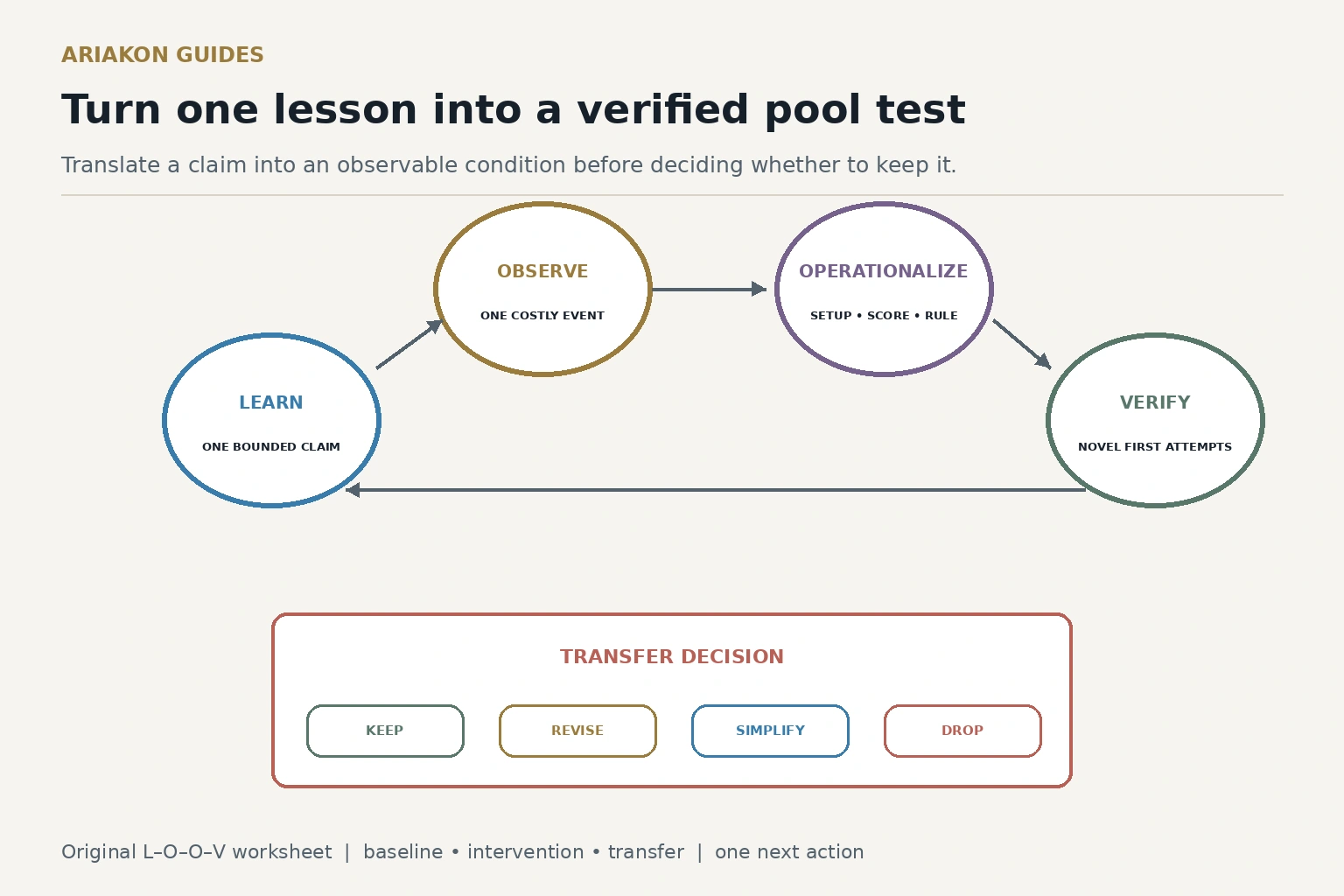
Start with one claim you can test
Write the source, date and exact claim in your own words. Mark whether it is a rule, manufacturer fact, coaching suggestion or personal hypothesis. A credible source does not make every application correct, and a useful idea still needs a condition.
Convert the claim into an if–then question: “If I name the cue-ball side before bending on this route family, then my first-attempt finishes should cluster more often in the intended half-table.” Avoid words such as smoother, better or confident unless you define an observable proxy.
Choose high-leverage improvement work before committing a full practice block.
Calibrate shot judgment when the decision forecast may be the costly event.
Use the L–O–O–V worksheet
| Stage | Write | Gate |
|---|---|---|
| Learn | One bounded source claim | Can it be stated without copying or exaggerating? |
| Observe | One costly event and its conditions | Was it seen often enough to test? |
| Operationalize | Setup, attempts, measure and decision rule | Could another player repeat it? |
| Verify | Novel layouts and first-attempt results | Did the effect survive changed conditions? |
Run three sessions with fixed measures
Keep equipment, approximate speed and scoring unchanged, and record the layout order. Familiarity with a repeated sequence can change the result, so do not assume one varied schedule is always superior. The transfer session asks whether the cue remains useful when the exact rehearsal is gone.
| Session | Design | Score |
|---|---|---|
| 1 — baseline | Three layouts × four attempts without the new cue | Intended line and broad finish zone, 0 or 1 each |
| 2 — intervention | Same layouts × four attempts with one cue | Same score plus process used, 0 or 1 |
| 3 — transfer | Six related new layouts × one attempt | First-attempt line, zone and decision |
Choose one of four next actions
Do not add a second intervention to rescue the first result. Preserve the failed record; it prevents recycling the same vague idea and can reveal that the original observation was poorly defined.
| Pattern | Next action |
|---|---|
| Practice and transfer both improve | Keep the cue for one longer block |
| Practice improves; transfer does not | Change variety or simplify the cue |
| Process is inconsistent | Reduce the cue to one observable action |
| No useful difference | Drop the idea and test a new hypothesis |
Worked example: from lesson to transfer
A player learns to name the intended side of the position line before choosing speed. Observation shows that medium one-rail routes cross to the wrong side in 7 of 12 baseline attempts. The operational test uses three marked layouts, scores line side and broad zone, and changes only the standing verbal cue.
The intervention improves combined scores from 11 of 24 to 17 of 24. On six new layouts, four finish on the intended side and three reach the broad zone. The player keeps the cue for another week but records that speed remains the limiting variable. The next loop tests speed inside the same route family instead of declaring the whole position game fixed.
Sources and further reading
References support the specific factual information above. The practical checklists are Ariakon editorial guidance.