
Practice planning · 3 min read
Build a Pool Game Around Strengths Without Ignoring Weaknesses
Playing to strengths does not mean practicing only comfortable shots, and fixing weaknesses does not mean rebuilding everything. Use scored evidence to identify what reliably wins decisions, what repeatedly costs innings and what merely feels awkward. Then assign separate doses for maintenance, repair and game transfer.
Build a ten-skill evidence baseline
Freeze the setup and scoring for each fixed task before collecting the baseline. A score is a repeatable snapshot under those conditions, not a permanent identity. Add match notes because a closed test and a live decision measure different things.
Rate each skill reliable, developing or costly only after collecting all three observations. Do not turn a favorite shot into a strength without transfer evidence or call one miss a weakness.
| Skill family | Fixed evidence | Variable or match evidence |
|---|---|---|
| Straight delivery | Marked straight shots | Distance and speed changes |
| Pocketing | Both cut directions | Decision under an ordinary rack |
| Stop/follow/draw | Declared zones | Position result after a choice |
| Speed control | Three distance zones | Leave quality on unfamiliar routes |
| Rail contact | One-rail kick or bank baseline | Recovery decision |
| Pattern choice | Three-ball planning | First avoidable route error |
| Safety | Declared object/cue-ball leave | Opponent difficulty created |
| Break | Legal contact and cue-ball result | Playable opening decision |
| Routine | Observable checklist | Survival after a miss or wait |
| Administration | Rules and score awareness | Correct action in competition |
Organize the broader practice system before assigning weekly doses.
Run a ten-skill baseline when you need a compact starting assessment.
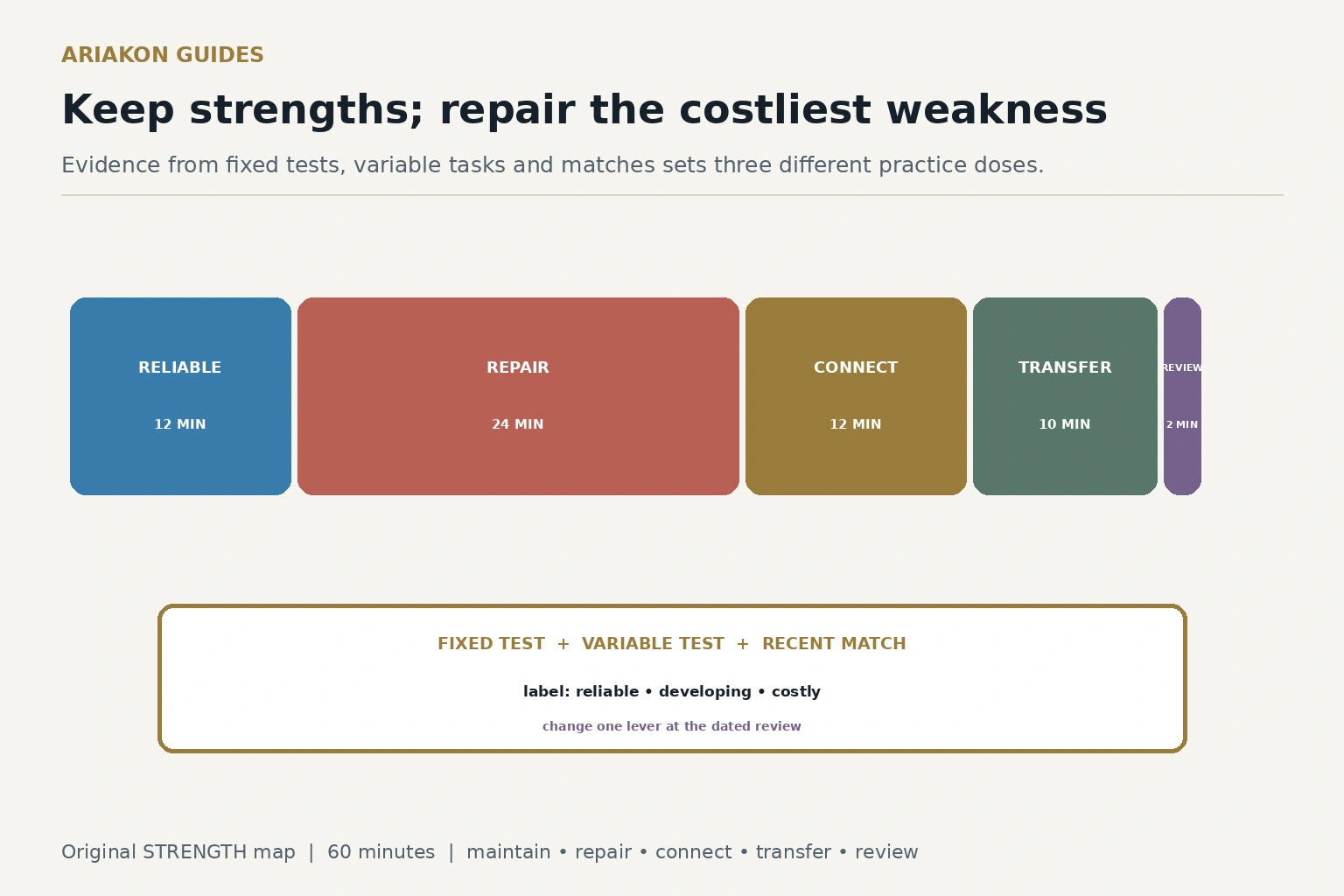
Allocate a 60-minute STRENGTH session
The high-cost weakness is the one that recurs and changes innings, not necessarily the skill with the lowest raw score. If long draw is weak but rarely required in your current game, while speed errors repeatedly block the next ball, speed control receives the repair block.
AASP guidance supports specific, observable, measurable and time-bounded goals plus written monitoring. Use those principles for the practice behavior, while keeping the match outcome as separate evidence.
| Block | Minutes | Purpose | Progress rule |
|---|---|---|---|
| Reliable strength | 12 | Maintain timing and confidence | Stop before careless repetition |
| High-cost weakness | 24 | One marked setup and one changed variable | Advance only after the stated score |
| Supporting skill | 12 | Connect strength to the repaired weakness | Record the first failed component |
| Variable transfer | 10 | Three- or six-ball decisions | Do not force the practiced shot |
| Review | 2 | One result and one next action | Change one lever only |
Worked four-week map
Hypothetical baseline: the player's stop shot and safety leaves are reliable; medium-speed position is developing; right-to-left cuts create the first avoidable miss in five recent racks. She keeps twelve minutes of stop and safety maintenance, assigns 24 minutes to one marked right-to-left cut ladder, connects that cut to position for twelve minutes and finishes with variable three-ball patterns.
After four weekly sessions, fixed-cut results rise from 13/24 to 19/24, but variable patterns remain 8/18. the player keeps the strength block and moves the repair task into more variable starting positions rather than declaring the weakness solved. If the fixed score had not moved, the next action would be instructor/video diagnosis of setup and delivery, not simply more repetitions.
Sources and further reading
References support the specific factual information above. The practical checklists are Ariakon editorial guidance.