
Practice planning · 3 min read
Build a Local Pool Practice Community Through Social Groups
A local social group becomes useful when it produces safe, specific practice sessions rather than a large silent member count. Start with one table task, one confirmed venue and one short pilot. Make skill level, capacity, costs and conduct visible before anyone travels, then measure attendance and completed practice—not reactions to the post.
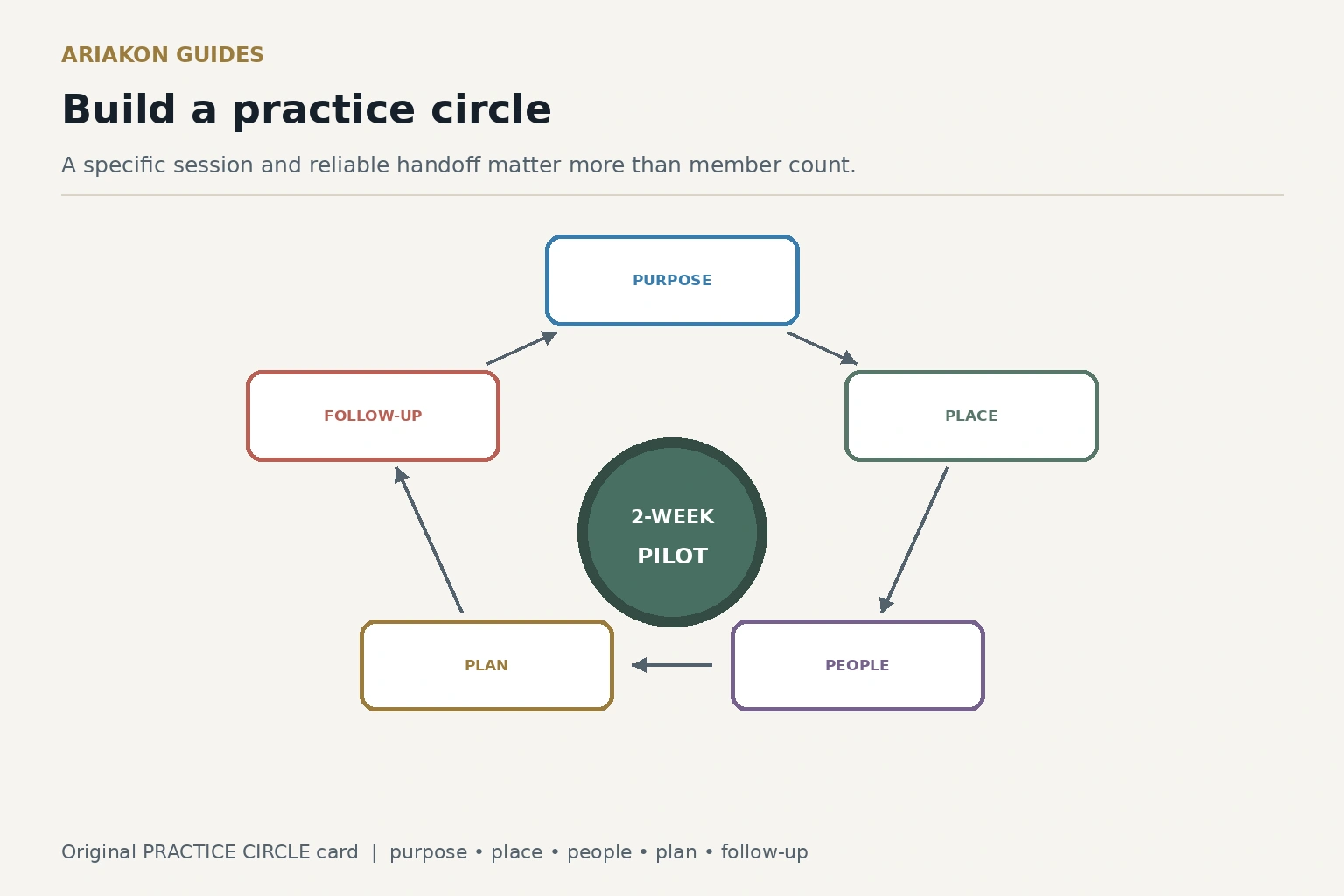
Build the PRACTICE CIRCLE card
Use an established local league or room as a discovery path when appropriate. APA's current help material directs players to a locator and local League Operator; that confirms a contact route, not an Ariakon relationship or an automatic place on a team.
Do not publish private phone numbers, exact home addresses or photos of members without permission. For a home table, share the address only with confirmed invitees and state household boundaries before the session.
| Field | Write before posting | Observable check |
|---|---|---|
| Purpose | One task, such as stop-shot speed or match routines | Everyone can describe the session in one sentence |
| Place | Venue, table rules, accessibility and confirmed permission | Host acknowledges the booking or walk-in plan |
| People | Skill range, capacity and whether guests are allowed | No one arrives expecting a different audience |
| Plan | Start time, duration, drill blocks and rotation method | Every player receives declared table time |
| Follow-up | RSVP deadline, cancellation channel and next-session decision | A named organizer closes the loop |
Build a reliable pool learning feed for choosing and verifying instruction sources.
Run productive pool team practice when the group is ready for structured table work.
Run a two-week pilot, not an endless invitation
Cap the pilot at the number the venue and tables can serve. On one table, four to six players may be manageable only when the rotation is written and the off-table task is useful. A bigger chat is not evidence that a bigger session will work.
Worked example: twelve people react to a post, six RSVP, four attend, and all four complete the baseline. Two say the 90-minute duration worked; two request a beginner lane. The next action is another four-person session with two marked difficulty levels—not recruiting twenty more members.
| Session | Primary task | Record after 60–90 minutes |
|---|---|---|
| 1 | Skill introductions and one shared baseline | Arrivals, completed turns and one safety issue |
| 2 | Paired drill at two difficulty levels | Partner fit and idle time |
| 3 | Short race or score challenge | Rule questions and table pace |
| 4 | Member-chosen repeat | Return interest and one change request |
Keep or change the group from evidence
A local community is successful when members know what is happening, feel safe participating and receive useful table time. Keep the roster small until the process—not just the post—works consistently.
| Signal | Interpretation | Next action |
|---|---|---|
| Most RSVPs attend and rotate cleanly | The format is reliable enough to repeat | Keep size and cadence for one month |
| People attend but wait too long | Capacity exceeds table time | Reduce seats or add a confirmed table |
| Skill gap blocks shared drills | One task is serving two audiences poorly | Create labelled lanes, not status labels |
| Venue or conduct rules are disputed | The boundary was unclear | Pause and get the host's written rule |
Sources and further reading
References support the specific factual information above. The practical checklists are Ariakon editorial guidance.