
Banking and kicking · 2 min read
Calibrate Back-Cut Bank Shots Instead of Guessing
A back-cut bank sends the cue ball away from the target pocket while the object ball travels to a cushion and returns toward it. Mirror geometry gives you a starting line, not a promise. Cut-induced spin, speed, rail response and cloth condition can move the bank enough to matter, so the reliable skill is calibration.
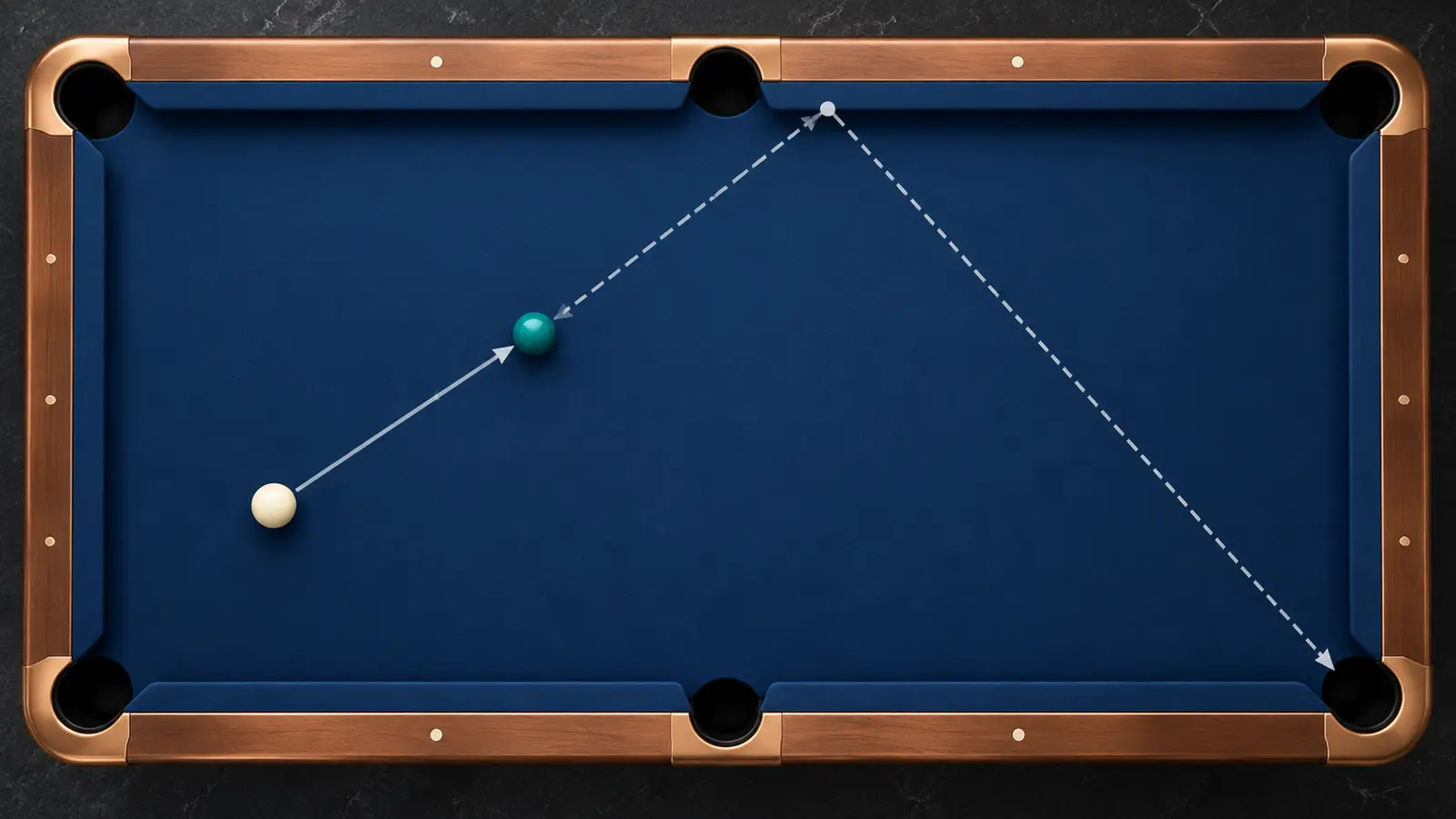
Recognize the back-cut picture
The cue ball begins nearer the target-pocket side than the object ball, and your hit cuts the object ball back toward the banking rail. First confirm that the cue-ball path has room and that the bank is worth choosing over a safety.
Call the ball, cushion route and pocket when the rules or situation require clarity. Current WPA bank-pool rules define a valid bank precisely and exclude accidental extra cushion or ball contacts.
Plot a geometric starting line
Imagine the target pocket reflected through the banking cushion. Draw a line from the object ball to that reflected target; where it meets the cushion is the geometric reference.
That equal-angle picture assumes ideal behavior. Use it to organize the shot, then let measured table results supply the correction.
Control the variables
Begin with center cue-ball contact and a comfortable medium speed. Mark both ball positions with removable reinforcements or a reusable template. Change only the aim point until the bank approaches the pocket consistently.
Cut angle can transfer spin to the object ball, and cushion compression varies with speed. Added sidespin creates another interaction, so leave it out until the center-ball version is repeatable.
Read the miss at the pocket
Record which jaw the object ball reaches and whether the cue ball stayed safe. Move the cushion contact by a small, visible amount; do not make a vague aiming change from memory.
Recalibrate on a different table or after a major speed change. Keep the cut, speed, spin intention and observed cushion point in the log so one changed condition is not mistaken for a universal bank correction.
Build a three-position test
- Set one object ball near, one midway and one farther from the banking rail.
- Use the same pocket and cue-ball speed for all three.
- Shoot five center-ball attempts from each layout.
- Write down the successful cushion reference for each.
- Repeat once at a softer speed and compare.
- Finish by choosing bank or safety from three random layouts.
Sources and further reading
References support the specific factual information above. The practical checklists are Ariakon editorial guidance.