
Practice planning · 2 min read
Adapt Pool Practice for an Adult Returning After Many Years
A returning adult may remember patterns and rules while current timing, vision, mobility or practice tolerance has changed. Do not treat old peak ability as today's baseline. This guide is for re-entry after years away; the broader adult-learning guide explains how to acquire a new skill at any age.
Open with a current-state card
| Field | Record now |
|---|---|
| Comfort | Standing, reaching and bridge positions that feel ordinary |
| Equipment | Cue, tip, vision aid and table access actually available |
| Knowledge | Rules and patterns remembered with confidence |
| Execution | Three shots that are currently repeatable |
| Tolerance | Time before attention or movement quality declines |
Learn pool as an adult without rushing for progressive learning principles.
Build a monthly fundamentals checkup after the return baseline stabilizes.
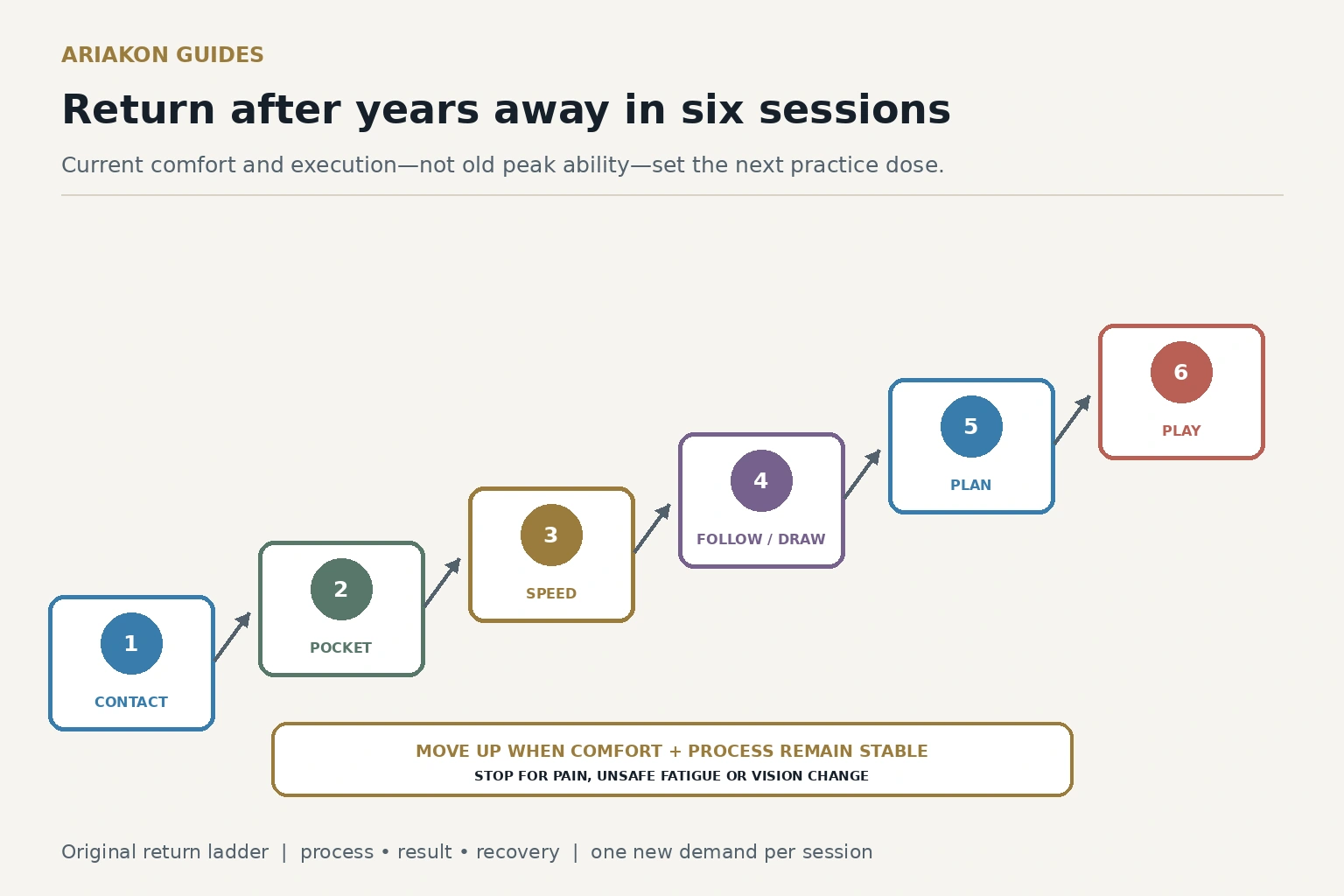
Run six sessions with one new demand at a time
Warm up before scoring and stop when discomfort, vision change or fatigue makes the setup unsafe. Health questions belong with an appropriately qualified clinician, not a pool drill.
| Session | Primary task | Dose |
|---|---|---|
| 1 | Comfort, center-ball contact and stop | 3 × 6 attempts |
| 2 | Pocketing at short and medium distance | 3 × 6 attempts |
| 3 | Three cue-ball speed zones | 6 attempts per zone |
| 4 | Follow and draw one-diamond targets | 2 × 8 attempts |
| 5 | Three-ball planning with broad zones | Four layouts twice |
| 6 | Short race or ghost set | One bounded set |
Score process, result and recovery separately
Each six-attempt block offers eighteen points. There is no universal passing score. Compare only repeated conditions and move up when technique and comfort remain stable, not merely because one ball was made.
| Column | One point when |
|---|---|
| Process | Plan and ordinary routine complete |
| Result | Pocket or zone requirement met |
| Recovery | Next attempt begins without rushing or over-correcting |
Treat equipment changes as separate experiments
An older cue may still fit, but inspect the tip, ferrule, joint, shaft and wrap before play. If a modern shaft or different tip is introduced, run it after a baseline rather than using it to explain every early miss.
Record table size, cloth pace and ball condition. Faster cloth or tighter pockets can make remembered routes feel wrong even when the planning idea is sound.
Worked return: memory is ahead of speed control
A hypothetical returning player scores Process 16/18, Result 13/18 and Recovery 15/18 on short pocketing, but only 7/18 Result points in the three-zone speed session. The player remembers the routes and routine; speed tolerance is the current bottleneck.
The next session repeats speed zones at a shorter distance and postpones draw progression. After two comparable improvements, the player transfers one speed target into a three-ball layout. Old rating, age and one good rack do not replace current evidence.