
Tournament preparation · 3 min read
A Tournament Preparation Checklist for Your First Competitive Weekend
A first tournament weekend creates two kinds of work: playing pool and managing unfamiliar logistics. Prepare the facts, equipment and routine early enough that check-in, match calls and schedule changes do not consume the attention needed at the table.
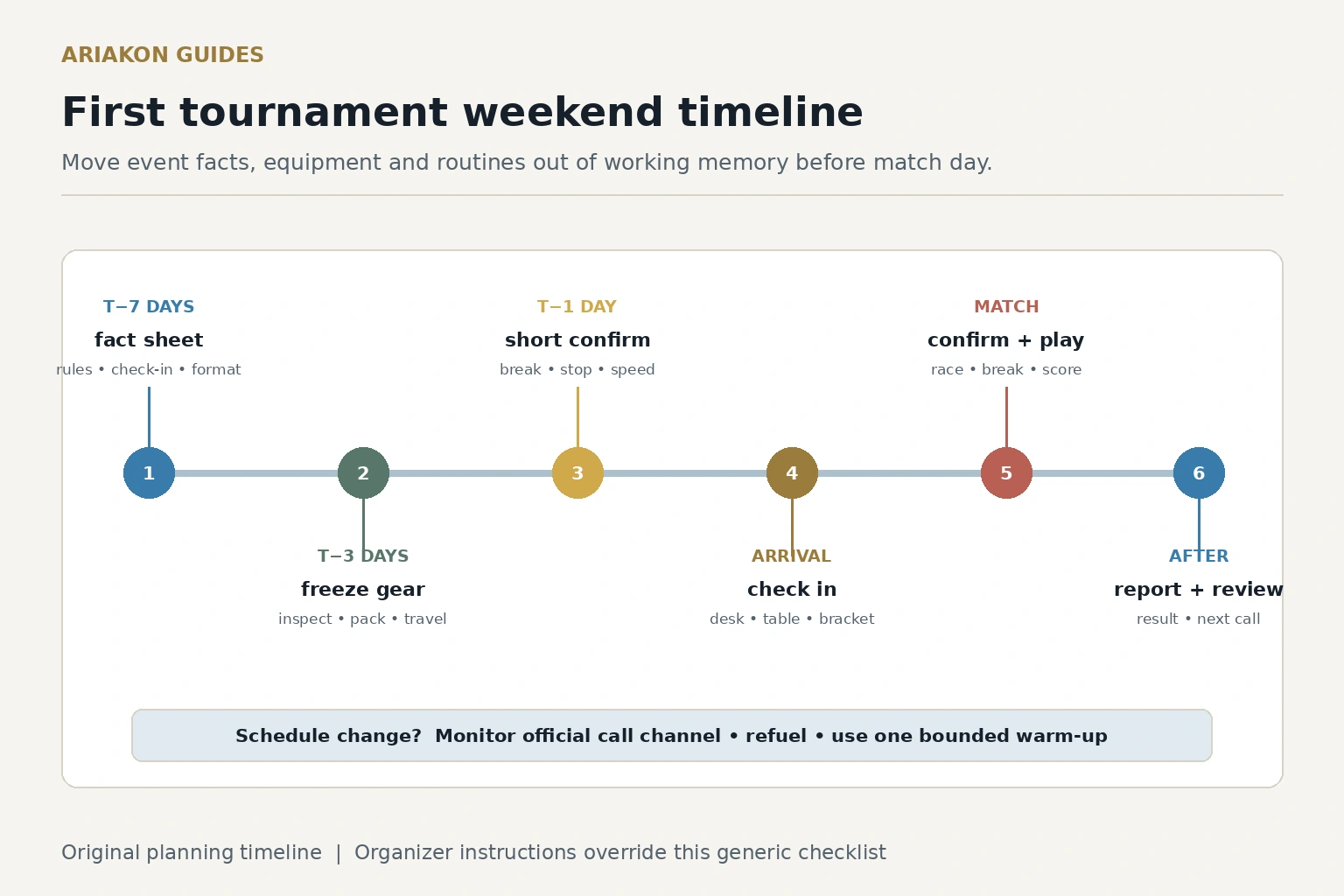
Seven days out: build one event fact sheet
Use the organizer's current page and direct communications to record venue, dates, check-in time, player meeting, game, ruleset, race length, format, dress code, equipment restrictions, entry status, refund terms and official contact. Mark every unknown instead of filling it from another event.
Read the actual event rules. A WPA, league or house rule label does not prove every tournament procedure is identical. Save an offline copy or screenshot of the organizer's current instructions and note the date checked.
Navigate a large pool tournament for venue flow, match calls and administrative procedures.
Three days out: freeze equipment and travel
Inspect cue tips, ferrules or plates, shafts, joints, bumpers and case closures. Pack chalk permitted by the event, a clean towel, any permitted glove, joint protectors and a mechanical bridge plan. Do not install an unfamiliar tip or make a major cue change just before travel unless damage requires service.
Confirm transport, parking, lodging, venue access and meal options. Build enough margin for check-in without inventing a universal arrival time; use the organizer's published deadline and add your own travel buffer.
Pack a compact match-day cue case without adding equipment you have not tested.
Plan tournament food and hydration around the actual venue and schedule.
The day before: use a short confirmation session
Practice the break, five stop shots, five speed-control shots and two common patterns. Stop while the stroke remains normal. The purpose is to confirm equipment and routine, not to rebuild technique or prove readiness through a marathon session.
Place the fact sheet, identification, entry confirmation and equipment together. Charge the phone, but plan to silence it and follow the venue's phone rules during play.
Use a 20-minute pool tune-up for a bounded final confirmation session.
Tournament day: follow the timeline
| Moment | Action | Evidence to confirm | Avoid |
|---|---|---|---|
| Arrival | Check in and locate tournament desk, table area and restrooms | Name appears in field or bracket | Assuming online registration completed check-in |
| Before match | Confirm table, opponent, race and break procedure | Score sheet or app matches the call | Starting from a verbal guess |
| Warm-up | Calibrate speed and pockets with permitted time | One simple observation per condition | Changing the stroke |
| During match | Use the same pre-shot and score routine | Score agrees after every rack | Arguing after the next break |
| Rules question | Stop and ask the official before the disputed shot | Ruling received before play continues | Relying on a spectator |
| After match | Confirm result and next reporting requirement | Result accepted by tournament system | Leaving before the result is recorded |
| Between matches | Refuel, reset and monitor official call channel | Know next match status | Starting a long practice set |
Work through a realistic schedule change
Suppose check-in is complete, but the first match is delayed ninety minutes. Keep the official call channel visible, eat the planned light meal, sit down and take one ten-minute warm-up block only when the match window becomes clearer. Do not leave the venue based on an unofficial estimate.
If the opponent or table changes, reconfirm the race and break procedure. The checklist prevents a delay from becoming a rules assumption or an exhausting practice session.
Review the weekend in three columns
Within twenty-four hours, record what was controlled, what was learned and what needs organizer clarification next time. Separate pool decisions from logistics. A late meal is not a stroke flaw, and a missed shot is not evidence that the packing list failed.
Choose one preparation change and one playing change for the next event. Preserve the fact sheet as a template, but replace every event-specific fact rather than carrying it forward unchecked.
Review a pool loss without guessing when the playing evidence needs its own analysis.
Sources and further reading
References support the specific factual information above. The practical checklists are Ariakon editorial guidance.