
Practice planning · 4 min read
A Balanced Pool Workout for Cueing, Position and Match Play
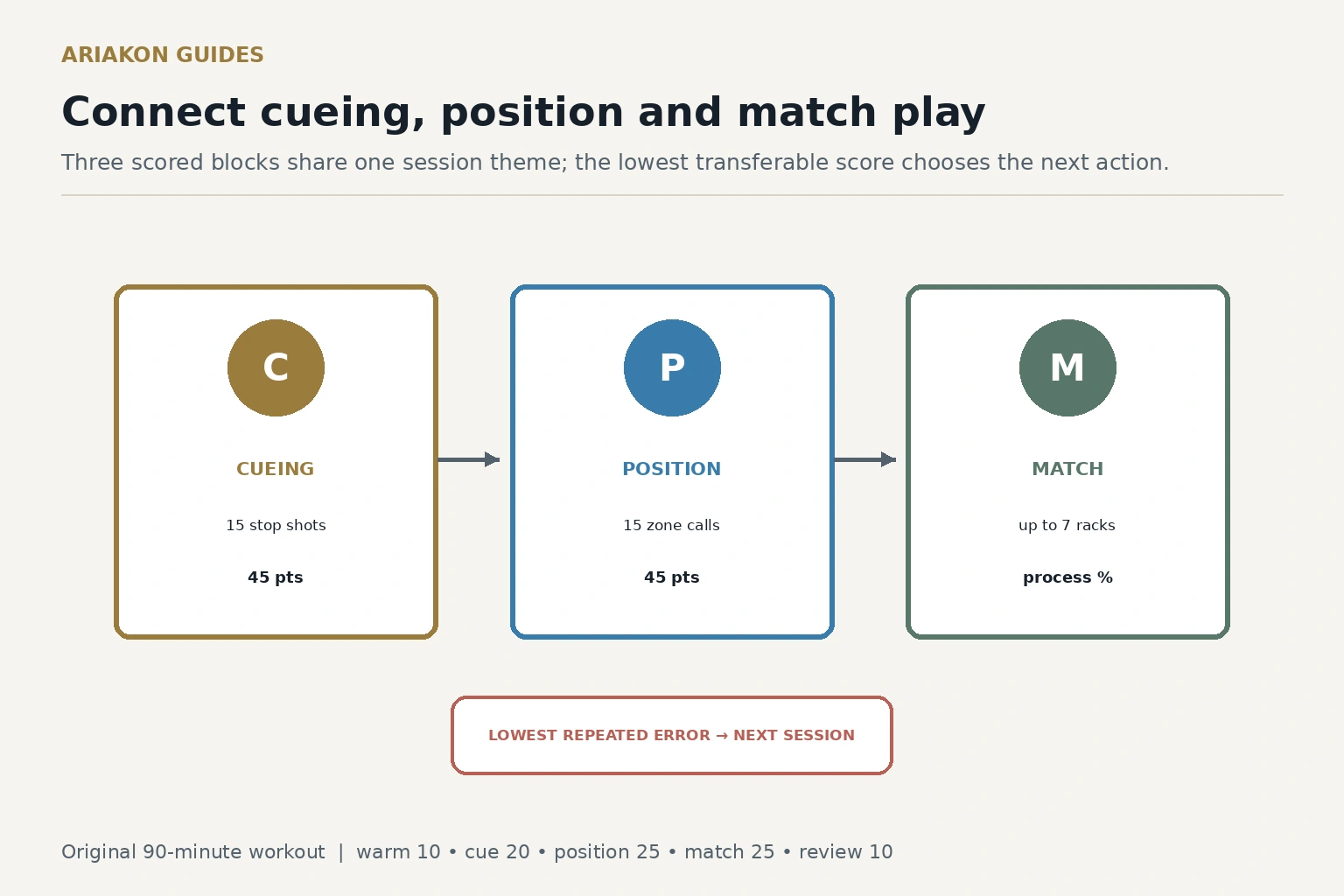
A balanced workout should not mean touching every pool skill briefly. It should give three connected areas enough repetitions to produce evidence: delivering the cue, landing the cue ball and choosing shots in game context. This ninety-minute plan is distinct from a general two-hour schedule because every block shares one vertical-axis contact theme and produces a comparable percentage score.
Prepare one theme and three scorecards
Choose a session theme before placing balls. This version uses the vertical cue-ball axis so position errors are easier to separate from sidespin compensation. Record table, date and conditions. Warm up for ten minutes without scoring, then keep the marked layouts unchanged during each station.
Do not compare raw difficulty between stations. Convert each to a percentage of its own maximum and identify the lowest transferable score. A weak match score may reflect decision-making even when the cueing station is high; that difference is the point of a balanced workout.
Build a productive two-hour session when you need a longer modular schedule.
Play a practice set without sidespin for a complete game constraint.
Block 1: twenty minutes of cueing evidence
Set a straight stop shot with the object ball one diamond from a corner and the cue ball two diamonds behind it. Shoot fifteen attempts. Score one for the called pocket, one for cue-ball center stopping inside a one-ball-wide window and one for a stable finish. Maximum forty-five.
Record forward, backward, left and right cue-ball finishes. If more than three shots leave the corridor, do not make the next station harder. Keep the position targets broad and interpret later errors cautiously because delivery is not yet stable.
For any straight stop-shot score in this guide, center the finish window on the cue-ball center at object-ball contact: one ball diameter behind the object-ball center on the incoming line. The cue-ball starting position is not the stop destination. Keep the window size fixed before the block.
Block 2: twenty-five minutes of position control
Place a half-ball cut to a corner and mark three broad cue-ball landing zones along the natural rolling route: near, middle and far. Shuffle five cards for each zone and shoot fifteen attempts. Use center-axis roll and change only speed. Reset exact ball centers.
Score one for the pocket, one for the called zone and one for avoiding a scratch or collision marker. Maximum forty-five. Record short or long on zone misses. If the cueing block showed directional error, retain that evidence rather than blaming speed for every miss.
Block 3: twenty-five minutes of match decisions
Score five process points per rack: legal first contact, planned first route, danger ball addressed, no avoidable scratch and honest rack result. Stop when either side reaches four rack wins, seven racks have been completed, or twenty-five minutes expires, whichever happens first. Convert points earned to a percentage of points available so an unfinished session is not represented as seven complete racks.
| Before each rack | Rule |
|---|---|
| Layout | Random legal open rack for the chosen game |
| Start | Ball in hand after the break or an agreed open layout |
| Plan | Call first shot, first position zone and one danger ball |
| Win | Run the rack under the chosen rules |
| Table wins | Any miss, foul or unplanned scratch ends the rack |
| Record | Decision quality separately from rack result |
Review for ten minutes and choose one next action
The worked example does not prove a universal standard; it shows how to choose. The position block is lowest and its long misses have a consistent direction, so the next session begins with an eight-shot middle/far speed contrast. The player does not add a fourth topic or replay the successful cueing station for a better-looking total.
The final ten-minute review already includes unscored easy play or cool-down and the written transfer note; do not add another ten-minute block. The complete timetable is 10 + 20 + 25 + 25 + 10 = 90 minutes. Across several sessions, rotate the theme—draw, follow, one-rail position or safety—while retaining the three-block structure.
| Block | Example | Interpretation |
|---|---|---|
| Cueing | 38/45 = 84% | Stable enough; two right finishes |
| Position | 30/45 = 67% | Six called zones finished long |
| Match | 22/30 = 73% | Two route calls changed while down |
| Next action | Middle/far speed contrast | Lowest score with clear repeated error |
Use the Ghost to measure progress when the match block needs a stable longer-term format.