
Mental game · 3 min read
Write a Short Pool Self Talk Script for Mistakes and Pressure
Self-talk is most useful when it is brief, believable and connected to an action you can observe. Write one script before the match instead of improvising an argument after every miss. The general mental-training guide introduces breathing, imagery and instructional cues; this resource builds and tests one mistake-and-pressure response.
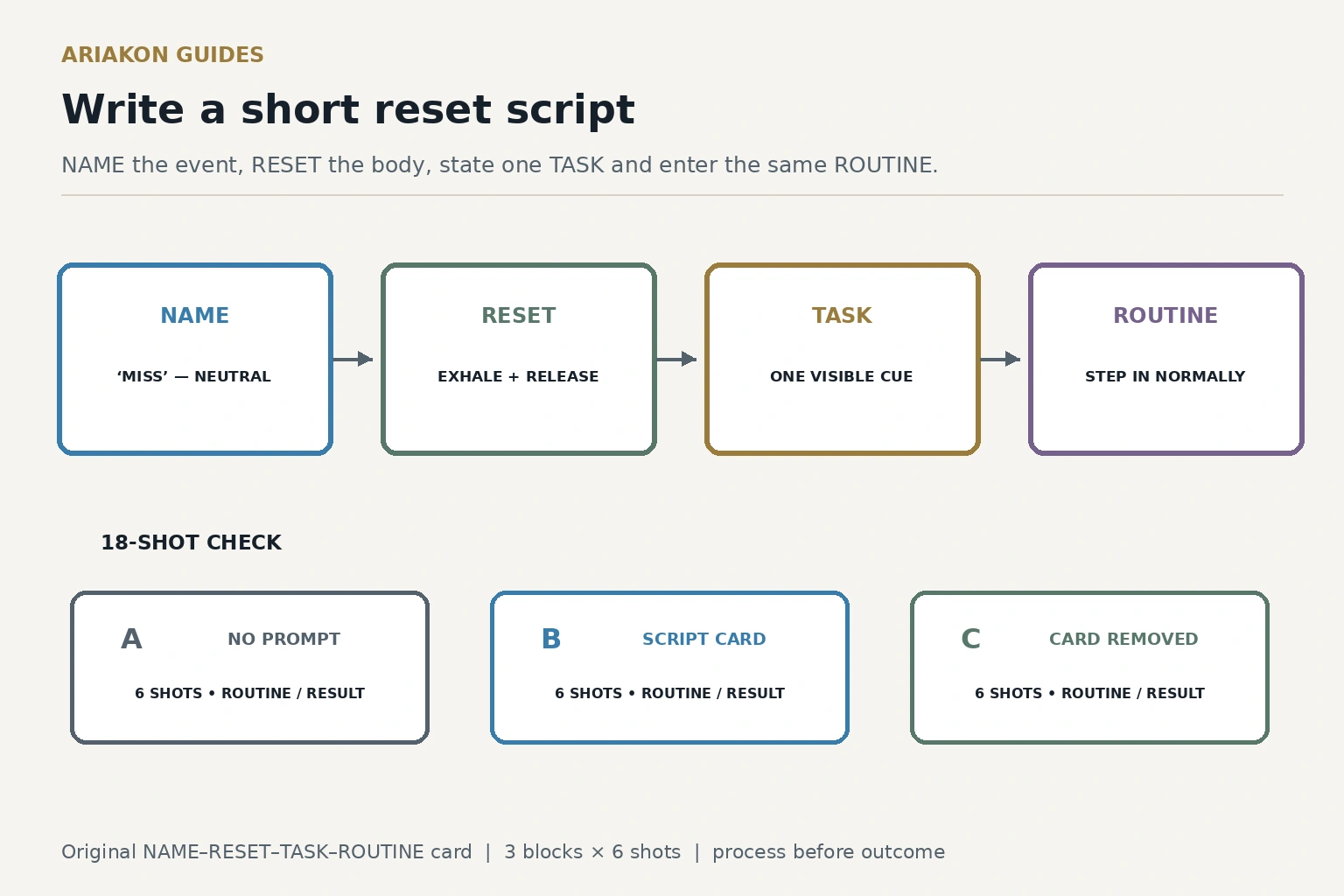
Build four lines with four different jobs
Keep the script under one comfortable breath after the factual line. It should not promise calm, confidence, a make or a win. Use language you actually accept. If a phrase creates more agitation, replace it with a neutral instruction rather than forcing positivity.
| Line | Job | Example |
|---|---|---|
| NAME | State one visible fact | Speed finished long |
| RESET | Mark the transition | One ordinary exhale |
| TASK | Name the next external job | See the object-ball entry |
| ROUTINE | Start or stand up | Plan first, then approach |
Use a simple pool mental-training routine for the broader breathing, imagery and review framework.
Practice a small pressure ladder after the script works in quiet blocks.
Prepare scripts for four common moments
Competition rules and etiquette still apply. Self-talk must not distract an opponent, delay play or become coaching from another person.
| Moment | NAME | TASK |
|---|---|---|
| After a miss | One result fact in five words or fewer | Watch the changed table; save diagnosis |
| Before a pressure shot | One visible pressure cue | Name pocket, route and speed |
| Plan changes while down | Picture changed | Stand up and restart |
| Opponent is shooting | My inning is over | Stay clear and observe legally |
Test the script in three six-shot blocks
Mark a moderate cut with the object ball one diamond from a corner and the cue ball two diamonds away. Add a one-diamond cue-ball finish zone. Shoot six quiet attempts, six with pocket and score declared aloud, and six observed by a consented silent partner. Use the complete script before every scored attempt. On the first attempt NAME can be “Baseline begins”; later name one observable prior result or registered pressure cue. In a match, use the shorter response only when needed, without distracting or delaying play.
Score four fields per attempt: factual NAME, completed RESET, external TASK and normal ROUTINE or correct stand-up. Each block offers twenty-four process points. Record pocket and zone separately; a made ball does not excuse a skipped process.
Worked match scenario: stop the internal debate
In a close set, a hypothetical player overruns position and leaves a thin cut. The script is: ‘Speed long. Exhale. Object-ball entry. Plan, then approach.’ The player does not add ‘do not choke’ or diagnose the prior stroke during the current decision. If the route changes after lowering, the routine line requires standing up.
In practice the script scores Quiet 22/24, Declared 19/24 and Observed 14/24. NAME remains stable, but TASK disappears in four observed attempts. The next block scores only the standing TASK and correct restart; the wording does not grow longer.
Keep the script inside its proper boundary
| Evidence | Next action |
|---|---|
| Script reliably returns attention | Keep the exact short wording |
| One line repeatedly disappears | Practice that line in a lower-demand block |
| The script becomes a mechanical checklist | Return mechanics to practice or an instructor |
| It delays play or distracts | Shorten it and follow current rules |
| Distress persists beyond ordinary competition | Use appropriately qualified mental-health support |
Sources and further reading
References support the specific factual information above. The practical checklists are Ariakon editorial guidance.