
Mental game · 4 min read
Build a Practice Pressure Ladder Before Your Next Pool Match
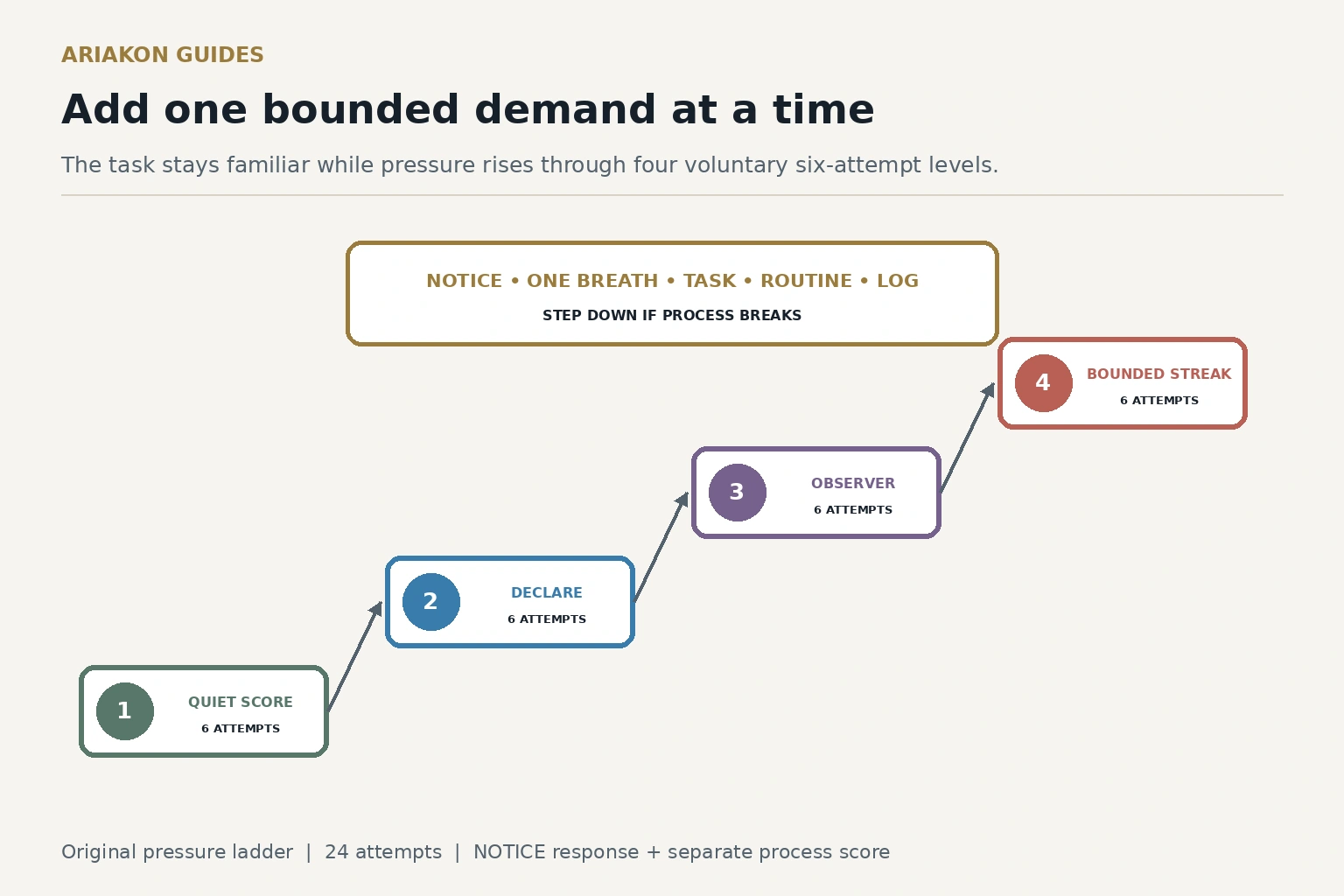
Pressure practice is useful only when the task stays recognizable and the added demand is safe, voluntary and bounded. Pick one familiar match scenario, climb four six-attempt levels and use the same response after tension or rushing appears. The competition-composure guide supplies broad match habits; this ladder schedules graded rehearsal before a specific upcoming match.
Choose a familiar match task and safe boundaries
Select a shot or short pattern already inside your normal practice range. Example: object ball one diamond from a corner on a moderate cut, cue ball two diamonds away, with a one-diamond position zone for the next ball. Use the same marks and medium speed for all levels.
Write the date of the upcoming match, expected game and current rules. Pressure is added only with consent. No money, alcohol, humiliation, punishment exercise, personal disclosure, endless make-before-leaving rule or unsafe fatigue belongs in the ladder. Stop for pain, distress, equipment damage or an observer who withdraws consent.
Use the competition composure routine for between-turn conduct and recovery during matches.
Test whether a routine survives pressure when the broader routine needs evaluation.
Climb four six-attempt levels
Add one demand at a time. If process completion falls by half from Level 1 or safety changes, step down one level. The goal is usable evidence and a practiced response, not maximal discomfort.
| Level | Added demand | Exit rule |
|---|---|---|
| 1 — Quiet score | Record result privately | Complete six ordinary attempts |
| 2 — Declared | Say the target and running score before each attempt | Complete six without changing setup |
| 3 — Observed | One consented partner watches silently | Complete six; observer records only agreed fields |
| 4 — Bounded consequence | A miss resets only the current three-shot streak | Stop after six attempts regardless of score |
Use the NOTICE response before stance
| Step | Action | Example |
|---|---|---|
| N — Notice | Name the visible sign | My pace sped up |
| O — One breath | Comfortable unforced exhale | Exhale while standing |
| T — Task | Name one external job | Object-ball entry and finish zone |
| I — Initiate | Begin the normal routine | Approach only when plan is set |
| C — Complete | Finish or stand up on a changed plan | No steering during warmups |
| E — Enter log | Mark process and result separately | NOTICE complete: yes; pocket: no |
Score the ladder without rewarding distress
Each level has twenty-four available points. Preserve the first three process subtotals separately from the outcome. A miss after a complete routine is not evidence that the response failed, and a make after rushing is not evidence that the process held.
Award the Response point for the correct registered action: use NOTICE when the cue appears, or continue the ordinary routine when it does not. Mark an unobservable field U and show its observed denominator. The 24-point ceiling assumes all four fields are observable on all six attempts; do not count U as either a success or a failure. Compare process completion rates over observed fields when applying the step-down rule.
| Component | One point when |
|---|---|
| Plan | Target and route are named before stance |
| Response | NOTICE is used when the registered cue appears |
| Routine | Normal process or correct stand-up restart is completed |
| Outcome | Ball is pocketed and cue ball reaches the zone |
Worked week-before-match scenario
A hypothetical player has a league match Saturday and runs the ladder Tuesday. Scores are Quiet 20/24, Declared 18/24, Observed 15/24 and Bounded 13/24. Outcome drops only one point from Level 2 to 3, but plan and routine completion fall four points because the player lowers before naming the finish zone.
Thursday's next action is six Observed attempts that score only the standing plan and correct restart. Level 4 is not repeated. On Saturday the match script is: ‘Notice pace, one breath, name entry and zone, run the normal routine.’ The ladder has rehearsed a response; it does not promise calm or a result.
Review and taper
| Evidence | Next action |
|---|---|
| Process holds at a level | Retain it once, then reduce volume before match |
| One process component drops | Step down and rehearse that component |
| Only outcome varies | Keep routine; do not invent a new technique |
| Distress, pain or unsafe behavior appears | Stop; use appropriate qualified support |
Sources and further reading
References support the specific factual information above. The practical checklists are Ariakon editorial guidance.