
Mental game · 3 min read
Use an Attention Reset After an Intrusive Pool Match Thought
An unwanted thought such as ‘do not scratch’ can arrive during a match without requiring an argument or a diagnosis. A brief attention reset acknowledges the thought, selects one external job and returns to the normal routine. This is narrower than general mental training: it supplies a repeatable in-match script and a log for one specific interruption.
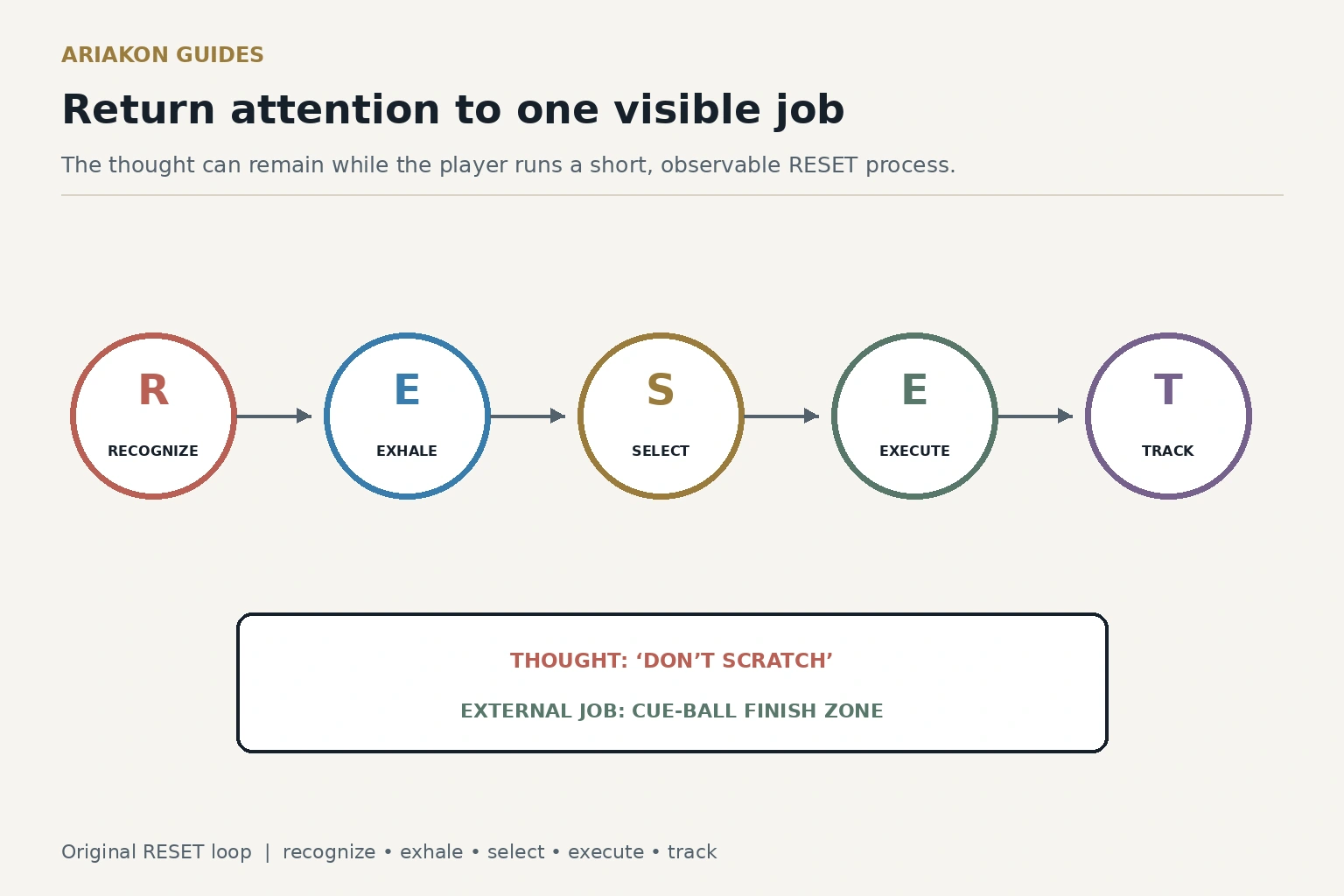
Use RESET before entering the stance
Do not demand that the thought disappear before shooting. The purpose is to redirect attention to a controllable job. If the thought returns while standing, repeat the label and target. If the plan changes after lowering, stand up and restart within the rules and pace of the event.
| Step | Action | Example |
|---|---|---|
| R — Recognize | Label the event neutrally | There is the scratch thought |
| E — Exhale | Use one comfortable breath | Long, unforced exhale |
| S — Select | Name one external target | Cue-ball finish zone |
| E — Execute | Run the familiar shot routine | Pocket, speed, one look, lower |
| T — Track | Log whether the reset was completed | Yes/no; outcome separately |
Build a general pool mental routine for attention, breathing and reflection beyond this reset.
Practice a routine under pressure after RESET is stable in ordinary practice.
Practice the script on twelve registered shots
Mark a routine cut shot with the object ball one diamond from a corner and the cue ball about two diamonds away. Name a one-diamond cue-ball finish zone. A partner or timer announces a neutral score before six of the twelve shots; the other six are quiet controls. No money, humiliation, physical punishment or endless make-before-leaving rule is used.
Before every announced-score shot, the player deliberately reads a prepared interruption card such as ‘protect the lead’ or ‘do not scratch,’ then completes RESET. This simulates an attention interruption without claiming to reproduce clinical intrusive thoughts or tournament pressure.
Score process and result separately
Maximum score is forty-eight. Report the first three process components separately from the shot result. A reset can be correctly executed on a miss, and a made ball does not prove attention was controlled.
| Field | Score |
|---|---|
| Reset completed before stance | 1 or 0 |
| External target named | 1 or 0 |
| Shot routine completed without added cue | 1 or 0 |
| Object ball pocketed and cue ball safe | 1 or 0 |
Worked match response
A hypothetical player leads late in a race and thinks, ‘I always miss this shot.’ While standing, the player says internally, ‘There is the prediction,’ exhales, names the object-ball entry point and cue-ball zone, then runs the normal routine. The shot misses, but the player records the reset as complete and waits until after the match to review the technical miss.
Across twelve practice attempts, the player completes RESET on ten, names an external target on eleven and pockets seven. Because the two incomplete resets both involved rushing into stance, the next action is six standing-only rehearsals—not a promise to eliminate the thought.
Know when this drill is not enough
This guide is a performance routine, not mental-health treatment. Stop the drill if it increases distress or feels involuntary. Persistent, disturbing or impairing thoughts deserve support from an appropriately qualified health professional; urgent safety concerns require local emergency or crisis support.
For ordinary match review, log the situation, the reset steps completed and the next controllable practice task. Do not diagnose yourself or another player from a scorecard.
Sources and further reading
References support the specific factual information above. The practical checklists are Ariakon editorial guidance.