
Competition · 3 min read
Set Realistic Pool Match Expectations From Recent Practice
A practice high score is evidence that an outcome can happen, not a prediction that it will happen on demand. Build expectations from several matched samples, convert them into decision bands and judge the match by decisions you could control. The feel-and-analysis guide balances two modes broadly; this worksheet turns recent scored practice into a specific pre-match plan.
Choose evidence that resembles the match task
Write the date, table conditions, drill, attempts and scoring method for three recent blocks. Comparable does not mean identical, but any change in pocket size, cloth speed, shot clock, game or equipment belongs beside the score.
Confirm the event's current break, call-shot, foul, coaching and time rules before building a plan. A familiar routine never overrides the event's published requirements.
| Check | Use when | Exclude or label |
|---|---|---|
| Same task | Game, drill or position problem resembles the match | Unrelated high score |
| Matched conditions | Table, time limit and rules are reasonably comparable | Different equipment or rules |
| Recent sample | At least three completed blocks are available | One best run |
| Recorded components | Decision, execution and outcome are separable | Memory-only impression |
Balance feel and analysis when it is time to stop reviewing and begin performing.
Use a monthly fundamentals checkup when recent evidence is not yet comparable.
Build green, amber and red decision bands
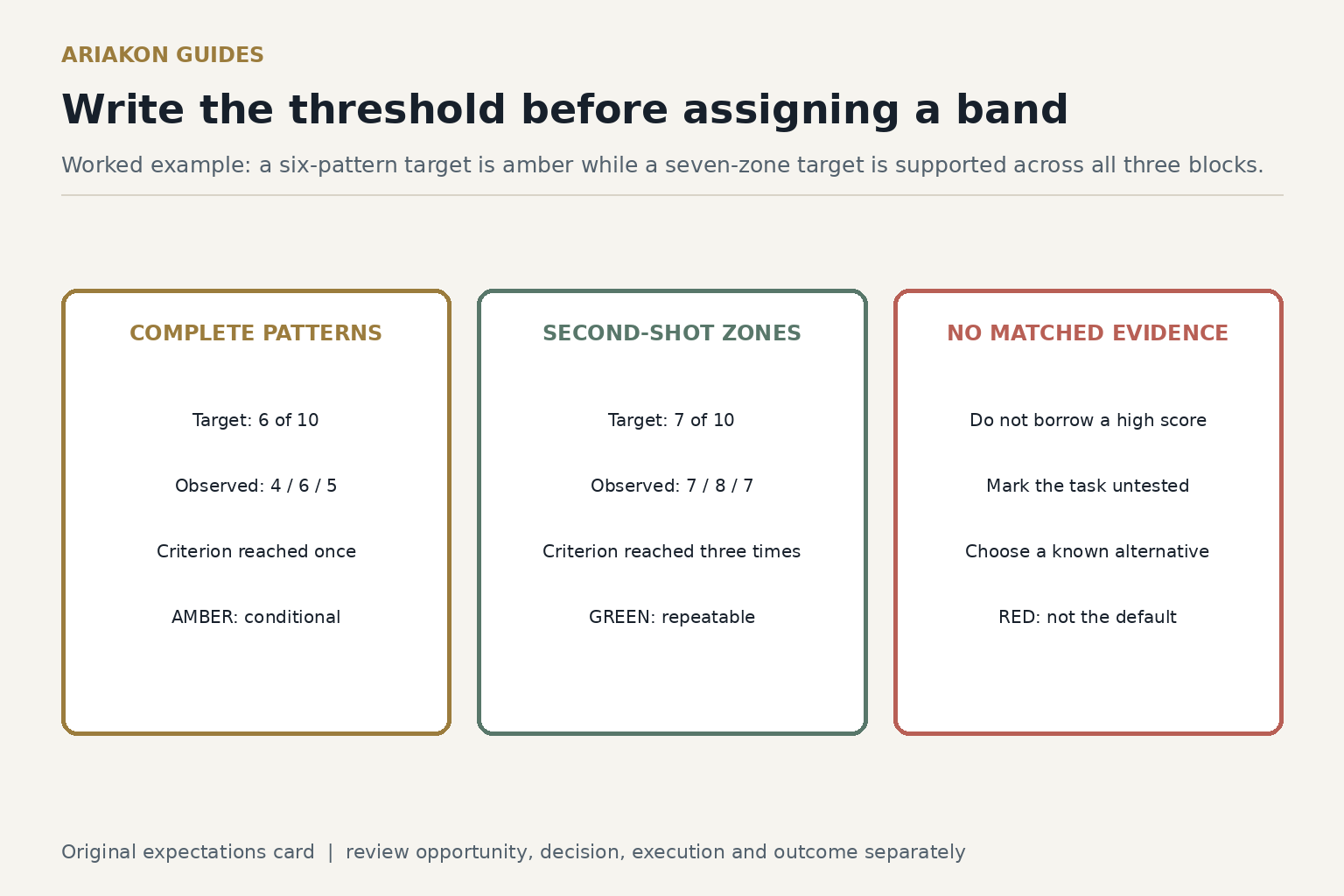
Before collecting samples, write the success threshold for each task. These are local planning bands, not universal skill grades. Green requires the threshold in at least two of three matched blocks; amber means it is reached once or depends on a narrow condition; red means no matched evidence or repeated breakdown. A band controls the default decision, not one shot result.
| Band | Evidence rule | Match response |
|---|---|---|
| Green — repeatable | Task held in at least two of three matched blocks | Use the trained route and normal routine |
| Amber — conditional | Task appeared once or depended on a narrow speed or angle | Choose a wider zone or lower-cost route |
| Red — untested | No matched sample or repeated breakdown | Do not make it the default under pressure |
Set three expectations you can verify
Outcome goals can motivate, but they are not fully controllable because opponents, layouts and table conditions vary. Keep the outcome as a reportable result and make process and decision expectations the active match plan.
| Layer | Useful expectation | Avoid |
|---|---|---|
| Process | Complete the standing decision and normal routine | I must feel confident |
| Decision | Use green routes; accept wider amber zones | I must attempt every aggressive route |
| Outcome | Record opportunities and results without a guarantee | I should run a fixed number of racks |
Worked example: three recent pattern blocks
A hypothetical player sets a threshold of six completed three-ball patterns per ten and seven playable second-shot zones per ten. Three matched blocks produce 4/10, 6/10 and 5/10 complete patterns; zone results are 7/10, 8/10 and 7/10. Zone control meets its criterion in all three blocks and is green. Full-pattern completion reaches its criterion once and remains amber. The match plan favors the verified next-shot zone without promising a fixed number of completed patterns.
The best 6/10 run is recorded but does not become the forecast. When a match layout requires an untested power-draw route, the card marks it red and prompts a containing safety or a larger zone unless the game situation justifies the risk.
Run a decision-first post-match review
A good decision can miss and a poor decision can get lucky. Update a band only after new comparable practice evidence, not from the emotion of one result.
| Question | Record |
|---|---|
| Opportunity | How often did the trained task actually appear? |
| Decision | Did the chosen route match its green, amber or red band? |
| Execution | Was the registered routine completed? |
| Outcome | What happened, without rewriting the earlier decision? |
| Next sample | What one task needs three new matched blocks? |
Sources and further reading
References support the specific factual information above. The practical checklists are Ariakon editorial guidance.