
Mental game · 3 min read
Separate Fear of Missing From a Poor Pool Shot Decision
Fear and decision quality are different problems. A good percentage choice can still be missed, and a made ball can reward a poor choice. Build evidence for one offensive route and one safety, choose while standing, then score commitment and execution separately. The broader composure guide manages the whole match; this test isolates whether hesitation changed the choice or only the delivery.
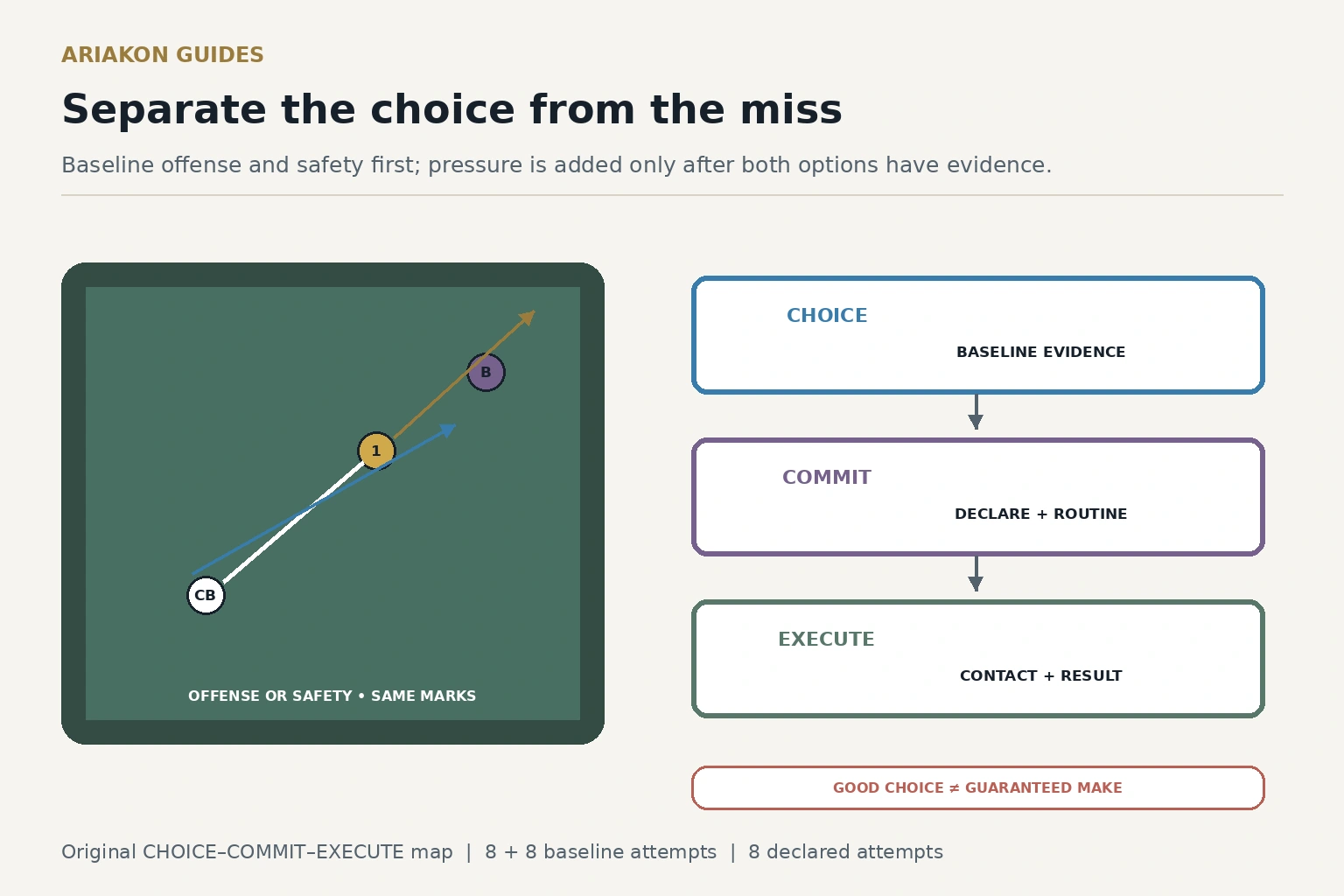
Define a decision before adding pressure
Mark a moderate cut to a corner: object ball one diamond from the foot rail and one diamond from the long rail; cue ball two diamonds up-table on the same half. Mark a two-diamond-wide cue-ball position zone. Place a blocker ball near the opposite side pocket so a thin safety can send the object ball up-table while hiding the cue ball.
Confirm that both options are legal under the rules in use. This is a personal evidence test, not a universal instruction to attack or defend.
Build calm competitive composure for the broader between-turn and post-miss routine.
Use high-percentage pool decisions for a wider offense-versus-safety framework.
Build an offense and safety baseline
Alternate options rather than shooting all makes first. Record exact conditions and do not translate the result into a permanent percentage. The baseline says only what happened in this setup on this table.
| Option | One point each | Eight-attempt maximum |
|---|---|---|
| Offense | Pocket; cue ball in broad zone | 16 |
| Safety | Legal contact; opponent cannot see a full direct hit | 16 |
Add a declared-choice pressure block
Run eight more attempts from the same registered layout. Before each attempt, choose OFFENSE or SAFETY using the written rule you derived from the two baseline component scores and miss costs. State the option and one speed cue while standing. A consented partner records the pre-shot choice and whether a changed picture led to a proper stand-up restart. Do not draw a random shot card: an assigned option cannot test your choice quality.
| Component | One point when |
|---|---|
| Choice | The option follows the written baseline rule, or a changed fact is recorded before a proper restart |
| Routine | Normal planning and approach remain intact |
| Contact | The first-contact and route requirement are met |
| Result | The option earns its baseline result point |
Diagnose fear and decision errors separately
| Pattern | Likely training target |
|---|---|
| Baseline option is weak before pressure | Decision or technical option needs work |
| Baseline is stable; routine drops when declared | Pressure routine and commitment |
| Routine holds; outcomes vary | Collect more attempts before changing |
| Player switches after getting down | Stand up and restart the decision |
| A poor option succeeds once | Do not promote it from one favorable result |
Worked transfer: keep the good choice after one miss
A hypothetical player scores offense 12/16 and safety 9/16 in baseline. In the declared block, the first offensive attempt misses but Choice and Routine both earn their process points; Contact is recorded separately. The evidence does not justify abandoning offense on the next comparable layout. Later, the safety option loses legal contact twice; that is an option-execution problem, not proof of fear.
Transfer the card to three racks. Log option, evidence available before the shot, routine completion and result. Review after the set, never while the opponent is shooting or after every single outcome.
Sources and further reading
References support the specific factual information above. The practical checklists are Ariakon editorial guidance.