
Mental game · 3 min read
Respond Productively When Your Pool Practice Score Falls
A lower practice score is information, but it is not a complete explanation. Table conditions, setup drift, fatigue, random variation and a real skill problem can produce the same total. The productive response is to verify the test, classify the lost points, constrain the next practice task and retest under comparable conditions.
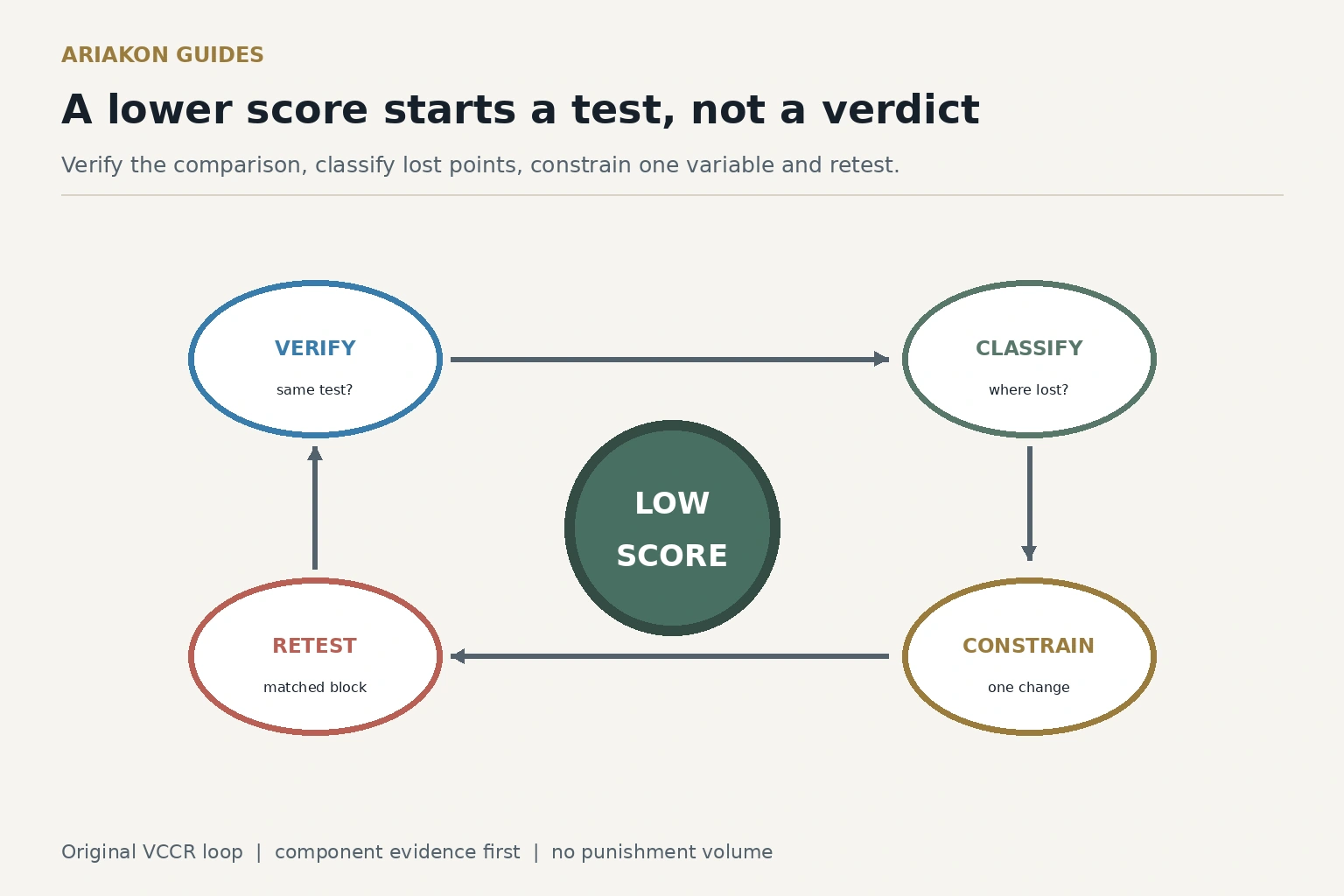
Use VCCR before changing technique
Defined tasks and component scores make a practice change observable. A score is useful when it points back to a reproducible action; it should not become a label such as bad player.
The mental-training guide offers a general routine. This protocol begins after a quantified practice drop and ends with a matched retest.
| Step | Action | Stop condition |
|---|---|---|
| Verify | Confirm setup, attempts, table, balls, warm-up and scoring | The comparison is genuinely comparable |
| Classify | Locate lost points by component | One or two components explain most of the drop |
| Constrain | Choose one smaller task or cue | No total stroke rebuild |
| Retest | Repeat the registered test after recovery or next session | Decision uses more than one low score |
Use a simple pool mental routine when attention needs a broader reset.
Build confidence from practice evidence after the matched retest.
Keep a comparable three-score window
Three prior scores are still a small sample; use them as a practical window, not a statistical guarantee. A single score below that window triggers review, while repeated loss in the same component justifies a focused test.
| Field | Record | Why it matters |
|---|---|---|
| Current total | Today’s score and component totals | Shows where points changed |
| Reference window | Previous three comparable sessions | Avoids comparing with a personal highlight |
| Conditions | Table, balls, setup and time | Surfaces environmental changes |
| Readiness | Ordinary, tired, rushed or in pain | Separates workload from technique |
| Intervention | Exactly one cue or task change | Keeps the retest interpretable |
Choose the response from the pattern
| Pattern | First response | Avoid |
|---|---|---|
| One low total; components mixed | Recover and retest unchanged | Punishment repetitions |
| Same component down twice | Build a shorter isolated block | Changing every mechanic |
| Setup or table changed | Re-establish the baseline or annotate the break | Calling scores directly comparable |
| Routine score fell before result score | Restore the routine under an easier task | Chasing harder shots |
| Pain, dizziness or unusual vision | Stop practice and seek appropriate help | Using the scorecard as diagnosis |
Worked response: a speed score drops
A hypothetical player’s last three twelve-lag scores are 8, 7 and 8 zone hits. Today’s result is 4. Verification finds the same zone and table, but the player skipped the usual warm-up. Component notes show six long misses and two short misses rather than random scatter.
The player does not add fifty lags. After a normal break, the next session begins with the standard warm-up, then six half-speed calibration attempts and the original twelve-lag test. The retest is 7, with balanced misses. The low score remains in the record, while the next action is to protect warm-up and monitor the long-miss pattern.
Protect the next session from the previous number
Write the next action before leaving: repeat unchanged, isolate one component, restore conditions or pause. At the next session, follow that line instead of replaying the total. AASP goal-setting guidance favors specific, observable actions and regular monitoring; it does not require every measurement to improve.
If low scores are accompanied by persistent distress, anxiety or loss of enjoyment beyond ordinary practice frustration, speak with an appropriately qualified professional. This protocol organizes practice evidence; it is not mental-health treatment.
Sources and further reading
References support the specific factual information above. The practical checklists are Ariakon editorial guidance.