
Competition · 3 min read
Practice Scotch Doubles Communication Before Match Night
Scotch doubles exposes unclear planning because partners alternate turns, but the legal time and form of a conference depend on the event. A good rehearsal starts with the organizer's current regulations, not a universal assumption. This guide turns those verified boundaries into an eighteen-turn circuit that measures whether two players can exchange useful facts without delaying play, coaching during delivery or blaming the previous turn.
Build an event rule card before practicing
Copy the current event name, discipline, race, alternate-shot order, coaching or conference rule, shot-clock procedure, timeout rule and who may acknowledge a foul. Leave an item marked unknown until the organizer answers it. CueSports International publishes a dedicated Scotch Doubles communication section in its tournament regulations, but another promoter can use different event-specific terms.
Both partners should be present for check-in and any required lag or coin-toss procedure. Confirm these facts again at the players meeting. The card controls the rehearsal; this article does not replace an event director's ruling.
Organize the wider team session when several pairs need rotating stations and observer jobs.
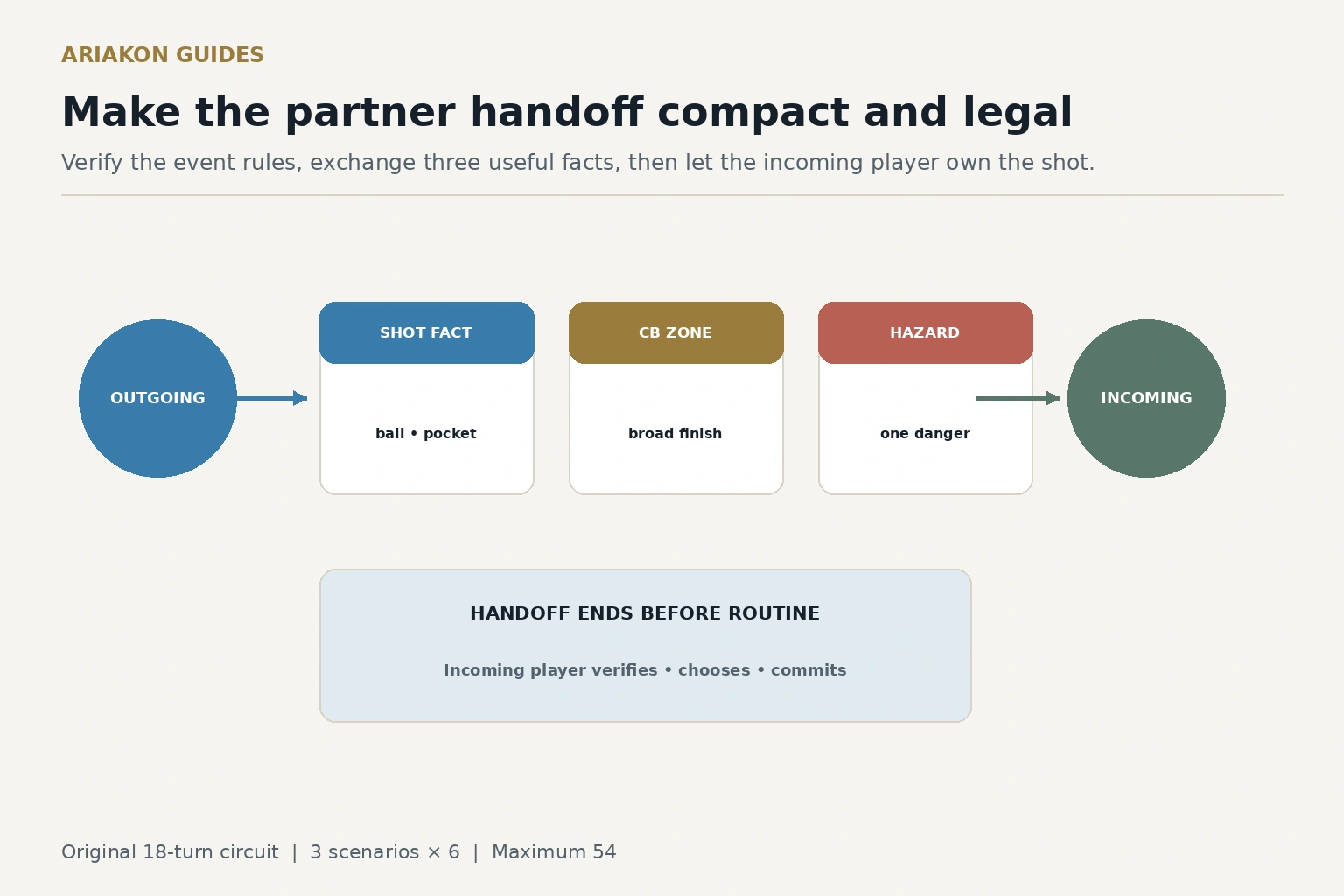
Use a three-part handoff
| Part | Useful example | Avoid | Incoming player's job |
|---|---|---|---|
| Shot fact | The 4 passes the 7 to the left corner | A speech about the whole rack | Verify the line |
| Cue-ball zone | Leave above the side-pocket line | Exact promises | Choose speed and spin |
| Main hazard | Do not cross behind the 8 | Mid-stroke correction | Commit or legally restart |
Run an eighteen-turn communication circuit
| Station | Starting task | Turns | Observer records | Reset |
|---|---|---|---|---|
| A | Open three-ball route | 6 | Order, zone, hazard | Same layout after every two turns |
| B | One blocked route | 6 | Whether the blocker was named | Mirror after three turns |
| C | Offensive shot or safety | 6 | Choice, target and legal boundary | Swap first speaker after three |
Score clarity without rewarding chatter
| Points | Handoff | Execution boundary |
|---|---|---|
| 0 | Contradictory, prohibited or missing | Stop and check the rule card |
| 1 | One useful fact | Incoming player owns the shot |
| 2 | Shot fact plus zone or hazard | No late correction |
| 3 | All three facts are concise | Clean handoff before the routine |
Work one layout all the way through
On Station B, Player A sees that the 4 passes the 7 to the left corner, but the natural route can cross behind the 8. The legal handoff is: ‘4 left corner; finish above the side line; avoid the back of the 8.’ Player B checks the picture, chooses a legal center-ball route and begins the routine. If the picture changes after bending, Player B stands up and restarts rather than waiting for a last-second instruction.
Suppose the pair scores 14 of 18 on clarity but names the hazard only twice at Station B. The next session is not ‘communicate more.’ It is six blocked-route repetitions in which the observer awards the third point only when the hazard is stated before the incoming routine begins.
Close with a five-minute review
| Question | Evidence | Next action |
|---|---|---|
| Which rule was uncertain? | Exact card field | Ask the director before match night |
| Which message was usually missing? | Station and turn numbers | Repeat that scenario six times |
| Where did the incoming player hesitate? | Before or after routine start | Clarify the handoff boundary |
| Did either partner coach during delivery? | Observed turn | Rehearse silence after handoff |
Sources and further reading
References support the specific factual information above. The practical checklists are Ariakon editorial guidance.