
Practice drills · 3 min read
Practice an Original Rail First Artistic Pool Shot With Clear Scoring
This original practice shot turns rail-first contact into a measurable artistic challenge without copying a published program shot. The cue ball must contact the long cushion inside a marked window, then contact the object ball and send it to the corner pocket. Score the contact order, pocket and cue-ball finish separately.
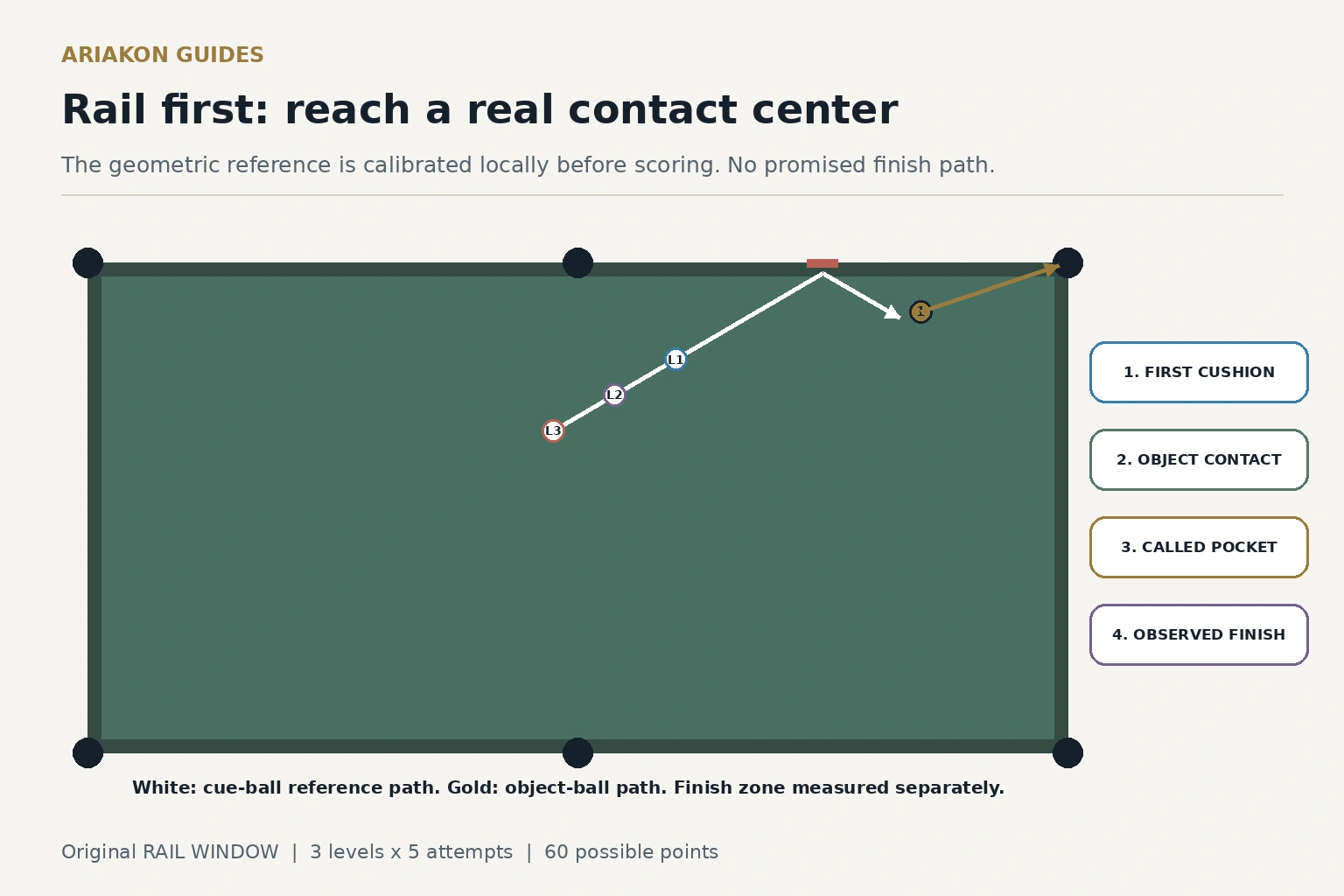
Build the RAIL WINDOW setup
The ray R to G meets the object ball before its center and directs a nonzero cut toward the real corner P. Reflect G across the cue-center cushion line y=3.91; C1, C2 and C3 lie on that incoming ray. This is a zero-spin equal-angle starting construction, not a prediction of actual cushion response. Calibrate each level at comfortable speed before freezing its marks; use no sidespin initially. Use permitted temporary practice references, never chalk on cloth.
This is an original rail-first practice layout with local scoring, not an official artistic program shot or record attempt. The next cue-ball finish depends on retained spin and speed. Declare a broad observed finish zone after unscored trials; the image does not prescribe an invented post-contact path.
| Element | Placement | Purpose |
|---|---|---|
| Table | 100 by50 inch example; x=0 to 8 long,y=0 to 4 wide | 2.25 inch balls; radius 0.09 unit |
| Object center | O=(6.8,3.6); real pocket P=(8,4) | Outgoing vector u=(3,1)/√10 |
| Contact center | G=O-0.18u=(6.629237,3.543079) | Cue and object centers one diameter apart |
| Rail center | R=(6.0,3.91), nose target=(6.0,4) | Cue center one radius inside upper cushion |
| Level1 cue center | C1=(4.8,3.2103) | Initial equal-angle geometric reference |
| Level2 and3 | C2=(4.3,2.9187), C3=(3.8,2.6271) | Same incoming ray, increasing distance |
| Window and finish | First contact x 5.875 to 6.125; broad observed cue-ball finish zone | Freeze only after unscored calibration |
Practice trick-shot skills that transfer for broader carom, breakout, bank and speed exercises.
Choose between a kick and a bank when the rail-first idea moves into match strategy.
Score three levels with exact attempts
Advance only after 15/20 or better at a level. If the cue ball contacts the object ball before the cushion, the attempt scores zero even if the ball drops. Do not move the object ball between attempts.
Worked example: the player scores 18, 15 and 9. At Level 3, four attempts miss the window on the pocket side. The next action is five Level 2 attempts with a smaller speed range; adding sidespin is not yet justified.
| Point | Requirement | Miss code |
|---|---|---|
| 1 — Window | Cue ball contacts the declared cushion window first | W |
| 1 — Contact | Cue ball then contacts the object ball | C |
| 1 — Pocket | Object ball enters the declared corner | P |
| 1 — Control | Cue ball finishes in the target and stays on table | F |
| Maximum | 20 points per level; 60 total | Record first failed component |
Diagnose the first miss and transfer it
In a match, use a rail-first shot only when the rules and table position make it legal and strategically sound. The artistic score trains observation; it does not guarantee the competitive choice.
| First miss | Next five attempts | Game transfer |
|---|---|---|
| W — Window | Keep object ball fixed; adjust only the cushion target | Kick-line planning |
| C — Contact | Recheck the measured contact center and actual cushion response | Escaping a blocker |
| P — Pocket | Keep contact; reduce speed variation | Rail-first pocketing |
| F — Finish | Declare a larger safe zone, then shrink | Cue-ball containment |
Sources and further reading
References support the specific factual information above. The practical checklists are Ariakon editorial guidance.