
Mental game · 3 min read
Handle Last Ball Pressure With a Repeatable Finish Routine
The last ball makes the outcome easy to imagine, which can change pace, attention and risk. A finish routine gives that moment the same sequence every time. It cannot guarantee a make or treat persistent anxiety, but it can keep the legal check, shot plan, one attention cue and post-shot response from changing merely because the rack is almost over.
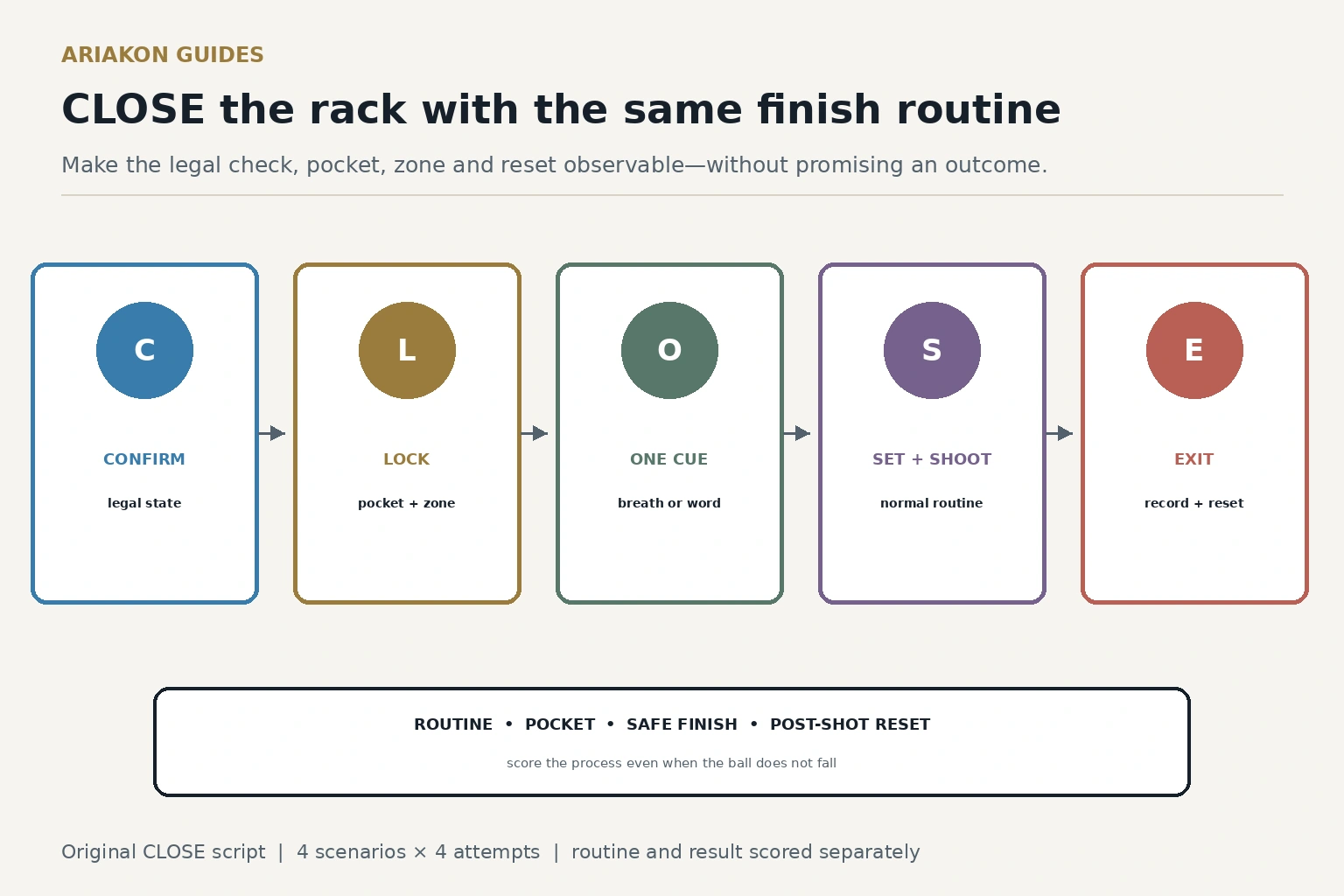
Use the five-step CLOSE script
Use the active league or tournament rules; this guide does not replace them. Keep the cue word task-relevant, such as center pocket or finish in zone, and use the same word on ordinary shots first.
The existing pressure ladder adds a scored consequence. CLOSE is the match-executable routine that can be rehearsed with or without that consequence.
| Step | Action | Evidence |
|---|---|---|
| C — Confirm | Game state, legal target and called-pocket requirement | Named while standing |
| L — Lock | Pocket, cue-ball finish and scratch line | One complete plan |
| O — One cue | One breath or short task word | No list of mechanics |
| S — Set and shoot | Normal pre-shot routine | Stand up if the picture changes |
| E — Exit | Accept result, clear table and record one fact | No immediate technical argument |
Practice a final ball under a small scored consequence after CLOSE is stable.
Build calm competitive composure for the wider between-turn reset.
Mark one finish shot and one safe zone
Place the final object ball one diamond from a corner and the cue ball two diamonds away on a modest cut. Mark a one-diamond-square cue-ball finish zone away from the nearest scratch path. Use the same shot for the first block so routine changes are not hidden by layout changes.
Before each attempt, say the legal target, pocket and finish zone while standing. If any part is uncertain after entering the stance, stand up and restart CLOSE. The restart is evidence of protecting the routine, not a failure.
Rehearse four match scenarios
Each attempt earns one point for completing C–L–O–S before and through the shot, one for legal pocketing, one for safe cue-ball finish and one for the Exit step; maximum sixty-four. Keep process and result subtotals separate.
The interruption is a neutral reset by the practice partner or timer, not misconduct. Never create distractions while another player is shooting.
| Scenario | Attempts | Added condition |
|---|---|---|
| Ordinary | 4 | No displayed score |
| After a miss | 4 | Read one neutral miss note before reset |
| For the rack | 4 | Say the rack consequence once, then return to task |
| After interruption | 4 | Step away, then restart from C |
Use one response script after the result
After a make: “Result recorded; next rack.” After a miss: “Miss side and speed recorded; next task.” Keep the observation to one factual line. A post-shot technical debate can pull the next inning back into the previous rack.
A routine is personal and should remain compact. One randomized experiment in beach-volleyball serving found no accuracy difference between new routine interventions and control under its pressure manipulation, while broader reviews report variable benefits. Treat CLOSE as a process to test, not a promise.
Worked review and next action
A hypothetical player scores four of four C–L–O–S routine points in Ordinary but two of four after an interruption. Pocketing stays three of four in both. The next block does not change aim or speed; it rehearses four interruption resets and requires a full restart from Confirm.
If CLOSE stays complete but one miss side repeats, remove the pressure scenario and diagnose the shot. If the routine itself becomes distracting, shorten it to Confirm, Lock and normal pre-shot routine. Persistent distress deserves support from a qualified mental-health or sport-performance professional, not a more punishing drill.
Sources and further reading
References support the specific factual information above. The practical checklists are Ariakon editorial guidance.