
Practice drills · 2 min read
Practice Cut-and-Leave Position With a Two-Target Drill
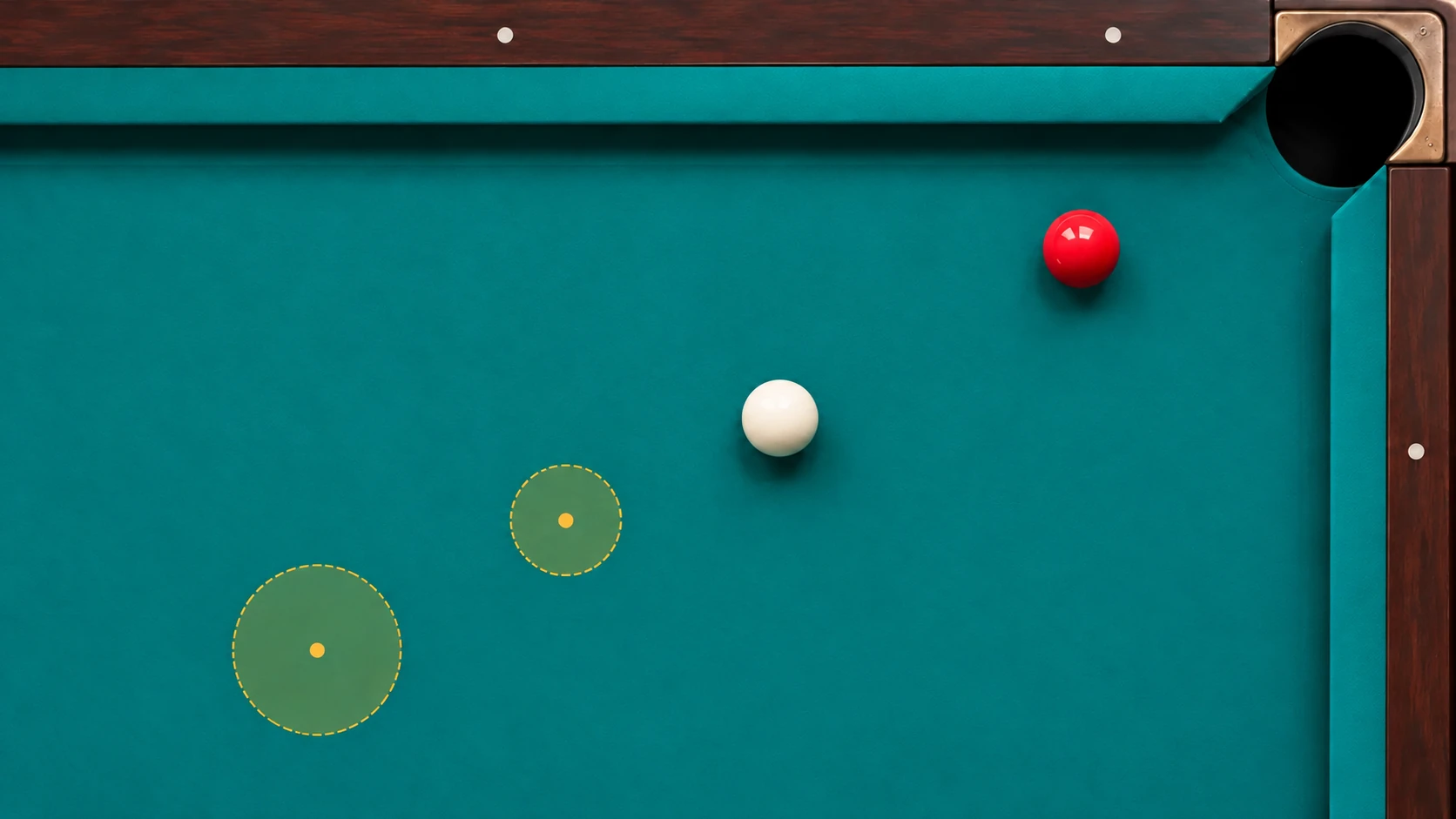
Position practice becomes more useful when pocketing and the next-shot leave are scored together. This drill uses one repeatable cut and two cue-ball landing zones. The near target rewards controlled speed; the farther target asks for a fuller route without changing the object-ball task. It is an original progression, not a claim about a single correct pattern.
Build one repeatable cut
Place an object ball about one diamond from a corner pocket and the cue ball at a comfortable thirty- to forty-five-degree cut. Use removable markers so every attempt begins from the same positions.
Choose a cut you can already pocket most of the time. The drill measures position speed, so an extreme cut would mix too much aiming difficulty into the result.
Mark a near and far leave
Place a small near landing zone on the cue ball's natural tangent-side route, then a larger far zone along the same general route. Keep both away from cushions and pockets at first.
The two targets should require different speeds, not different trick shots. Adjust their locations until center-ball or a small vertical-axis change can reach both reliably.
Score pocket and position separately
Award one point for pocketing the object ball and one point for the cue ball finishing inside the called zone. A position point does not count on a missed object ball.
Record near and far sets separately. This shows whether misses come from aim, speed selection or a delivery that changes when more travel is required.
Change backswing before changing spin
Use the same cue-ball contact for the first round and vary travel with stroke length and speed. This isolates speed control from spin effects.
If the natural route cannot reach a useful target, make one documented vertical-axis change. Avoid adding sidespin until both the cut and basic route are consistent.
Reverse the cut after a passing score
When you score at least eight of ten available points for both targets, mirror the setup to the other side of the table. The reversed cut tests whether your sight picture and stroke remain balanced.
If one side falls behind, compare alignment and stance access before changing aim. A difference between sides is useful diagnostic evidence, not a reason to rush the harder side.
Play the two-target round
- Call the near zone and shoot five attempts.
- Score one for the pocket and one for the leave.
- Call the far zone and shoot five attempts.
- Keep cue-ball contact constant for the first round.
- Record aim misses separately from speed misses.
- Mirror the layout after both targets reach eight of ten.