
Practice planning · 3 min read
Create a Pool Improvement Checklist for Your Current Skill Level
A list of generic tips cannot tell you which skill deserves your next hour. A useful checklist samples several domains under fixed conditions and converts the weakest repeatable evidence into one bounded practice assignment. The result is a current work queue, not a permanent player label or a universal rating.
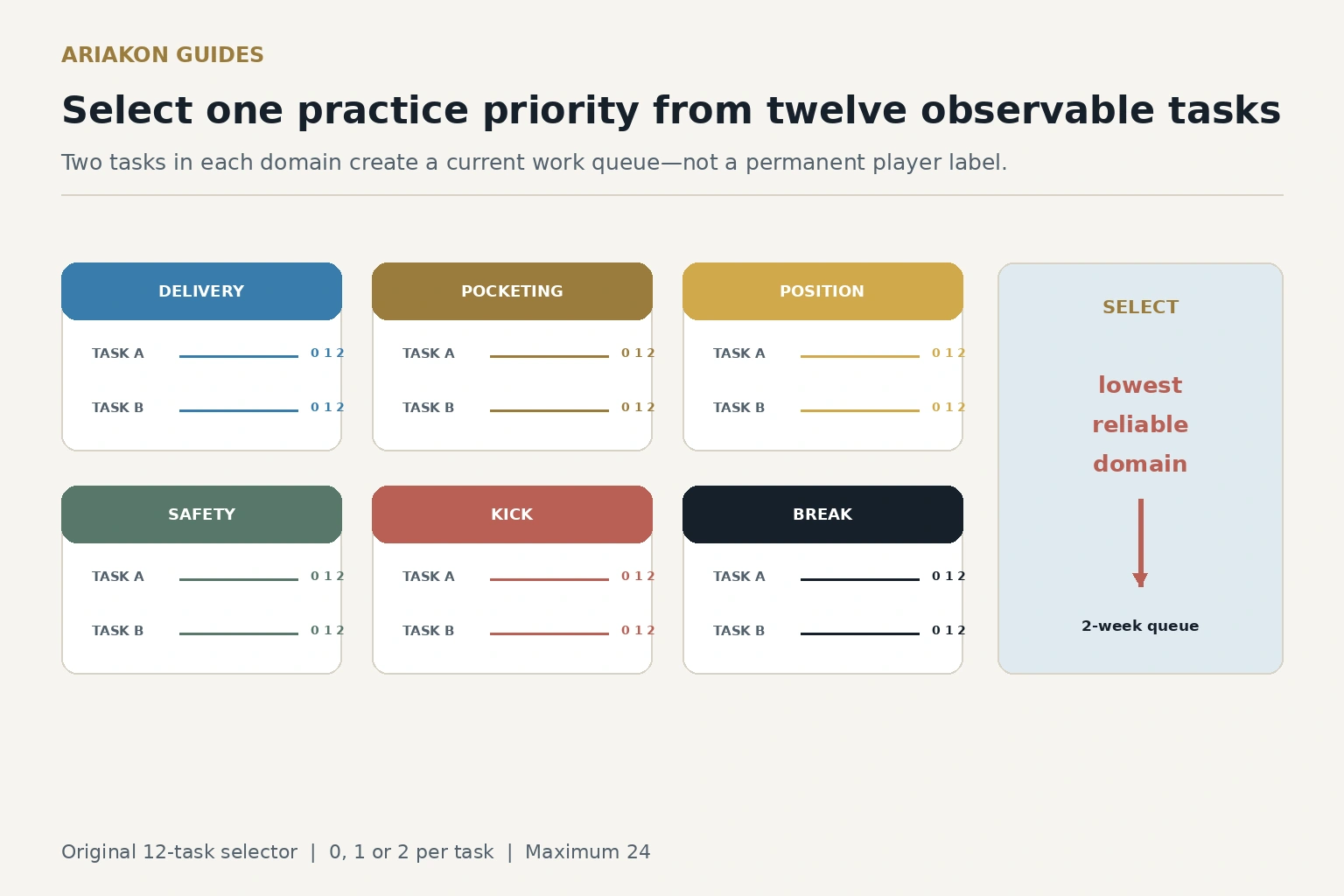
Define three evidence levels
| Score | Evidence in five attempts | Checklist meaning | Next action |
|---|---|---|---|
| 0 | Zero or one called success, or a safety/rule failure | Not yet reliable | Simplify and learn the prerequisite |
| 1 | Two or three called successes | Developing | Practice the same geometry |
| 2 | Four or five called successes | Working skill | Add one game constraint |
Use the five-action improvement cycle after this checklist selects the current priority.
Run twelve tasks without warm-up coaching
| Domain | Task A | Task B | Record |
|---|---|---|---|
| Delivery | Five straight stop shots from one diamond | Five cue-ball gate passes without an object ball | Called line and finish |
| Pocketing | Five half-ball cuts total, alternating left/right; reverse the 3/2 split next session | Five long straight shots at personal speed | Make and miss side |
| Speed and position | Five lag-to-zone shots | Five one-rail routes to a two-diamond zone | Signed short or long |
| Safety | Five thin contacts leaving distance | Five cue-ball-behind-blocker routes | Legal contact and cover |
| Kick and recovery | Five one-rail center-ball contacts | Five kick contacts with called target half | Rail reference and contact |
| Break and rules | Five legal controlled breaks | Five verbal layout decisions under current rules | Legality, cue ball and decision |
Keep the test conditions honest
Mark starts and target zones, alternate left and right where required, and write all five outcomes before changing technique. Use the current rules of the game you actually play. A task that is unsafe, unfamiliar or impossible in the room receives no attempt until its prerequisite is learned; it does not receive an invented score.
These twelve original task labels sample chosen practice questions only. Repeating the same layouts improves familiarity with those layouts; the resulting total is not a complete playing rating or an organization's examination.
Calculate the twenty-four-point snapshot
Two tasks in each of six domains create twelve scores and a maximum of 24 points. Total the whole sheet, but choose practice from the lowest domain subtotal, not from a flattering overall number. A domain at 0 or 1 of 4 is prerequisite work; 2 is developing; 3 is mixed reliability; 4 is ready for a transfer constraint.
Do not compare totals across table sizes, task changes or different scoring rules. Date the sheet and preserve the exact setup so the next check measures change rather than memory.
Work a sample result into one assignment
| Domain | A | B | Subtotal | Interpretation |
|---|---|---|---|---|
| Delivery | 2 | 2 | 4 | Add pressure later |
| Pocketing | 1 | 2 | 3 | One direction varies |
| Speed and position | 1 | 0 | 1 | Current priority |
| Safety | 1 | 1 | 2 | Developing |
| Kick and recovery | 2 | 1 | 3 | Contact is usable |
| Break and rules | 2 | 2 | 4 | Maintain |
| Total | 17 of 24 | Not a permanent skill label |
Build a two-week work queue
For the sample, choose the zero-point one-rail position task. In each of four sessions, shoot three blocks of five attempts from the same coordinates, recording short, zone or long. Advance only after two consecutive blocks score at least four zone finishes. Then add one object-ball cut while holding the destination zone.
Keep stronger domains alive with one five-attempt maintenance block, not an equal share of time. Retest all twelve tasks after two weeks before selecting a new priority. If the lowest score moves to another domain, that is useful new evidence rather than failure.
Match the next guide to the evidence
| Lowest domain | Start here | Advance when |
|---|---|---|
| Delivery | Straight stop-shot and cue-path work | Four of five called stops |
| Speed and position | Distance and one-rail zone drills | Two passing blocks |
| Kick | One-rail reference calibration | Four of five legal called contacts |
| Break | Controlled break progression | Legal break and cue-ball control repeat |
| Planning | Three-ball pattern planning | Called route survives five attempts |
Calibrate one-rail kick and bank references when kick and recovery is the lowest domain.
Develop a faster controlled break when break contact and cue-ball control are the current limit.
Sources and further reading
References support the specific factual information above. The practical checklists are Ariakon editorial guidance.