
Tournament play · 3 min read
Build a Seven Day Pool Tournament Preparation Plan
A tournament week should remove uncertainty, not create seven days of frantic practice. This plan begins with the event's own rules and schedule, uses one baseline to choose a narrow skill focus, rehearses the expected format, and reduces workload before travel or check-in. It is a planning template; the event organizer's current materials control registration, equipment, dress, match and arrival requirements.
Create one verified event sheet
| Field | Write the exact answer | Source | Action if unknown |
|---|---|---|---|
| Game and rules | Ruleset, race, break and foul procedure | Current event rules | Ask organizer |
| Check-in | Date, time, location and ID | Confirmation or event page | Set two reminders |
| Equipment | Table size, balls, cue restrictions | Current event materials | Practice comparable conditions |
| Format | Single, double elimination or round robin | Bracket information | Plan waiting time |
| Logistics | Travel, parking, lodging and contact | Confirmed bookings | Keep offline copy |
Use the large-event logistics guide for match calls, venue flow and administrative routines.
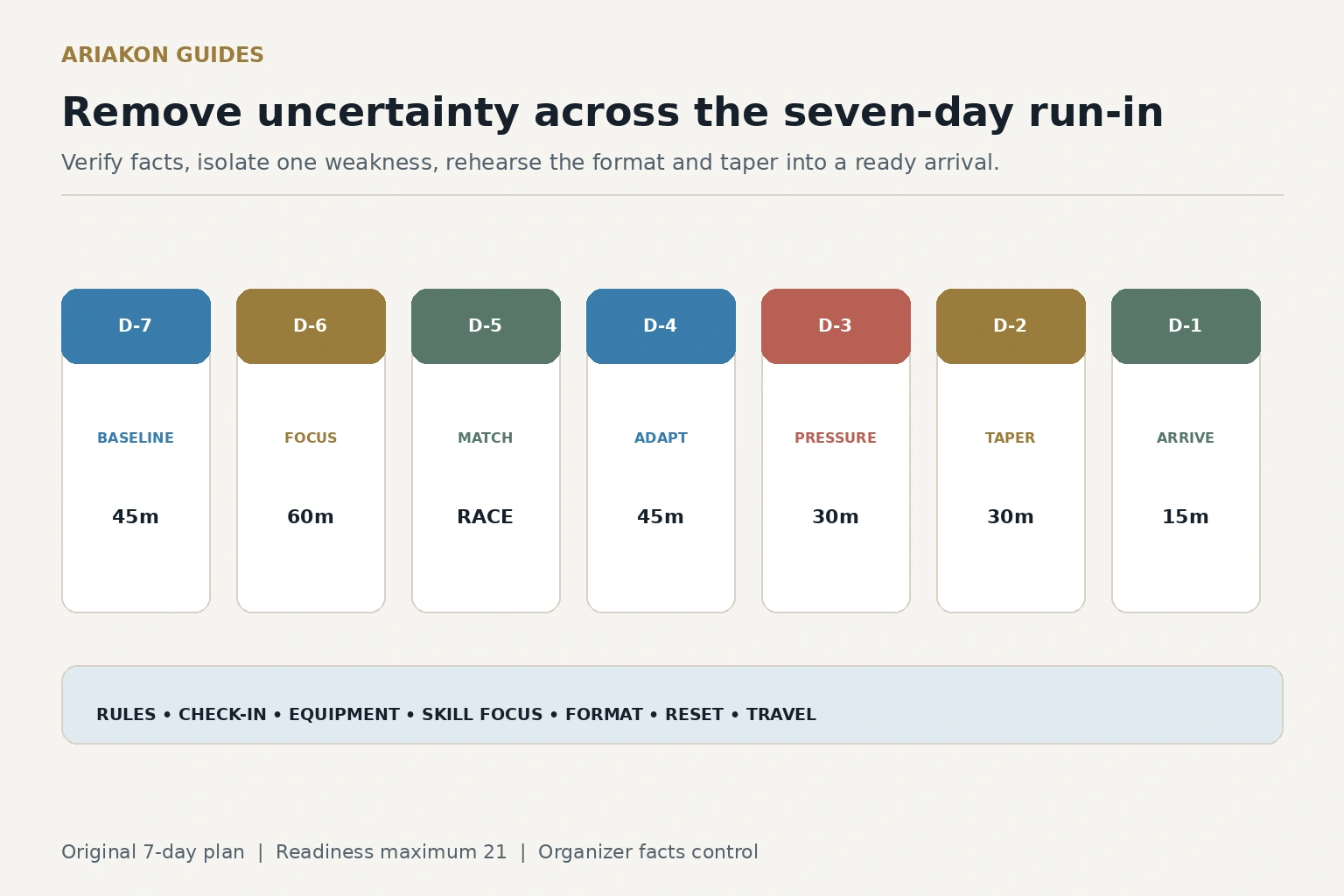
Follow the seven-day workload
| Day | Table work | Off-table work | Stop rule |
|---|---|---|---|
| D-7 | 45-minute baseline | Verify event sheet | Choose one weakness |
| D-6 | 60 minutes on that weakness | Review score, not feelings | No second project |
| D-5 | One full race in event format | Record pace and fouls | End after debrief |
| D-4 | 45-minute table adaptation | Confirm travel | No equipment experiment |
| D-3 | 30-minute pressure set | Write between-match reset | Finish on schedule |
| D-2 | 30-minute taper | Clean and inspect permitted gear | Service defects; do not improvise |
| D-1 | 15-minute familiarization or rest | Pack, hydrate, travel, alarms | Protect arrival readiness |
Make the baseline choose the week
Use twelve scored attempts: three pocketing, three speed-control, three safety and three recovery shots. Score 0 for foul, 1 for legal attempt, 2 for primary result and 3 for result plus cue-ball condition; maximum 36. The lowest category becomes D-6's only technical project.
APA's tournament-preparation guidance recommends progressive drills and practice in the format expected at competition. This plan makes those ideas measurable while avoiding claims that a particular routine guarantees performance.
Rehearse one complete match day
On D-5, use the event's race length and rules. Include the lag or break procedure, scorekeeping, time between racks and any coaching boundaries that actually apply. If the event rules are not available, do not import a different league's rule as fact.
After the race, write three observations only: first technical leak, first decision leak and first logistical distraction. One becomes the D-4 table-adaptation target; the others enter a post-event list.
Score readiness without pretending to predict wins
| Area | 0 | 1 | 2 | 3 |
|---|---|---|---|---|
| Rules | Unknown | Located | Read | Scenario checked |
| Check-in | Unknown | Time known | Route known | Backup saved |
| Equipment | Defect | Unchecked | Inspected | Packed |
| Skill focus | None | Named | Practiced | Retested |
| Match format | Unknown | Read | Partial rehearsal | Full rehearsal |
| Reset routine | None | Written | Tried | Used in race |
| Travel | Unplanned | Tentative | Confirmed | Buffer included |
Work a realistic correction
A player scores 22 of 36 on D-7 and safety is the lowest category. D-6 becomes a sixty-minute safety block; the player does not rebuild the break too. D-5 shows solid safety choices but two late arrivals to the shot clock or match call. D-4 therefore keeps the safety routine and fixes the timing plan.
After the tournament, compare the plan with observed events: what rule or venue fact surprised you, which task broke first, and which preparation item was unnecessary? Update the template for the next event rather than treating the finish position as the only evidence.
Sources and further reading
References support the specific factual information above. The practical checklists are Ariakon editorial guidance.