
Buying guides · 4 min read
Build a Pool Accessory Kit for Home Practice
A useful home kit supports a repeatable session from setup through cleanup. It is not a list of favorite brands, and it should not duplicate every object in a cue case. Start with six jobs, inspect what the room already supplies and add a candidate only when fit, permission, care and storage are documented.
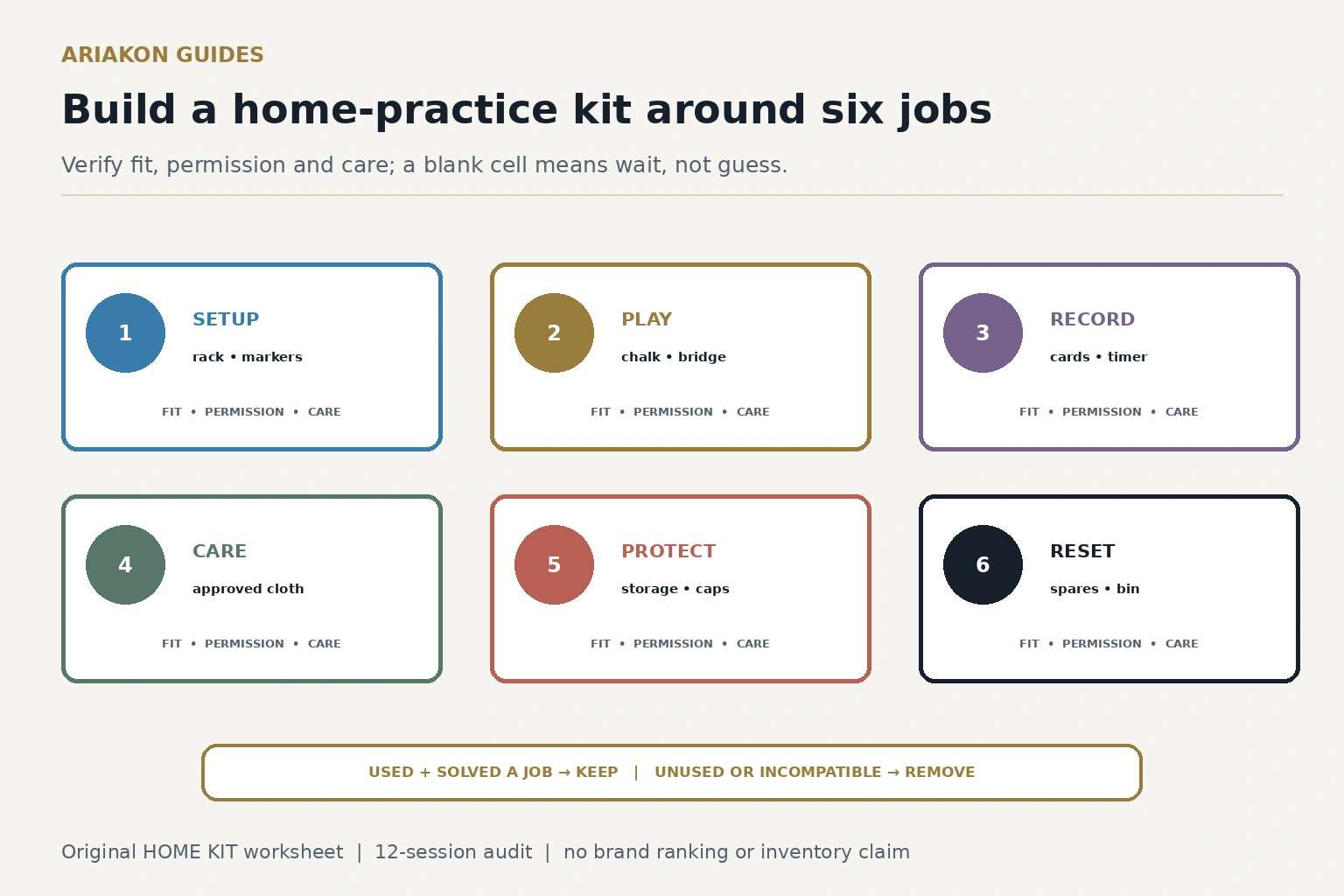
Audit the room before building the kit
Write the friction observed in the last four sessions next to each job. An empty job is acceptable. A home table does not require one product from every category.
Keep table-care items separate from cue-care items. A chemical or abrasive that is acceptable for one shaft or finish can be inappropriate for another, and loose tools should never remain on the playing surface.
| Job | Possible category | Question before adding |
|---|---|---|
| Setup | Rack, flat position markers | Does the table already supply it? |
| Play | Chalk, mechanical bridge | Is it permitted and compatible? |
| Record | Score cards, pencil, timer | Will it capture the selected drill? |
| Care | Approved cloth or table-care tool | Does the maker allow it on this material? |
| Protect | Closed storage, joint protection | Does it fit without pressure? |
| Reset | Small bin or counted spares | Can every item return to one place? |
Choose accessories by function before novelty for the individual-product gate.
Build a pool-table care routine before choosing cloth or rail care tools.
Complete the fit, permission and care card
Verify current maker documentation for dimensions and care. For a bridge head, confirm shaft fit and stable use; for markers, confirm that they lie flat and are removed before any ball can contact them; for storage, confirm that no cue or joint is loaded sideways.
A current store page can establish that a destination exists, but it does not prove a particular item is in stock later or appropriate for this kit. Recheck the live product page before buying.
| Field | Candidate A | Candidate B |
|---|---|---|
| Exact home-practice job | ||
| Size, joint or surface fit | ||
| Room or event permission | ||
| Maker-supported care method | ||
| Storage location | ||
| Replacement or consumable trigger | ||
| Twelve-session success condition |
Build a minimum kit before an expanded kit
Run the minimum kit for three sessions. Add one item at a time only when a log entry identifies a repeated problem. This keeps a new purchase from hiding whether a simpler setup change solved it.
Store the instructions or current product link with the kit card. A label such as carbon-safe or cloth-safe is not interchangeable with the actual maker instructions for the specific product and surface.
| Stage | Keep it small |
|---|---|
| Minimum | One setup aid, one recording method and only the allowed playing consumables actually used |
| Care | Only material-approved tools with instructions retained |
| Expanded | Add a protection or reset item after an observed failure |
| Do not add | Duplicate tools, unknown chemicals or incompatible fittings |
Use a twelve-session keep test
Review at sessions three, six and twelve. A candidate used only once may still be essential protection, but write the failure it prevents and its inspection interval. An unused convenience tool with no observed job should leave the active kit.
These thresholds organize a personal decision; they are not performance tests or product rankings.
| Point | Evidence |
|---|---|
| Ready | Item was present and usable |
| Used | Item performed its named job |
| Solved | The named friction was reduced |
| Reset | Item returned safely to storage |
| Maximum 48 | Twelve sessions; unused items earn zero for Used and Solved |
Worked example: a thirty-minute position session
A player plans six marked positions and currently loses time rebuilding the layout. The minimum kit is six removable flat markers, a printed score card and pencil. The markers are removed from any ball path before shooting, and everything returns to a closed tray. A cue-care cloth stays in the cue case because it does not solve the home-layout problem.
After twelve sessions the markers and card were ready and used every time, while an added phone tripod was used twice and did not support the chosen score. The player removes the tripod from the active kit. Browse Ariakon’s current shop only after the worksheet identifies a relevant category and recheck fit, care and availability on the live listing.
Sources and further reading
References support the specific factual information above. The practical checklists are Ariakon editorial guidance.