
Competition · 3 min read
A Pool Team Captain's Match Night Administration Checklist
Captaincy on match night includes a quiet administrative job: confirm who is eligible, preserve accurate records, keep decisions inside the active rules and close the session cleanly. This checklist does not replace a league manual, local bylaws or operator direction. It turns those sources into a sequence that a captain and backup can actually follow.
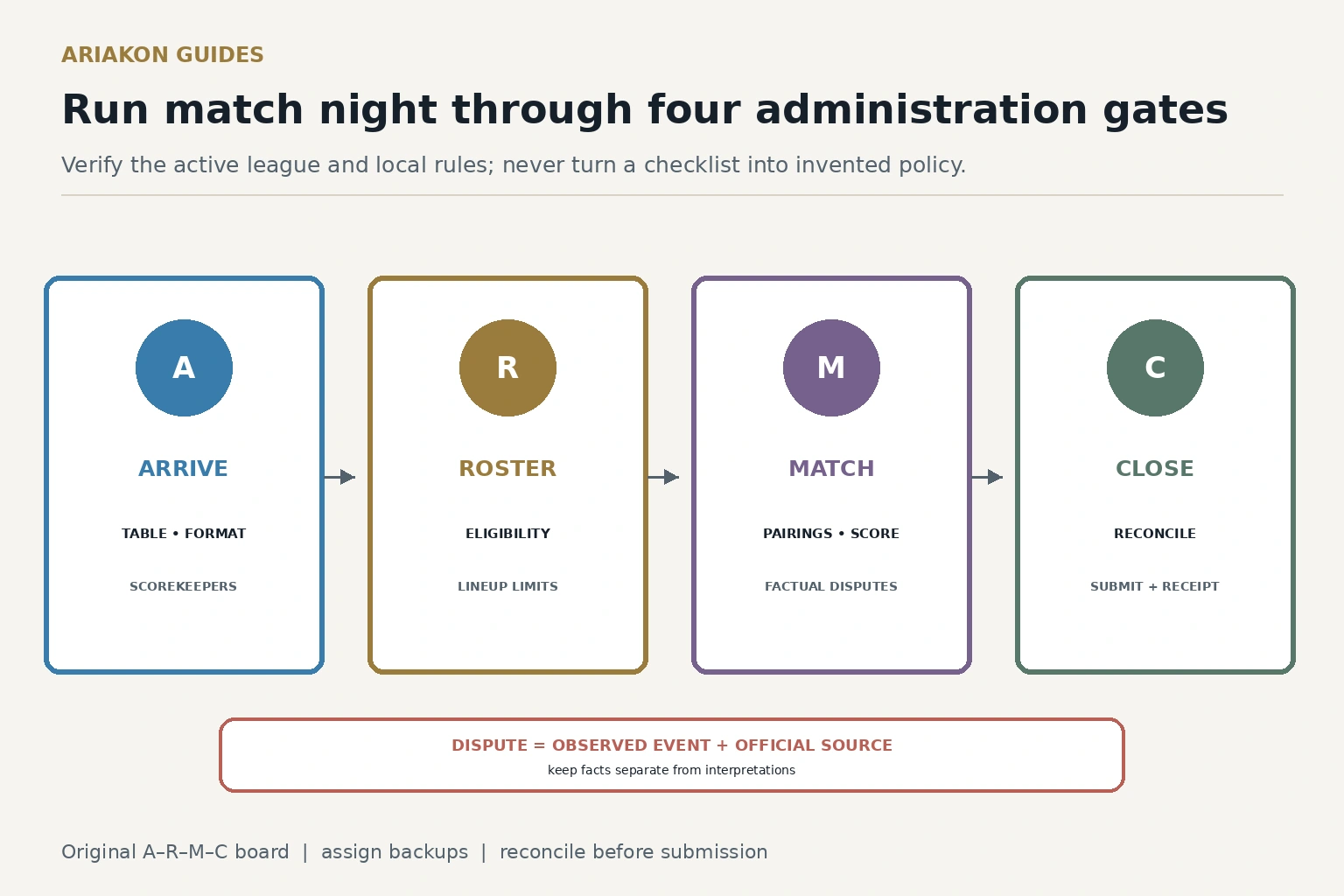
Build one match packet before leaving home
| Item | Match-night proof |
|---|---|
| Current roster and eligibility | League app, official sheet or operator source |
| Location and start time | Current schedule and host confirmation |
| Lineup limits | Active format, handicap and local rules |
| Scorekeeping method | Official paper or digital workflow |
| Fees and deadlines | League or operator instruction |
| Escalation contact | Operator or authorized division contact |
Use the broad team-captain guide for leadership, communication and season-long responsibilities.
Review pool match etiquette before assigning team conduct reminders.
Run the A–R–M–C checklist
Assign a backup captain and scorekeeper before the first pairing. Read only the fields needed for tonight; a long speech invites confusion. APA materials, for example, address roster, team order, coaching, scorekeeping, defensive shots, protests and conduct, but other organizations can use different procedures.
| Phase | Required checks |
|---|---|
| Arrive | Find the table, meet the opposing captain, confirm format and identify scorekeepers |
| Roster | Verify eligible players, absences, lineup constraints and backup choices |
| Match | Record each pairing, watch scoring, mark required events and keep disputes factual |
| Close | Reconcile totals, obtain required acknowledgments, submit by the deadline and retain proof |
Handle a disputed event as an evidence problem
Pause only through the procedure allowed by the active rules. Record the table state, players, game and exact disputed event. Separate what was observed from what each person believes the rule means. Consult the official source or authorized contact; do not invent a compromise that changes scoring.
Keep language neutral: “We agree the cue ball moved before contact; we disagree about the required remedy.” If play must continue under protest, record the required notice and timing exactly. Respectful conduct and attention to the opponent reduce avoidable disputes, but they do not replace the rule source.
Worked example: a late player changes the plan
A hypothetical team expects six players, but one reports a delay. The captain does not promise that player a later match. The A–R–M–C sheet shows five verified players present, the active lineup restriction and the local contact. The captain builds only legal pairings from present eligible players and records when the sixth player arrives.
During the third pairing, two score totals differ. The scorekeepers compare rack-level entries before anyone signs. One unmarked defensive shot is corrected only if the active procedure allows it. At close, both captains reconcile the final total, the home captain submits through the required channel and saves the receipt.
Close with a five-minute administration review
| Question | Next action |
|---|---|
| Was every player eligibility check documented? | Add the missing proof source |
| Did scoring diverge? | Identify the exact field and assign one scorekeeper |
| Did a local rule surprise the team? | Link the current rule in the next packet |
| Was submission accepted? | Save confirmation; escalate failures promptly |
| Did conduct create friction? | Address the observable behavior privately |