
Mental game · 3 min read
Track Why Your Pool Stroke Changes Between Practice and Competition
A stroke can feel different in competition because attention, pace, planning, observation and consequences change together. Recreate those demands one at a time on the same shot and log visible process evidence before making a mechanical diagnosis. This protocol is separate from slump recovery: it compares contexts, not a long run of results.
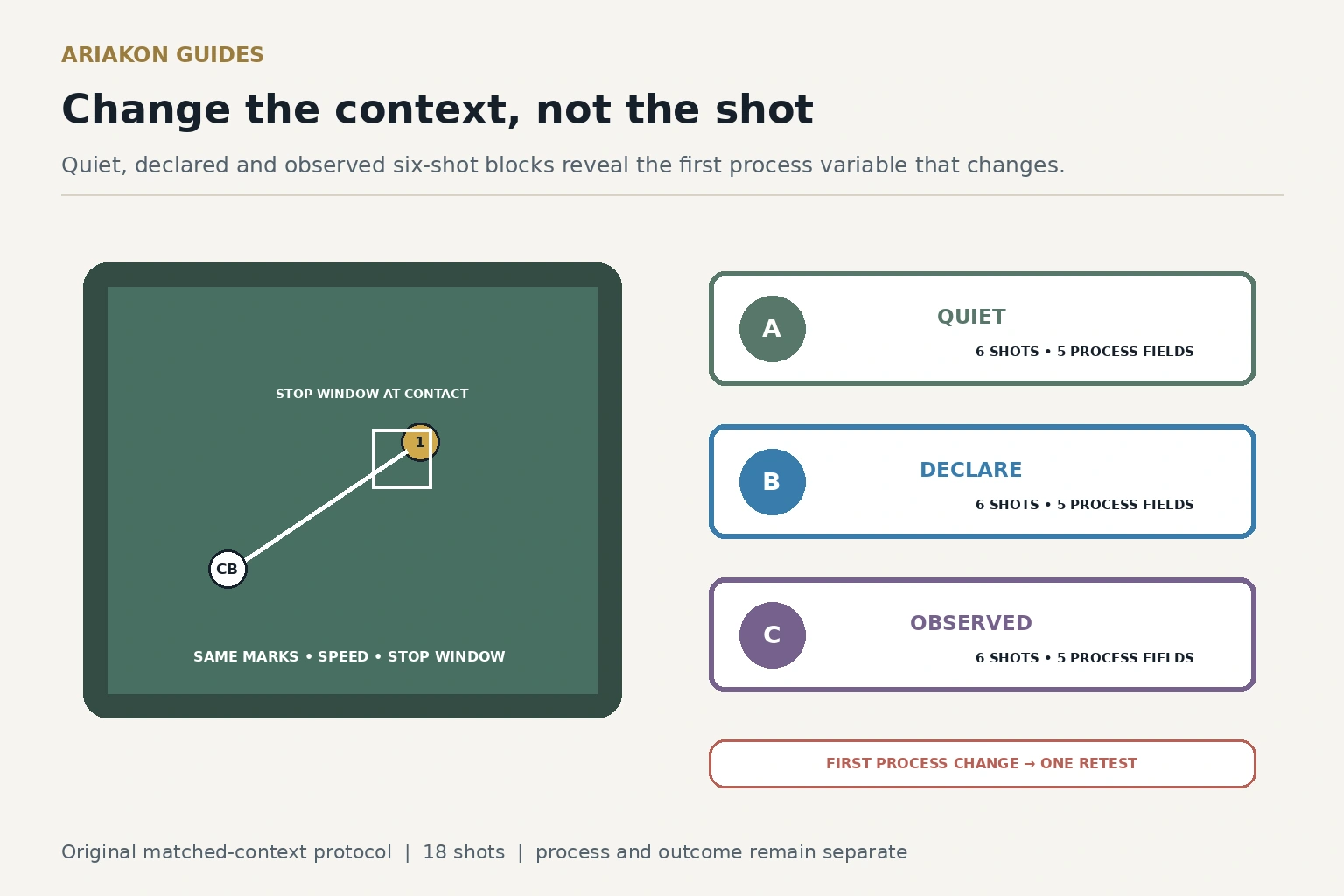
Fix the shot before changing the context
Mark a straight stop shot with the object ball one diamond from a corner pocket and the cue ball two diamonds away on the pocket centerline. Use the same cue, bridge type, vertical-axis contact, named pocket speed and two-ball-wide cue-ball stop corridor. Complete an ordinary warm-up, then shoot three blocks of six.
Do not rebuild stance, grip or aim between blocks. The intended variable is context. Stop for pain, distress, repeated miscues, unsafe fatigue or withdrawn observer consent.
Recover from a pool performance slump when the problem persists across contexts and sessions.
Build a practice pressure ladder after identifying a specific demand to rehearse.
Run three matched six-shot blocks
If Block C is not practical, use a fixed camera outside all traffic and review after the block. Recording permission and venue policy come first. A camera is an observation aid, not competition itself.
| Block | Only added demand | Boundary |
|---|---|---|
| A — Quiet | Private score after each shot | No audience or consequence |
| B — Declared | Say pocket, stop corridor and running score | Still private |
| C — Observed | Consented partner silently records | No coaching or reactions |
Track five process variables and two outcomes
Use the player's usual warmup band rather than a prescribed count. Mark uncertain when a field cannot be seen. A process change that appears before a miss is a test candidate, not proof that it caused the miss.
| Field | Mark | What it can show |
|---|---|---|
| Standing plan | Complete / incomplete | Whether the shot was decided before stance |
| Warmup band | Usual / shorter / longer | A relative rhythm change |
| Final pause | Present / absent / uncertain | One visible transition |
| Finish hold | Held / released early | Whether delivery was observed before rising |
| Restart | Used / needed but skipped / not needed | Response to a changed picture |
| Pocket and stop | Yes / no separately | Outcomes without inventing a cause |
Worked comparison: outcome hides the change
A hypothetical player pockets 5/6, 5/6 and 4/6 in Blocks A, B and C. The outcome difference is small. However, standing plans score 6, 6 and 3; usual warmup band scores 5, 5 and 2; correct restarts score 2/2, 1/2 and 0/3 when needed. The first repeatable change is lowering before the plan is complete, not a proven flaw in elbow or grip.
The next action is one observed six-shot block that scores only standing plan and correct restart. Mechanical changes wait. If the process holds but the same delivery pattern remains visible across contexts, take matched evidence to a qualified instructor.
Transfer one response to match play
| Finding | Next action |
|---|---|
| Plan changes first | Name pocket and cue-ball job while standing |
| Tempo changes first | Use one external rhythm cue, then begin |
| Finish changes first | Score a brief hold in the next matched block |
| No stable difference | Collect another comparable session |
| Health concern or severe distress | Stop and use appropriately qualified support |
Sources and further reading
References support the specific factual information above. The practical checklists are Ariakon editorial guidance.