
Practice drills · 4 min read
Three Beginner Stroke Drills With Simple Scoring
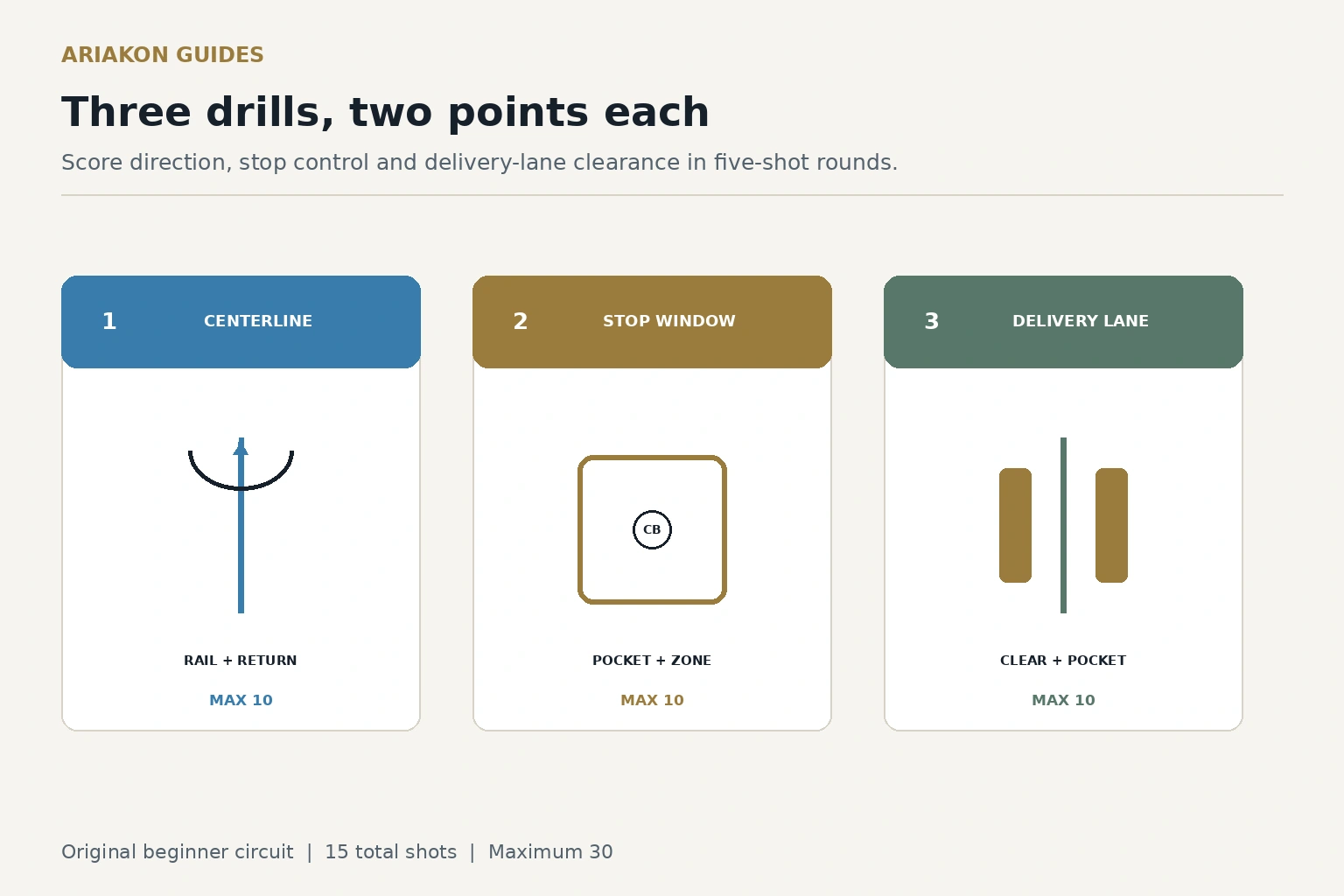
A beginner stroke session should answer a small question, not imitate an advanced workout. These three drills use short straight shots, five attempts and two visible points per shot. The first checks cue-ball direction, the second checks stop control and the third checks cue-path clearance. A low score chooses the next drill; it is not a label for the player.
Use one safe setup rule for all three drills
Work at soft to medium speed. Mark positions with removable paper reinforcements and remove anything that could contact a moving ball. Begin each drill with five unscored familiarization shots. Use a straight line to a corner pocket and shorten the cue-ball-to-object-ball distance if the pocket is missed more than half the time.
Keep the head, torso and bridge stable through cue-ball contact without forcing a rigid pose. The scoring observes outcomes; it does not prescribe one body shape for every player.
Learn a repeatable pre-shot routine so each beginner repetition begins the same way.
Move to advanced stroke drills later after the simple circuit is stable on two sessions.
Drill 1: centerline roll
Place the cue ball on the head spot or another centerline mark. Aim it softly up-table and back, without an object ball, so it contacts the middle of the short rail and returns. Keep out of other players' lanes. A legal practice surface and room rules come first.
Award 1 point if the cue ball contacts the short rail within half a diamond of center and 1 if it returns across the centerline within one ball width of the starting mark. Five attempts; maximum 10. Do not catch the moving ball.
Drill 2: stop-window shot
Set a straight object ball one diamond from a corner pocket and the cue ball one diamond behind it. Mark a stop window extending one ball width forward, backward, left and right from the cue ball's contact-position center. Call a center-ball stop-speed shot.
Award 1 point for pocketing the object ball and 1 if the cue-ball center stops inside the window. Five attempts; maximum 10. Log forward, back, left or right when it finishes outside.
For any straight stop-shot score in this guide, center the finish window on the cue-ball center at object-ball contact: one ball diameter behind the object-ball center on the incoming line. The cue-ball starting position is not the stop destination. Keep the window size fixed before the block.
Drill 3: follow-through lane
Use the same straight shot. Place two safe lightweight markers well outside the shaft path, several inches beyond the cue ball and clear of every ball path. Make the lane generously wider than the shaft. Shoot softly; no marker may sit under the cue or near the bridge hand.
Award 1 point if the cue clears the lane without touching a marker and 1 for the called pocket. Five attempts; maximum 10. If the markers cause tension or unsafe movement, remove them and substitute an overhead video observation.
Add the scores without hiding the parts
| Drill | Direction or control points | Pocket or lane points | Maximum |
|---|---|---|---|
| Centerline roll | Rail-center contacts: 0–5 | Centerline returns: 0–5 | 10 |
| Stop window | Window finishes: 0–5 | Called pockets: 0–5 | 10 |
| Follow-through lane | Gate clears: 0–5 | Called pockets: 0–5 | 10 |
| Session | Keep six component totals | Do not collapse diagnosis | 30 |
Let the lowest component choose the repeat
Worked example: a player scores 7, 5 and 8. The stop-window drill includes four made balls but only one cue ball in the window. The next block repeats the stop shot with the same aim and a clearer contact-height call. The result does not justify changing stance and grip as well.
| Lowest component | Repeat | One change allowed |
|---|---|---|
| Rail-center contact | Centerline roll | Shorter distance |
| Centerline return | Centerline roll | Softer speed |
| Stop window | Stop shot | Contact-height call |
| Pocket count | Short straight shot | Standing alignment |
| Lane clearance | Wide delivery lane | Lighter grip call |
Finish with six game-transfer shots
Place a second object ball in an easy next-shot position. Play six two-ball attempts: pocket the first with a stop-window finish, then shoot the second. Award 1 for the first pocket, 1 for the stop window and 1 for the second pocket; maximum 18. Keep this transfer score separate from the thirty-point stroke circuit because it adds planning and a second aim.