
Mental game · 3 min read
Separate a Pool Slump From Normal Score Variation
A lower score can come from ordinary attempt-to-attempt variation, harder conditions or a repeatable weakness. Calling every dip a slump adds a global label before the evidence exists. This guide provides a matched-score screen and response script; it does not diagnose mental health or promise a performance outcome. The recovery guide remains the next resource when a persistent pattern is established.
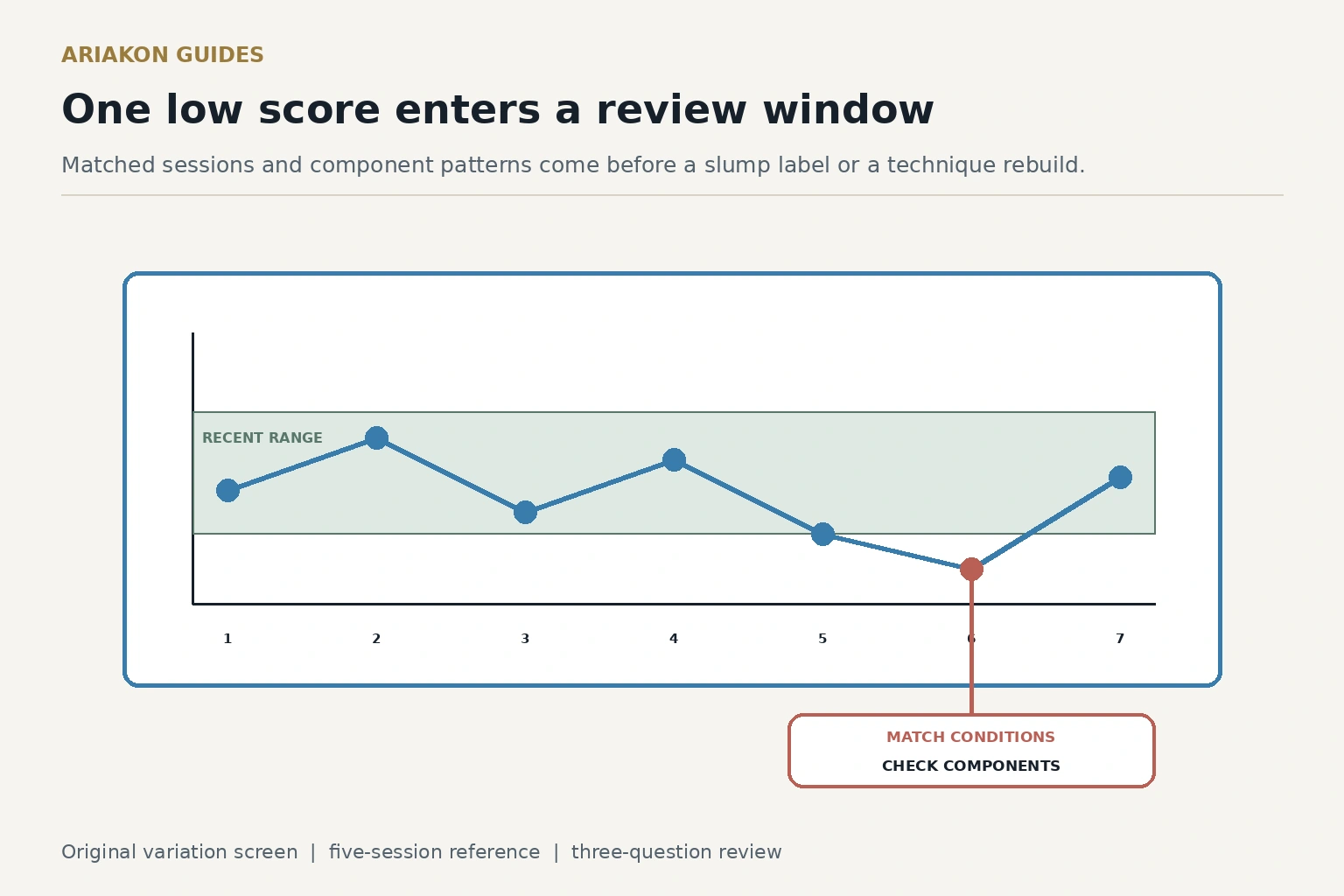
Build a five-session reference band
Complete the same twenty-attempt task in five ordinary sessions before using it as a reference. Keep every score, including the low and high ones. A band is descriptive evidence for your setup, not a universal rating.
For a make/miss task, scores are counts of repeated outcomes and will naturally vary even when the underlying chance has not obviously changed. NIST's binomial reference formalizes that repeated binary outcomes have a distribution rather than one guaranteed total; this worksheet uses that principle qualitatively and does not claim a significance test.
| Hold steady | Record | Do not assume |
|---|---|---|
| Same marked drill | Attempts and component points | A different layout is comparable |
| Same scoring rule | Makes, zone hits, fouls and routine completion | A total explains the cause |
| Similar warm-up | Start time and block order | Cold and warmed scores are identical |
| Known equipment and table | Material changes or obvious table difference | Every room plays the same |
| At least 20 attempts | Raw result, not only percentage | One miss defines a trend |
Use the performance-slump recovery plan after a repeated decline has been identified.
Respond productively to one lower practice score when the evidence is only one session.
Run the three-question slump screen
Use three matched sessions as a review trigger, not a statistical law. The purpose is to prevent one emotional result from becoming a diagnosis while still acting when a specific weakness repeats.
| Question | If no | If yes |
|---|---|---|
| Were conditions close enough to compare? | Record context; repeat matched | Compare components |
| Is the same component down in three matched sessions? | Treat as a dip and keep observing | Isolate that component |
| Does a simple baseline reproduce it? | Review decision or pressure context | Build a narrow practice response |
Use a repeatable response script
| Step | Say or write | Action |
|---|---|---|
| F — Facts | ‘The last three speed scores were below my five-session band.’ | Name the exact measure |
| A — Alternate causes | ‘Table speed and rushed setup may contribute.’ | List testable conditions |
| C — Controlled test | ‘I will repeat twelve lag-zone attempts.’ | Change no technique yet |
| T — Time boundary | ‘I will decide after the next two matched sessions.’ | Stop daily re-labeling |
Worked example: a dip that needs observation
A hypothetical twenty-shot baseline across five sessions is 12, 14, 11, 13 and 10 makes. The next session is 9. That result is below the recent range, but it is one observation. The player records two unusual conditions—no warm-up and a tighter pocket—and repeats the same setup twice before changing technique.
The next matched scores are 12 and 13, with no repeated miss side. The evidence supports normal variation and context, not a continuing pocketing decline. If the next three matched sessions instead produced repeated thick misses and a lateral cue-ball finish, the player would isolate delivery.
Keep the log useful and bounded
Stop the exercise if tracking increases distress or encourages endless testing. A coach can help with table performance; persistent low mood, anxiety or health concerns belong with an appropriate qualified professional, not a pool scorecard.
| Date/setup | Score | Component pattern | Conditions | Next action |
|---|---|---|---|---|
| Session 1 / straight 20 | 12/20 | 4 thin, 4 thick | Normal warm-up | Continue |
| Session 6 / same marks | 9/20 | No stable side | No warm-up, new table | Repeat matched |
| Session 7 / same marks | 12/20 | No stable side | Baseline conditions | Do not label slump |
Sources and further reading
References support the specific factual information above. The practical checklists are Ariakon editorial guidance.