
Mental game · 4 min read
Respond to a Lucky Pool Roll Without Changing Your Next Decision
A fortunate kiss or unlucky leave is already part of the table by the time you stand to shoot. The broad lucky-roll guide explains why variance should not rewrite a match plan. This guide narrows the task to the next sixty seconds: state one fact, interrupt the reaction, rebuild the legal choices and commit to one current-table decision.
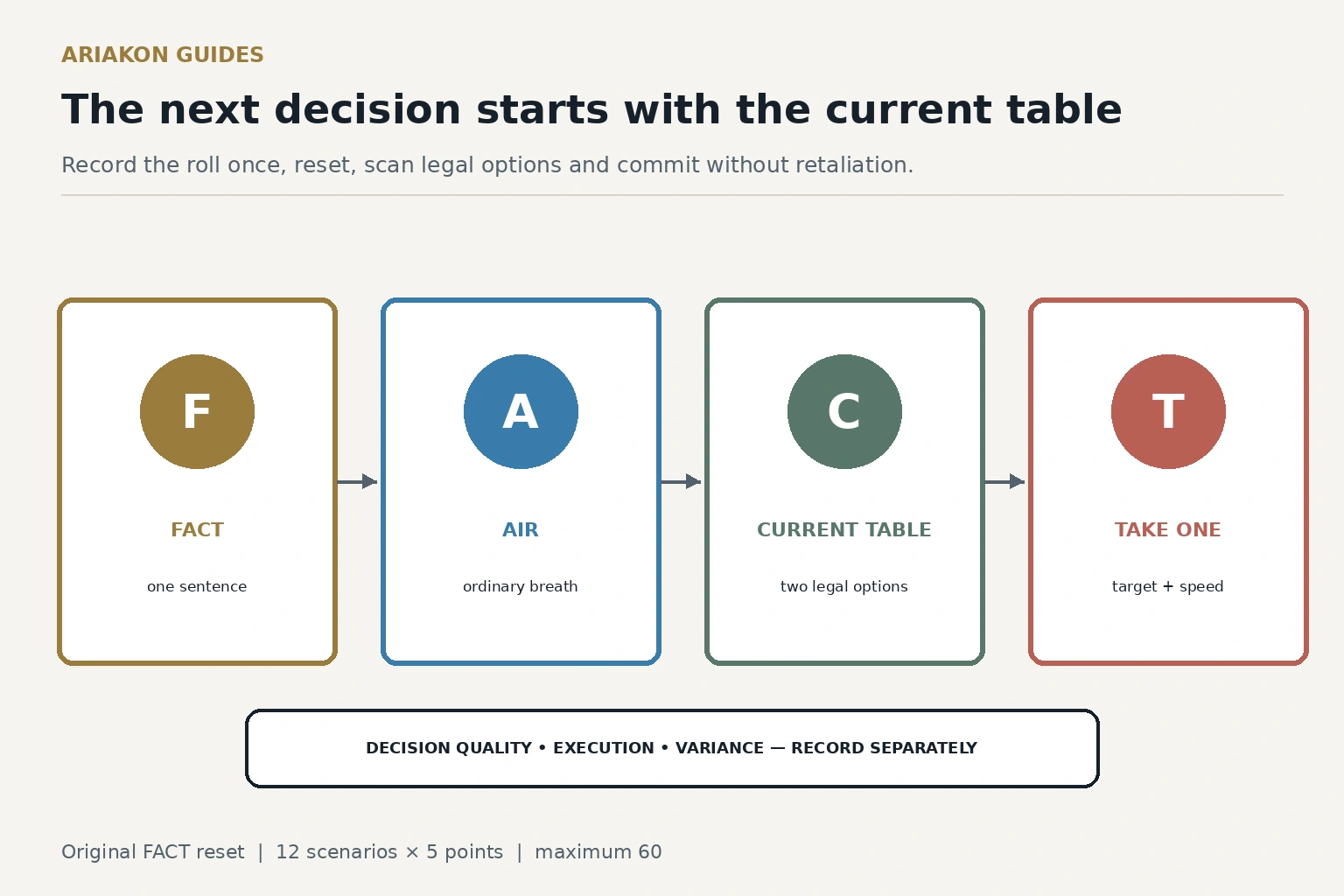
Use four steps before approaching the shot
Association for Applied Sport Psychology guidance on pressure routines recommends reviewing and letting go of the previous point, redirecting attention to strategy, breathing and using a present-focused cue word. FACT adapts that structure to a pool table without claiming to control emotion or guarantee an outcome.
If the event uses a shot clock, the event rules and referee control the available time. The reset must fit inside that procedure; it is not permission to delay play.
| Step | Action | Stop condition |
|---|---|---|
| F — Fact | Describe only the ball movement and resulting leave | No claim about fairness, intent or the rest of the match |
| A — Air | Take one comfortable breath and release grip tension | Breathing feels ordinary; do not turn it into a contest |
| C — Current table | Check legal first contact, pockets, scratches, blockers and safeties | At least two legal choices are named when available |
| T — Take one decision | Choose target, cue-ball task and speed while standing | Lower only after the choice is complete |
Review the broader lucky-roll match plan for sportsmanship and post-match review.
Use a one-route, one-speed plan after the current options are clear.
Separate the roll from the decision ledger
The ledger prevents a lucky event from being used as the explanation for every later result. Decision quality is judged from information available before the stroke. Execution is judged against the declared plan. A new kiss after a sound attempt can remain variance rather than proof that the decision was wrong.
| Field | Write before lowering | Evidence after the shot |
|---|---|---|
| Event | One factual sentence | Do not revisit it this inning |
| Option A | Pocket or safety plus failure cost | Was the option available as read? |
| Option B | Simpler alternative plus failure cost | Would it have reduced exposure? |
| Choice | Ball, target, cue-ball task, speed | Did execution match the choice? |
| Review | Decision / execution / variance | Assign only one primary label |
Practice twelve forced-response scenarios
Rebuild each layout with marked ball centers. Say FACT aloud, write two options and then play one. Reset the same position four times so the exercise measures the response process instead of inventing twelve unrelated trick shots.
Award one point each for a factual event statement, complete table scan, two compared options, declared choice and full pre-shot routine. Twelve attempts yield a maximum of sixty. Pocketing is recorded separately and never repairs a missing decision step.
| Scenario | Starting fact | Required comparison |
|---|---|---|
| A — fortunate leave | A missed object ball leaves the opponent hooked | Attack versus containment after ball in hand is unavailable |
| B — unlucky leave | A legal pocket sends the cue ball behind a blocker | Kick, intentional foul where rules allow, or damage-limiting contact |
| C — neutral surprise | A kiss opens one pocket and closes another | Original route versus a new simple route |
Worked response without a luck story
A hypothetical player misses the 6 but a kiss hides the cue ball behind the 8. The fact is: “The 6 stayed up and the cue ball finished behind the 8.” The opponent now faces the position, so the player sits quietly rather than apologizing repeatedly or celebrating. On the next visit, the layout is scanned from zero instead of assuming the rack is owed to fortune.
Later, the opponent misses and leaves a thin 6. The player compares a low-percentage cut with a containing safety, chooses the safety, names the cue-ball speed and completes the normal routine. Whether the safety succeeds is reviewed separately from the earlier kiss.
Keep the script only if it protects decisions
After three sessions, compare FACT scores with ordinary-routine scores. Keep the card if it reduces skipped scans or retaliation shots. Shorten it to “fact, table, choice” if the full words become distracting.
Persistent distress, anger or anxiety outside normal competition belongs outside this practice guide. Seek an appropriately qualified professional when performance routines are not enough; this exercise is not diagnosis or treatment.
Sources and further reading
References support the specific factual information above. The practical checklists are Ariakon editorial guidance.