
Practice drills · 3 min read
Progress From Short Pool Shots to Longer Shots With the Same Routine
Longer shots expose small alignment and delivery errors, but distance should not create a completely different routine. This ladder holds the pocket, object ball and center-ball plan constant while the cue ball moves farther away. The score separates pocketing from process so a lucky make does not hide a rushed approach and a clean miss does not erase a stable routine.
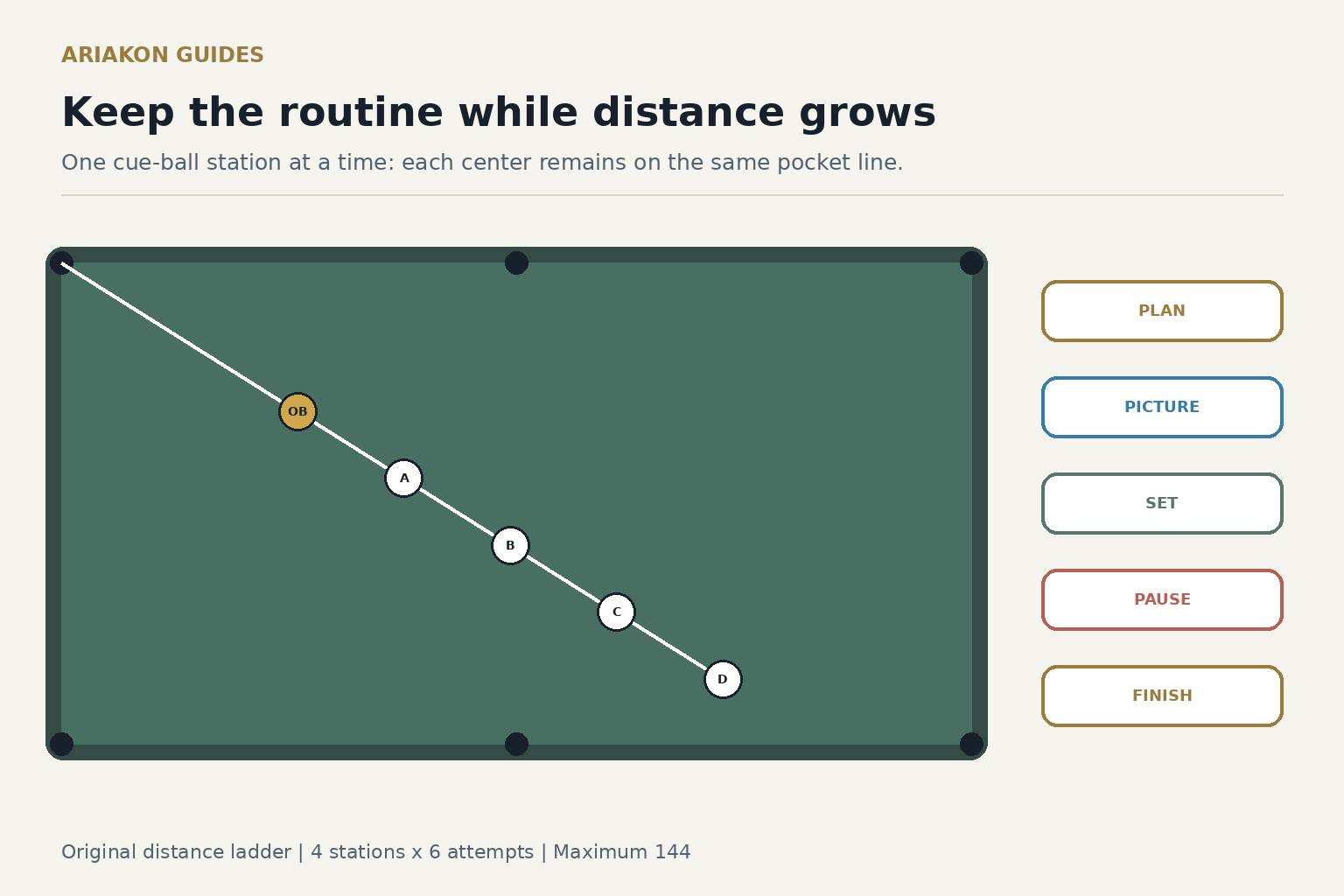
Mark one line and four cue-ball stations
Place an object ball one diamond from a corner pocket on a straight line to pocket center. Mark four cue-ball centers behind it at about one, two, three and four diamonds, shortened as needed to avoid a cushion or uncomfortable bridge. Use the same cue, bridge style, center-ball contact and pocket throughout. Remove loose markers before every shot.
The station is a routine test, not a claim that all straight shots play identically. More distance increases the effect of small line errors and may require more delivery speed. Keep the planning sequence fixed while allowing a comfortable bridge length and enough speed to reach the pocket.
Build a repeatable pre-shot routine before using distance as a test.
Approach along a chosen line if bridge placement changes between stations.
Freeze a five-check routine
Have a partner record checks or use safe rear video; self-score immediately after the ball stops. Each check is one point and the pocket is one additional point. A stand-up reset preserves the process point when the player restarts from standing. Changing aim while down loses the Set point even if the ball drops.
| Check | Observable evidence |
|---|---|
| Plan | Pocket, contact and speed chosen while standing |
| Picture | Shot line viewed before first step |
| Set | Bridge and cue settle without sideways search |
| Pause | Final backswing is not rushed |
| Finish | Head and bridge remain stable through contact |
Run a twenty-four-shot distance ladder
If a station misses its condition, repeat it on the next practice day rather than taking unlimited attempts. Record miss side and which routine check failed. Advancement is based on a useful denominator, not on making the last ball after several unrecorded retries.
| Station | Distance | Advance condition |
|---|---|---|
| A | About 1 diamond | At least 5 makes and 25/30 process points |
| B | About 2 diamonds | At least 4 makes and 24/30 process points |
| C | About 3 diamonds | At least 4 makes and 24/30 process points |
| D | About 4 diamonds | Record baseline; do not force promotion |
| Maximum 144 | 24 shots × 6 points | Pocket and process recorded separately |
Diagnose a distance failure before changing aim
| Pattern | Next check |
|---|---|
| Process drops before makes | Slow the standing picture and approach; retain station |
| Process stable; misses alternate | Check cue delivery and center contact |
| Process stable; misses one side | Check setup line and vision placement |
| Pocket jaw reached but speed dies | Add only enough delivery speed; keep routine timing |
| Near station also deteriorates | End distance work and restore the short baseline |
Worked example and game transfer
A player scores 30/36 at Station A, 29 at B, 25 at C and 20 at D. Makes are 6, 5, 4 and 2. At D the Picture and Set checks disappear on four attempts while misses split left and right. The next action is not an aiming correction; it is a six-shot Station C/D alternating block with a deliberate stand-up picture.
For transfer, place the same object ball and shoot eight attempts alternating Stations B and D in random order. Call the distance before approaching. Score the same six points. Compare the process score per observed attempt with the corresponding B/D baseline; rescale both to the same denominator. If the difference is no more than one process point per attempt, move the object ball to a mild cut while retaining the four cue-ball distances. If not, keep the straight picture and stabilize the transition.
Use a nine-position aiming practice after one line remains stable across distance.