
Competition · 3 min read
Pool Match Terms: Races, Sets, Spots and Clear Agreements
A race, a set and a spot are not interchangeable. A game or rack produces one result; a race ends when a player reaches the agreed number of game wins; a set can contain a declared race or rack count. Spot can mean placing a ball on a marked table location in a rulebook, or an informal competitive advantage. Write the meaning before the break.
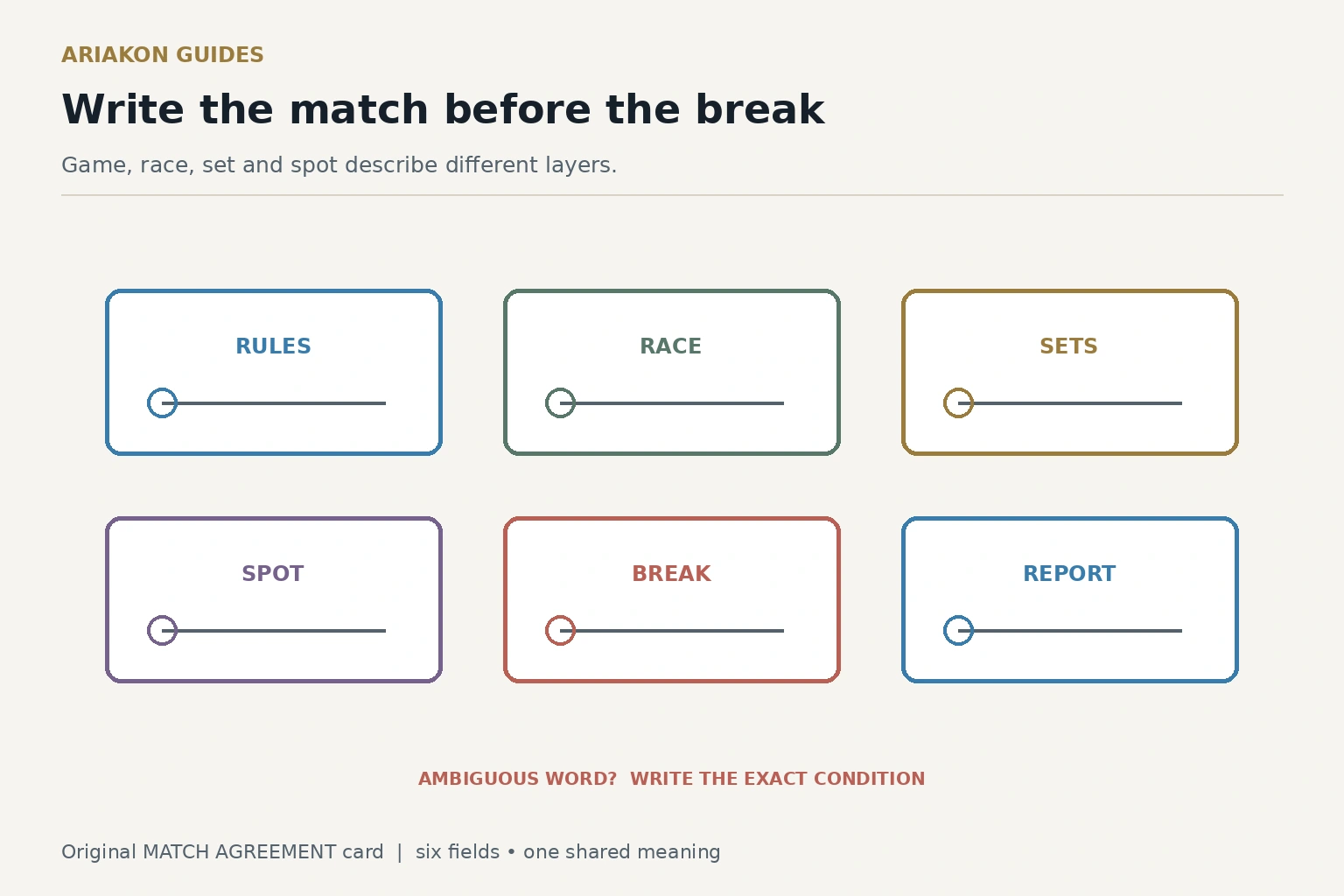
Separate six match fields
WPA rules use spot as a table location when balls are placed on the long string. Informal pool also uses spot for a handicap or advantage. Those meanings must stay separate from a ball that is physically spotted during play.
Current CSI material gives a useful event example: a set can be a declared player-versus-player unit made of a race or fixed number of racks, while the event player guide and tournament regulations control the actual format.
| Field | Clear entry | Ambiguous entry |
|---|---|---|
| Discipline | WPA nine-ball rules dated September 15, 2025 | Normal nine-ball |
| Race | First to seven game wins | A short race |
| Sets | Best two of three sets; each set race to four | Two sets |
| Spot or handicap | Player B begins each set with one game, 1–0 | Give a game |
| Break | Alternate break; lag for first break | We alternate somehow |
| Finish | Record set score and name who reports it | Winner tells someone |
Understand common pool action terms for broader neutral match-negotiation language.
Read event formats in layers when an organizer supplies the agreement.
Test the agreement with three scenarios
Worked example: two players agree to best two of three races to four with Player B starting each race 1–0. They choose alternate break and write that no set needs a two-game margin. The card now answers the score at 3–3 and the reset after set one.
For organized competition, never replace the published player guide with a private agreement. Ask the tournament director before play if a field is missing or conflicts with the event documents.
| Scenario | Question | Acceptable written answer |
|---|---|---|
| Score reaches 3–3 in a race to four | Is there win-by-two? | No; the next game wins the set |
| Handicap player starts 1–0 | Does the score reset next set? | Yes; each new set begins 1–0 |
| A rule requires a ball to be spotted | Who places it and where? | Apply the named rulebook and ask the referee if present |
Review clarity after the match
If the match involves money or another prize, confirm local law and venue policy. Ariakon does not provide legal advice or facilitate wagering; the card's purpose is clear rules and safe play.
| Observed problem | Likely missing field | Next version |
|---|---|---|
| Players disagree at hill-hill | Race finish or win-by-two | Write exact closing condition |
| Break order is disputed | Opening lag and break format | Add a break row |
| Handicap changes mid-match | Spot duration | State game, race or full-session scope |
| Venue stops play | Time and house boundary | Confirm venue conditions first |
Sources and further reading
References support the specific factual information above. The practical checklists are Ariakon editorial guidance.