
Competition · 4 min read
Plan a Pool Comeback When You Are Several Racks Behind
Several racks behind, you cannot win those racks again. You can only improve the quality of the next decision and remain eligible for another turn. A comeback plan should not demand hero shots or promise momentum. This guide adds a scored deficit simulation and rack ledger to the general next-decision comeback approach, so the player can rehearse what to do when the scoreboard is loud and opportunities are limited.
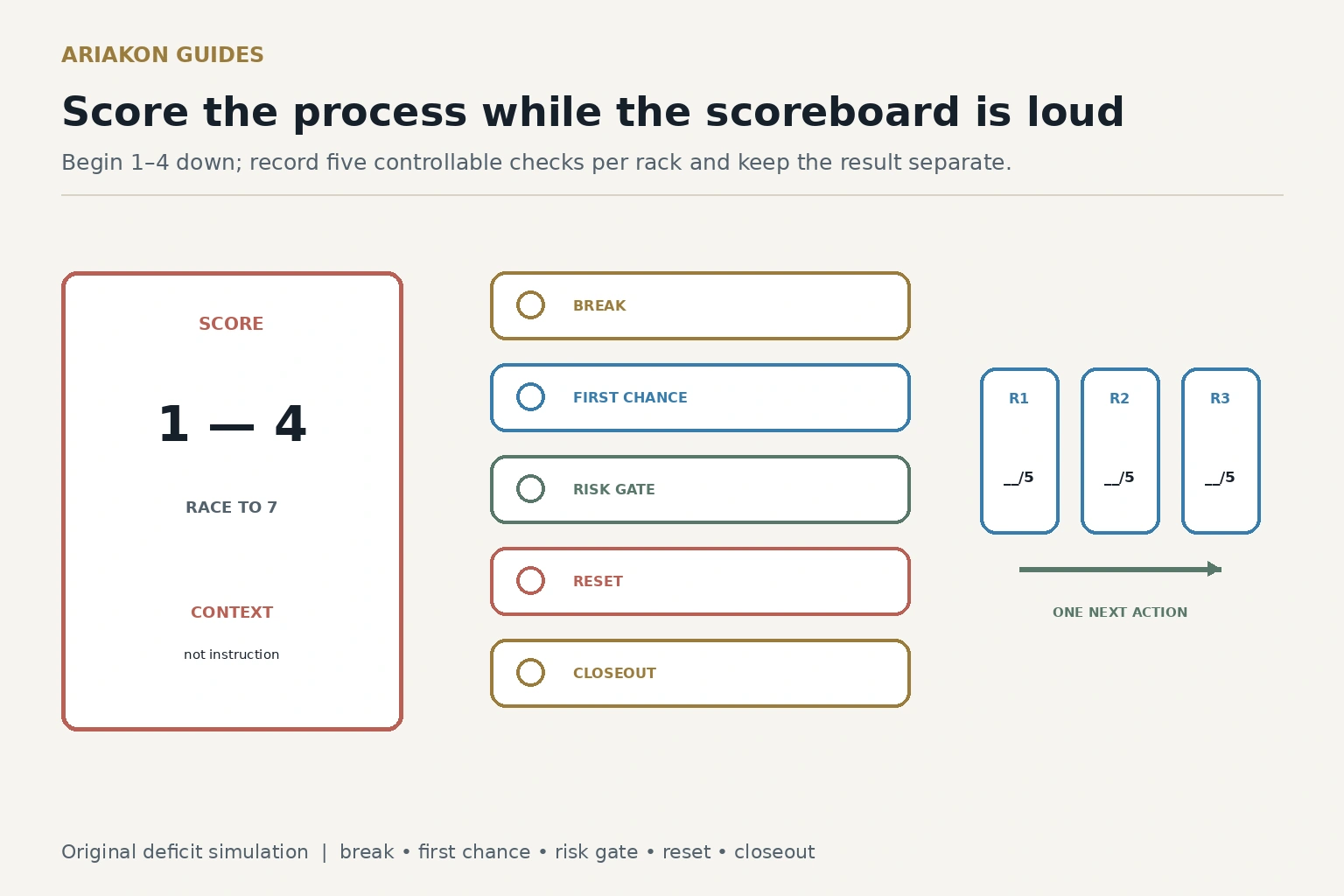
Translate the deficit into remaining opportunities
Confirm the real score, race length, break order and format. Write how many racks the opponent needs and how many you need. Do not change a sound shot merely because the arithmetic feels urgent. The deficit changes the value of giving away a turn, not the geometry of the table.
Choose one process objective for the next rack: keep the break cue ball in a named zone, use the full routine on the first open shot, or apply a defined risk gate before attacking. Specific, observable process goals are controllable and reviewable; win the next three is an outcome target that provides no instruction.
Build a pool match comeback one decision at a time for the general live-match checklist.
Prepare for an important pool match before score pressure begins.
Use a five-check rack ledger
A legal safety can earn the risk-gate point; a difficult make can miss it if no failure cost was considered. This keeps the ledger from rewarding recklessness. Use the governing rules for calls, fouls, concessions and scorekeeping; local competition documents control the actual match.
| Checkpoint | Earn the point when |
|---|---|
| Break decision | Correct break order is confirmed; when breaking, legal plan and cue-ball target are named |
| First chance | First opportunity receives a complete plan, or the player correctly remains seated if no turn is offered |
| Risk gate | Attack is chosen only with a named pocket, position route and failure cost |
| Reset | After an error or opponent success, one breath/cue statement returns attention to the table |
| Closeout | Score is confirmed and one observable note is written after the rack |
| Maximum 5 | Rack result is recorded separately and does not add a process point |
Run three deficit simulations
Play a race-to-seven simulation beginning 1–4 down. Use the correct break order for the format and either a practice partner or a ghost level that normally produces meaningful decisions. Play until either side reaches seven. After each rack, take no more than thirty seconds to mark the five checks and one error code: B break, P pocketing, C cue-ball control, D decision or R routine.
Repeat the simulation three times on separate sets or days. Do not lower the opponent/ghost level after a loss. The purpose is representative pressure and decision evidence, not manufacturing a comeback percentage. Maximum process score is five times the actual racks played, so report both numerator and denominator.
| Set | Starting score | Final score | Process points | Most frequent error | One next action |
|---|---|---|---|---|---|
| 1 | 1–4 | __–__ | __ / __ | B / P / C / D / R | One bounded drill |
| 2 | 1–4 | __–__ | __ / __ | B / P / C / D / R | Preserve or change one process |
| 3 | 1–4 | __–__ | __ / __ | B / P / C / D / R | Match-transfer cue |
Worked example: the loss still improves the comeback plan
Down 1–4, the player loses 4–7 after six more racks. The process score is 24 of 30. All six first-chance and reset points are earned, but only three of six risk-gate points. The ledger shows two low-percentage attacks with open-table safety options and one aggressive bank chosen immediately after the opponent's break-and-run.
The next action is a twelve-layout cut-versus-safety comparison, not a promise to be more confident. In the second simulation the player uses the written gate—pocket, route, failure cost—and scores five of six risk points. Whether the set is won remains separate evidence.
Change one process, not your whole game
In a live match, keep the ledger mental and brief. Do not delay play, coach yourself through the opponent's turn or violate event rules. Afterward, record the facts while they are fresh. If competition anxiety is persistent or disruptive beyond ordinary performance pressure, a qualified mental-performance or health professional—not an article—should guide the next step.
| Pattern in ledger | Next adjustment |
|---|---|
| Break checks fail | Return to a legal cue-ball-control break block |
| First-chance checks fail | Use a standing three-question decision card |
| Risk-gate checks fail | Compare runout chance, safety chance and failure cost |
| Reset checks fail | Pair one exhale with a short process cue statement |
| Closeout checks fail | Confirm score immediately and write one fact only |
| High process, few rack wins | Preserve process; diagnose the dominant execution code |
Sources and further reading
References support the specific factual information above. The practical checklists are Ariakon editorial guidance.