
Practice drills · 3 min read
Choose a Ghost Pool Format That Fits Your Current Runout Ability
Playing the ghost means the imaginary opponent does not miss: after the declared opening procedure, you receive one offensive turn to complete the rack. That makes the exercise useful for runout planning, but it does not measure safety play or every match skill. Choose the ball count and rule set that create real decisions while still producing enough successful racks to learn from.
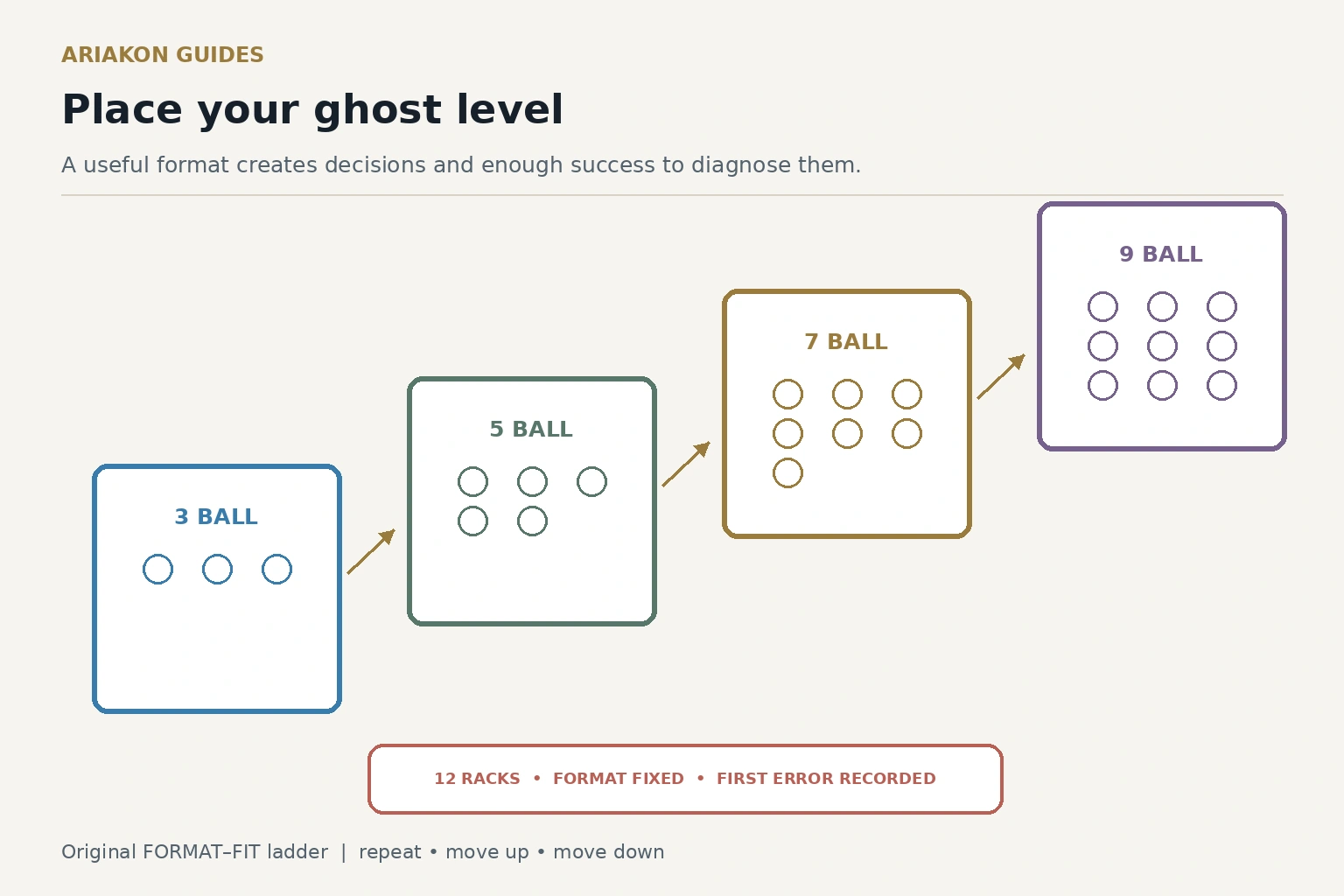
Write one FORMAT–FIT card before racking
Ghost practice has many house variants. Declare the ball count, opening procedure, ball-in-hand privilege and legal-shot standard before starting. This article supplies an original placement worksheet; its score is meaningful only with that complete format attached.
Use the same rack template and legal-shot standard for all twelve racks. Do not quietly rerack an ugly spread; pattern difficulty is part of the offensive test unless your written format says otherwise.
| Field | Write it exactly | Why it matters |
|---|---|---|
| Ball count | Start with 3, 5, 7 or 9 balls | Changes pattern length and cluster risk |
| Opening | Break or hand-spread; ball in hand or fixed start | Changes the first-shot advantage |
| Order | Rotation or any-order pockets | Changes route constraints |
| Rack result | Win only after a legal runout; miss or foul ends rack | Prevents mid-session negotiation |
| Score | Rack win plus balls made before the miss | Shows progress when wins are scarce |
| Table | Table size, pocket condition and session date | Keeps future comparisons honest |
Use the Ghost to measure pool progress for a complete-session log and error categories.
Build a ten-skill pool baseline when you need defense, speed and fundamentals beyond runouts.
Run the twelve-rack placement test
After each rack, write only the first decisive event: missed makeable ball, lost cue-ball route, unopened cluster, foul or successful plan. A long story after every miss hides the repeated pattern.
Use the result as placement evidence, not a permanent rating. Four or more wins in twelve racks with several unfinished racks ending late may be a workable level. Zero wins with most racks ending in the first half suggests removing one or two balls; ten or more wins suggests adding one ball or tightening one written condition.
| Block | Racks | Record | Do not change |
|---|---|---|---|
| Settle | 1–4 | Wins and balls before ending | Ball count or opening rule |
| Plan | 5–8 | First decision that made the rack easier or harder | Scoring |
| Transfer | 9–12 | Wins, balls and one match-like pressure cue | Table or equipment |
Work one honest placement example
This player is neither beating the format automatically nor failing before meaningful decisions occur. The five-ball version stays. The player isolates the repeated 3-ball route for ten attempts, then returns to the unchanged ghost card on another day.
A safety-inclusive ghost variant is a different test and needs its own written rule. Do not combine those scores with the offensive baseline.
| Evidence | Observed result | Next action |
|---|---|---|
| Rack wins | 5 of 12 | Keep five balls for the next session |
| Average balls before ending | 3.8 | Do not add difficulty yet |
| Repeated first error | Two-rack position route from the 3 | Practice that route separately |
| Retention check | At least 4 wins next visit | Then test six balls |
Sources and further reading
References support the specific factual information above. The practical checklists are Ariakon editorial guidance.