
Mental game · 3 min read
Build a Pool Tournament Nerves Checklist Before Your First Match
Nerves before a first tournament match are not proof that preparation failed. The useful response is to separate facts you can settle from sensations you cannot command. Build one short checklist before the event, rehearse it under modest consequence, and record whether the routine returned—not whether you felt perfectly calm.
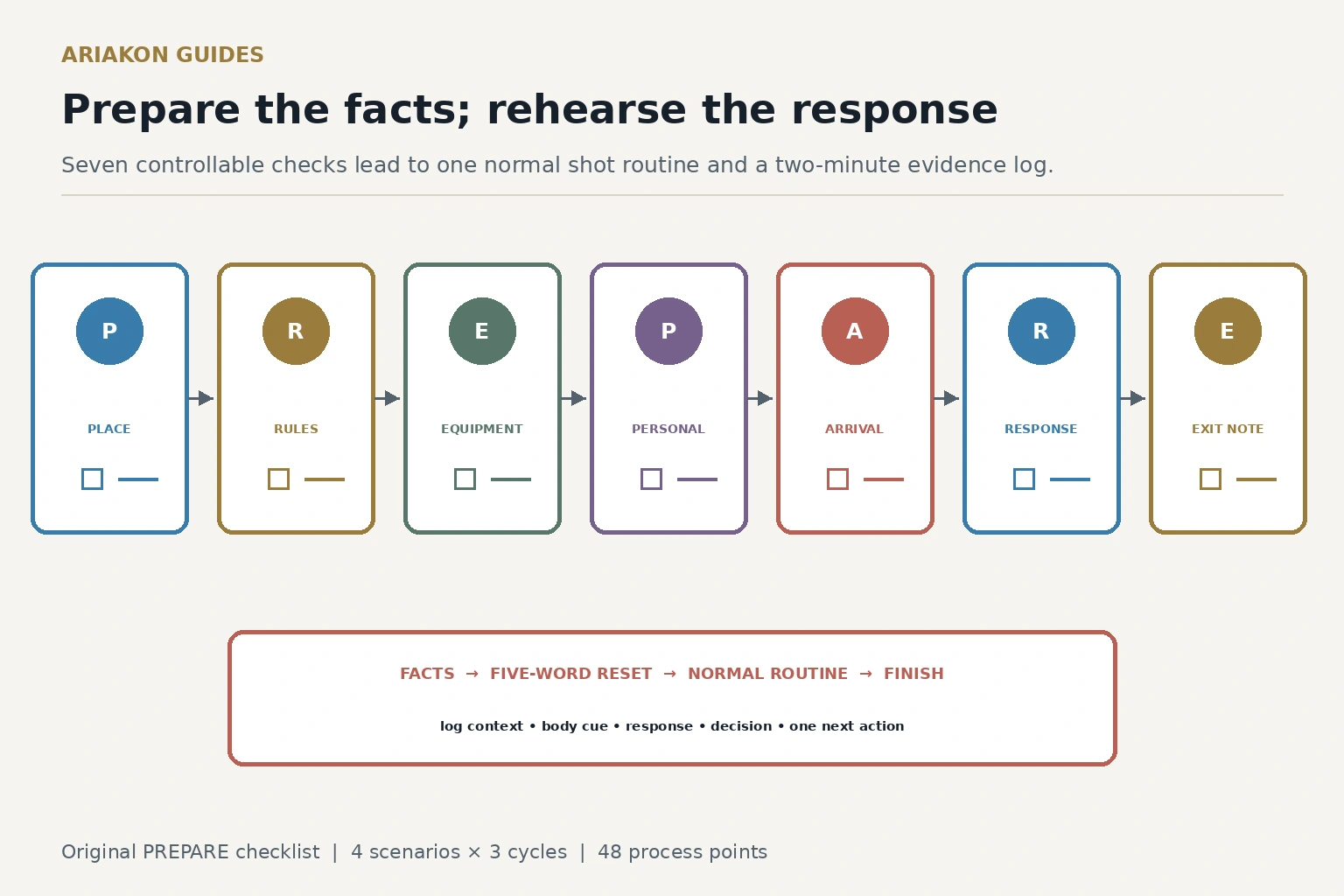
Complete PREPARE before match day
Use the event's own rules rather than assuming league customs apply. Write unknown beside any unsettled entry and ask the organizer. Once an answer is recorded, stop repeatedly checking it unless the organizer announces a change.
The response script should be descriptive rather than motivational: ‘Fast breath; feet; line; smooth finish.’ AASP goal-setting guidance favors specific, observable actions under the athlete's control. This checklist follows that boundary; it is a performance routine, not treatment for an anxiety disorder. Persistent or overwhelming symptoms deserve support from a qualified health professional.
| Letter | Action | Evidence |
|---|---|---|
| P — Place | Confirm venue, table area, parking and check-in desk | Saved address and arrival plan |
| R — Rules | Read the organizer's current rules, race and break format | Dated packet or official page |
| E — Equipment | Inspect cue, tip, joints, case and permitted accessories | Nothing loose, damaged or unknown |
| P — Personal | Plan food, water, medication, clothing and rest | Items fit venue policy and personal needs |
| A — Arrival | Allow check-in, payment and warm-up time | One written target time |
| R — Response | Choose a five-word reset and normal shot routine | Script rehearsed aloud |
| E — Exit note | Reserve two minutes for a factual review | Blank log already in the case |
Build the broader competition routine before condensing it into the first-match card.
Pack for multiple tournament disciplines when the event schedule includes more than one game.
Rehearse twelve match-entry cycles
Stage four entries: the first shot of a set, the first shot after a long wait, an easy ball after the opponent misses, and a hill-hill decision with two routes. Run three cycles of each. Add a small consequence such as resetting the full scenario after a skipped routine, not punishment or exhaustion.
Worked example: the player scores 12 facts, 10 resets, 8 routines and 7 finishes for 37/48. Nine balls are made, but the useful pattern is that the finish disappears after waiting. The next practice is six wait-then-shoot cycles. The evidence does not promise that nerves vanish; it shows which controllable step needs rehearsal.
| Point | Observable condition |
|---|---|
| 1 — Facts | Player states the rule, score and legal ball correctly |
| 1 — Reset | Five-word response is used once without adding a speech |
| 1 — Routine | Normal standing decision and preshot routine are completed |
| 1 — Finish | Player stays down long enough to observe the result |
| Maximum | 48 process points; ball outcome is recorded separately |
Use a two-minute post-match log
Close the log after naming one next action. If the same difficulty appears across several matches, bring the notes to a qualified instructor or mental-performance professional. A short record makes the conversation concrete without turning normal competition arousal into a medical claim.
| Field | Write | Avoid |
|---|---|---|
| Context | Event, opponent, format, score and table conditions | A global judgment about talent |
| Body cue | One observable sign such as fast walk or tight grip | A diagnosis |
| Response | Which PREPARE step was used or skipped | Claiming a feeling caused every miss |
| Decision | One shot choice to review | Replaying the entire match |
| Next action | One six-attempt rehearsal | Ten unrelated changes |
Sources and further reading
References support the specific factual information above. The practical checklists are Ariakon editorial guidance.