
Competition · 4 min read
A Pool Player's Responsibilities Before, During and After a Match
A player cannot delegate responsibility for knowing the format, recognizing a live turn or checking the final score. Current WPA rules put rules, regulations and schedules on the player even when officials make the information available. This guide turns that broad duty into a practical before-during-after card. It is a preparation aid, not a replacement for the event sheet, referee or house rules.
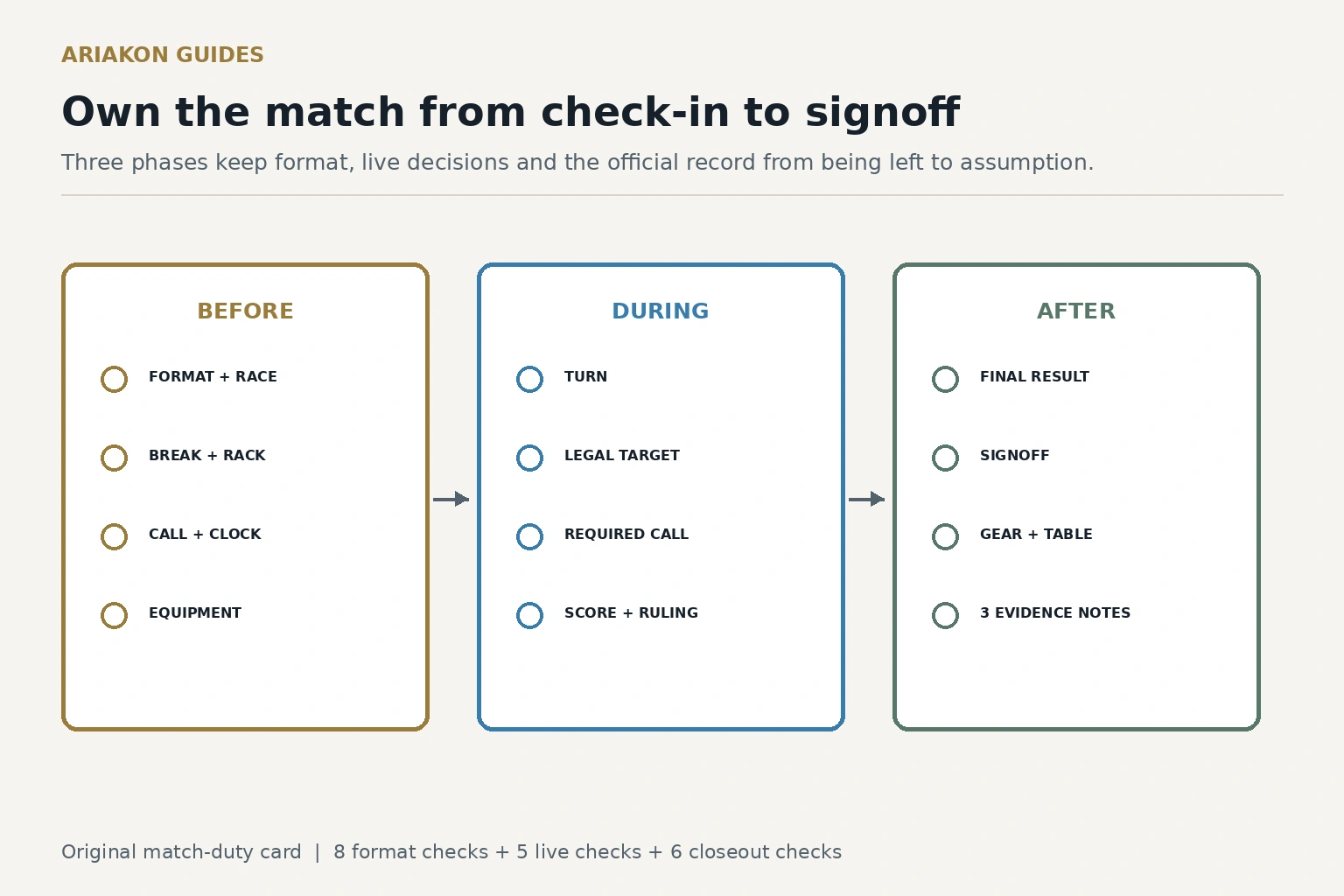
Before the match: identify the actual competition
Write the discipline, race length, break order, rack method, call-shot requirement, shot-clock procedure, timeout rule and scoring method at the top of the card. Ask the desk or official about anything that is unclear before play begins. Do not import a familiar league rule into a WPA event—or the reverse—because two formats share the words eight ball or nine ball.
Inspect the assigned table without altering it. Confirm the correct ball set, empty full pockets when permitted, locate the score display and check which cue, bridge and chalk uses the event allows. Under the current WPA rules, uncertain equipment use should be discussed with tournament management before play. A chalk cube is not an aiming marker.
Use a structured match-preparation plan for travel, food, equipment and warm-up timing.
Build a repeatable pre-shot routine for the delivery process inside each turn.
During the match: protect the next decision
Do not move a ball to demonstrate what happened, continue after a disputed ruling or argue through the opponent's turn. Current WPA procedure lets a player ask a referee to reconsider a judgment and request the designated appeals authority for a claimed rule-application error; play is suspended during that appeal. The local event may designate a different chain, so identify it before the match.
Keep the cue assembled while the opponent is on a potentially decisive rack unless the format clearly directs otherwise. Under current WPA rules, unscrewing a jointed playing cue during the opponent's decisive rack can be treated as concession.
| Moment | Player check | If uncertain |
|---|---|---|
| Before approaching | Is it my turn, and is the score correct? | Stay out of the playing area and ask the scorer or referee |
| While standing | What ball, pocket or safety call does this format require? | Make the call clear before the shot |
| Before contact | Are all balls still and is cue-ball placement legal? | Stand up; request a ruling before touching anything else |
| After the shot | Did a foul, score or turn change need recording? | Stop promptly and use the event's protest procedure |
| Opponent shooting | Am I clear of sight lines and movement paths? | Sit or stand in the designated place |
After the match: close the record before analysis
Separate the official result from the learning record. A win can contain a weak break pattern; a loss can contain improved safety decisions. Log one repeatable success, one specific decision or execution error and one next practice task. Avoid labels such as played terrible, got lucky or had no confidence because they do not identify an action.
| Check | Complete when |
|---|---|
| 1. Result | Winner and final score agree with the official display or sheet |
| 2. Signoff | Any required signature, initials or digital confirmation is complete |
| 3. Dispute | A discrepancy is raised through the official channel before leaving |
| 4. Equipment | Personal gear is collected and room equipment is returned |
| 5. Reset | Balls and table are left as the venue directs |
| 6. Evidence | Three observable notes are logged without rewriting the score |
Worked example: a timed eight-ball race
Before play, the player writes: race to five, alternate break, call ball and pocket when not obvious, one event-defined timeout and the posted shot-clock procedure. During rack seven, a combination pocket is unclear, so the player stays standing and calls the ball and pocket. On the next rack, the score display shows 4–3 instead of 3–4; both players pause before the break and ask the scorer to correct it.
After a 5–4 loss, the player confirms the sheet and logs three facts: four of the player’s five break cue balls stayed above the side pockets; two safeties failed because the object ball did not reach the planned rail; the complete pre-shot routine was abandoned on the final two open shots. The next action is an eight-shot safety-distance block, not a vague promise to focus harder.
Practice etiquette that protects the game when the match is self-officiated or played in a busy room.
Print a one-card review
| Phase | Write or confirm |
|---|---|
| Before | Discipline • race • break • rack • call • clock • timeout • scoring • equipment questions |
| During | Turn • legal target • required call • still balls • ruling channel • score after each rack |
| After | Final result • signoff • gear • one success • one error • one next practice block |
Sources and further reading
References support the specific factual information above. The practical checklists are Ariakon editorial guidance.